Cleaners working around low beds
During repeat changeovers, you need an attachment that reaches past bed legs and supports without lengthy setup. Measure the gap before relying on a floorhead or a claim about suction.


Choose a cylinder vacuum whose attachment can physically reach beneath your beds: a slim or flexible crevice nozzle matters more for this task than a motor claim. For repeated holiday-let changeovers, also consider operating reach, bag or bin capacity, carrying weight and whether the supplied floorhead suits the property’s flooring. Measure the lowest bed clearance before deciding; no listed attachment is assured of fitting every bed frame.
During repeat changeovers, you need an attachment that reaches past bed legs and supports without lengthy setup. Measure the gap before relying on a floorhead or a claim about suction.
If bedrooms and shared rooms combine carpet and hard flooring, check the supplied floorheads as well as the under-bed tool. SEBO UK, for example, specifies different supplied heads for the AIRBELT E1 Komfort +Boost and says the correct head and setting must be used.
When cleaning extends beyond loose fluff to hair on carpet or upholstery, a suitable brush becomes part of the decision. Check whether it comes with the particular model rather than assuming every cylinder in a brand’s range has one.
Start with access beneath the lowest bed, then consider how the vacuum will handle repeated room-to-room cleaning and the other floors in the let.
| Concern | What to check | Who this matters to |
|---|---|---|
| Reach beneath beds | Measure the lowest clearance, including supports; check the supplied nozzle’s shape and how it connects to the hose or tube. | If fluff collects beyond a low bed frame, I need a tool that can actually enter the gap. Around 50% of consumers put under-bed access first. |
| Uninterrupted changeovers | Compare operating reach, bag or bin capacity, and carrying weight if the vacuum must go upstairs. | With several rooms to clean between stays, I want fewer stops to change sockets or deal with collected debris. For around 30% of consumers, reducing those interruptions is the primary need. |
| Other floors and fibres | Match the supplied floorhead and any turbo brush to the property’s flooring and the debris you regularly encounter. | When the same vacuum must also cover carpets, hard floors and recurring hair, under-bed reach alone will not settle my choice. Around 20% of consumers give that wider cleaning need priority. |
A vacuum cannot collect fluff from a space its attachment cannot enter. Miele UK lists a flexible crevice nozzle with the Guard M1 Flex; Henry describes its compatible Flexi Crevice Tool as a separate accessory.
Measure beneath the bed and around its supports, then check the exact model’s included tools before buying.
A separately obtained tool is another accessory to store and keep available for changeovers.
The under-bed task may need a narrow nozzle, while carpets and hard floors call for an appropriate floorhead and setting. SEBO UK makes that distinction for the AIRBELT E1 Komfort +Boost.
List the property’s floor types and check the manufacturer’s guidance for the heads supplied with the model you are considering.
Numatic International lists the Henry HVR160 at 7.5 kg alongside its 6 L capacity and 10 m cable. Capacity and reach may be useful across several rooms, but the carrying route still matters when stairs are involved.
Check the storage space and whether staff must carry the vacuum between floors before choosing a larger cylinder.
The Health and Safety Executive says visual examination is essential and that the relevant regulations do not prescribe one testing frequency for every appliance. City of York Council’s holiday-let guidance recommends annual portable appliance testing in its local guidance.
Check the guidance and requirements that apply to your property, and include visible damage to the plug, cable and housing in routine appliance checks.
The specified Guard M1 Flex models are worth examining when a flexible crevice nozzle stored with the vacuum is important.
The bagged AIRBELT E1 Komfort +Boost is relevant where under-bed edges are one part of cleaning a property with carpets and hard floors.
The HVR160 is a large-capacity bagged option to consider when cleaning several rooms without frequent socket or bag changes is a priority.
This cylinder vacuum is a choice to examine for a holiday let with carpets, hard floors or recurring pet hair. Check its supplied attachment against your bed clearance before treating it as a solution for under-bed fluff.
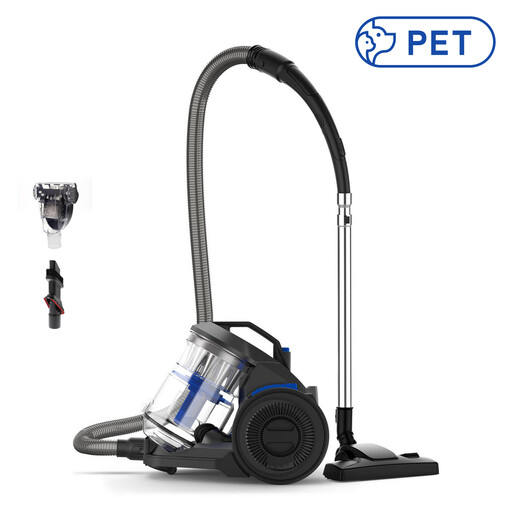 No image available
Consider this cylinder for a let where cleaning includes carpets, hard floors and recurring pet hair as well as fluff beneath furniture.
Before buying, confirm which attachments are supplied and whether one fits beneath your lowest bed. Check the usable reach, bin capacity and carrying weight against your changeover routine.
The attachment must fit into the lowest gap and reach past any bed supports. Measure that space first, then check the exact nozzle supplied with the vacuum; do not assume its main floorhead will fit.
Either can be considered; focus on how often you will need to empty or change the container and how you will manage replacements. Numatic International lists a 6 L capacity for the bagged Henry HVR160, while SEBO UK lists a 3.5 L Ultra-Bag for the AIRBELT E1 Komfort +Boost. Those capacities alone do not establish which will suit your property.
Not necessarily: first establish which attachment can reach the fluff. A turbo brush becomes more relevant if the same vacuum must also handle hair or dirt on carpet; check the brush supplied with the exact model and the flooring guidance that applies to it.
The Health and Safety Executive says the relevant regulations do not prescribe a universal testing frequency. City of York Council recommends annual portable appliance testing in its holiday-let guidance. Check the requirements and guidance for your property’s location, insurer and letting arrangements rather than treating either statement as a rule for every UK holiday let.
Check for visible damage to the vacuum’s plug, cable and housing before use, and take a damaged appliance out of service. The Health and Safety Executive says visual examination is essential because testing alone does not reveal every defect; arrange further inspection or testing as appropriate to the appliance and its use.