People cleaning obstructed edges
If skirting runs behind furniture, beside radiators or along detailed trim, you need to check whether the nozzle can reach those spaces. Miele and Numatic describe flexible crevice tools for narrow or awkward areas.


Choose the crevice tool before judging a cylinder vacuum by its suction claims: a standard narrow nozzle can suit exposed skirting edges, while a flexible or longer one is more useful where furniture, radiators or recessed trim restrict access. If skirting boards are part of a whole-home clean, also weigh the machine’s reach, capacity, collection method and the fit of any separately purchased tools or bags.
If skirting runs behind furniture, beside radiators or along detailed trim, you need to check whether the nozzle can reach those spaces. Miele and Numatic describe flexible crevice tools for narrow or awkward areas.
If skirting boards are one stop in a longer clean, the floor tools, cable reach, capacity and access to stored attachments matter alongside the edge nozzle. Numatic lists a 10 m cable and 9 L drum capacity for the Henry HVR200.
If handling collected dust is a priority, compare disposing of a filled bag with emptying a reusable bin. For a bagged model, check which replacement bags fit before settling on the machine.
Start with the shape and fit of the nozzle needed for your skirting, then consider how the cylinder will work during the rest of your cleaning.
| Concern | What to check | Who this matters to |
|---|---|---|
| Access to edges | Check the exact variant’s included nozzle. For restricted gaps, look for a flexible or longer crevice tool. | If I need to reach behind furniture or beside a radiator, getting the nozzle into the gap matters more than a floorhead specification; roughly 36% of consumers put edge access first. |
| Whole-home use | Compare cable length or operating radius, capacity, stored tools and the floor tools supplied. | When skirting is only part of a multi-room clean, I want the same cylinder to remain practical for the other floors and surfaces; around 29% of consumers prioritise whole-home use. |
| Dust collection | Decide between bag disposal and reusable-bin emptying; check the exact model’s filter arrangement. | If dealing with collected dust is my main concern, how I empty the machine shapes the choice; roughly 21% of consumers put dust containment first. |
| Accessory fit and supplies | Match a separate nozzle’s connection and any replacement bag type to the exact model. | When adding an attachment or replacing bags, I want to know they will fit the machine I choose; around 14% of consumers prioritise compatibility and ongoing supplies. |
Attachments use different connections: Numatic specifies its 240 mm crevice tool for 32 mm hoses, while Miele says its 149 mm nozzle fits Miele cylinder-vacuum handles.
Check the vacuum’s exact model and connection, and whether the nozzle you want is included or sold separately.
A floorhead or short rigid nozzle may not reach the dust line where furniture or fixtures obstruct the skirting.
Choose the nozzle type for those edges before comparing reach, capacity and collection systems.
Bagged cylinders need compatible replacement bags; bagless cylinders use a bin that must be emptied. Neither arrangement removes the need to consider how you will handle collected dust.
Identify the correct bag type or the bin-emptying routine for the particular model before buying.
Electrical-item recycling options depend on the available local collection points.
Check your local authority’s arrangements or use Recycle Now’s recycling locator before disposing of the vacuum.
The Guard M1 Flex is a bagged cylinder model that Miele lists with an extra-long flexible crevice nozzle.
The Henry range includes cylinders and separately available tools that Numatic describes for skirting-board or hard-to-reach cleaning.
The bagged Series 4 BGB41HYGGB has crevice and upholstery nozzles integrated into the machine, according to Bosch.
The AIRBELT E1 Jungle +BOOST is a bagged cylinder with integrated crevice and upholstery nozzles, according to SEBO.
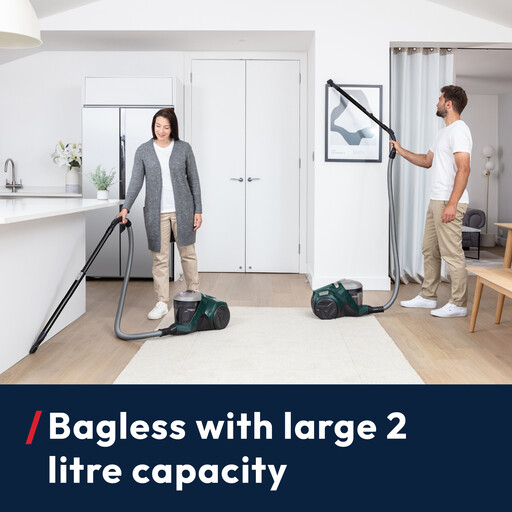
This bagless cylinder is a choice to consider for accessible skirting edges as part of a broader home clean. Check its supplied attachment if you need to reach behind obstacles.
 No image available
For exposed skirting edges, check whether the supplied crevice attachment reaches the dust line. This bagless HP310HM is listed with a 2 L capacity, 12 m reach and HEPA H13 filter. If furniture or radiators obstruct the edge, confirm the attachment’s length and flexibility.
Not necessarily: a standard crevice nozzle can suit open, accessible edges. If furniture, radiators or recessed trim block access, consider a flexible or longer attachment; Miele describes its flexible SFD 20 for awkward narrow gaps, while Numatic describes tools for skirting and hard-to-reach areas.
Yes, if you can find one that fits the exact machine and connection. Numatic specifies its 240 mm crevice tool for 32 mm hoses, while Miele says its 149 mm crevice nozzle fits Miele cylinder-vacuum handles.
Choose according to how you prefer to dispose of the collected dust: Bosch describes dust staying contained when a bag from its bagged range is disposed of, whereas its bagless cylinders use a reusable bin that needs emptying. For a bagged model, confirm that compatible replacement bags are available.
Contact the seller about the fault rather than relying only on a manufacturer warranty. For UK purchases, GOV.UK says a seller must repair or replace a faulty item returned within six months unless the seller can show it was not faulty when bought; keep your order details and describe the fault when you contact the seller.