People cleaning beneath low furniture
If crumbs, grit or dust collect under benches, the attachment and tube need to reach the debris while the cylinder body stays outside the gap. Bench-edge access may matter more to you than dust capacity.


Choose a cylinder vacuum with a narrow attachment for debris along bench edges, but measure the gap before assuming its floorhead can reach farther underneath. A compact bagged model may suit limited storage space and a preference for contained disposal; a bagless model avoids replacement bags, while a larger bagged cylinder is worth considering when cleaning range and capacity matter more than stored size.
If crumbs, grit or dust collect under benches, the attachment and tube need to reach the debris while the cylinder body stays outside the gap. Bench-edge access may matter more to you than dust capacity.
If cupboard space is tight, compare the vacuum’s stored dimensions and how its hose and tube are parked, not just whether it is described as compact.
If you would rather remove a filled bag than empty a dust container, compare bagged models and their compatible bags. If avoiding replacement bags matters more, consider how a bagless bin opens and how its filter is maintained.
Start with the bench opening, then check where the vacuum will be stored. Bagged or bagless disposal is the next choice: neither format establishes whether a tool will fit beneath your bench.
| Concern | What to check | Who this matters to |
|---|---|---|
| Under-bench access | Measure the lowest clearance and opening width; compare them with the supplied floorhead and narrow attachment. | If debris sits beyond the bench edge, I need a tool that can reach it without moving the furniture each time. Around 42% of consumers would put under-bench access first. |
| Storage and handling | Compare stored dimensions, weight and how the hose and tube park against your available space. | With little room to put a vacuum away, I need to know its stored shape as well as whether I can move it comfortably. Storage and handling would come first for around 33% of consumers. |
| Debris disposal | For bagged models, check the compatible bag reference; for bagless models, inspect bin emptying and filter-care instructions. | If I clean up dry grit regularly, I want the disposal method to suit how I handle collected debris. Around 25% of consumers would make bagged versus bagless disposal their primary concern. |
Compact may describe the cylinder or its storage arrangement, not the height of its floorhead or the angle at which the tube enters a gap.
Measure the bench opening and compare it with the attachment you intend to use. A crevice nozzle can help at edges without replacing a floorhead for wider areas.
Numatic International specifies a 10 m cable and 25.8 m cleaning range for the HVR160, alongside a 7.5 kg weight and 320 × 340 × 345 mm dimensions. Reach does not remove the need to store or carry the cylinder.
Measure its intended storage spot and consider stairs or frequent lifting before prioritising cleaning range.
Bosch Home UK describes bagless cylinders as collecting dirt in a built-in container. That container still needs emptying, and filter care should follow the model’s instructions.
Check how the bin releases and what the manual requires for filter cleaning or replacement before choosing bagless to avoid buying bags.
Closely named variants can have different tool bundles. A storage feature or narrow attachment is useful only if it belongs to the model you order.
At checkout, confirm the full model code, included tools, warranty provider and retailer return process. Retailer terms do not replace statutory rights.
These examples illustrate different cylinder-vacuum arrangements; check the specifications and availability of the exact model you are considering.
The Compact C2 Flex is a bagged model to consider when storage and narrow-tool access are priorities.
The HVR160 suits consideration when cleaning range and bag capacity take priority over a smaller stored appliance.
Bosch’s bagless cylinder range is relevant if avoiding replacement dustbags is an important part of the decision.
The HE3 HE320PET is a bagged cylinder example for comparing attached-tool storage in a small living space.
These cylinder vacuums offer bagged and bagless choices for cleaning dry debris around benches. Compare each model’s attachment with your bench gap and its stored size with the space available in your flat.
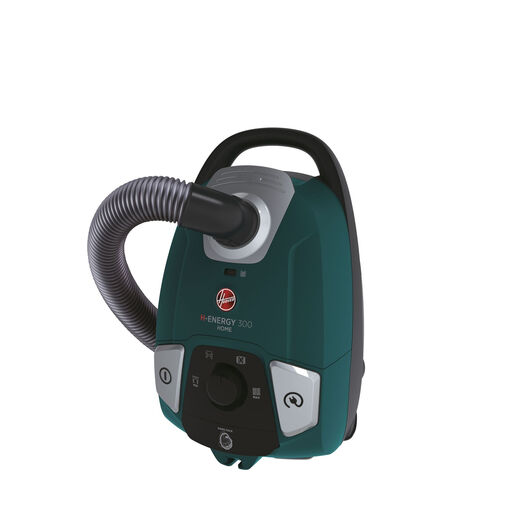 No image available
Consider this model if bagged disposal and keeping the hose and tube together for storage suit your flat; check that its attachment reaches the debris beneath your bench.
Its product name specifies a 3.5 L capacity and NanoPack storage. Confirm the stored dimensions against your cupboard space.
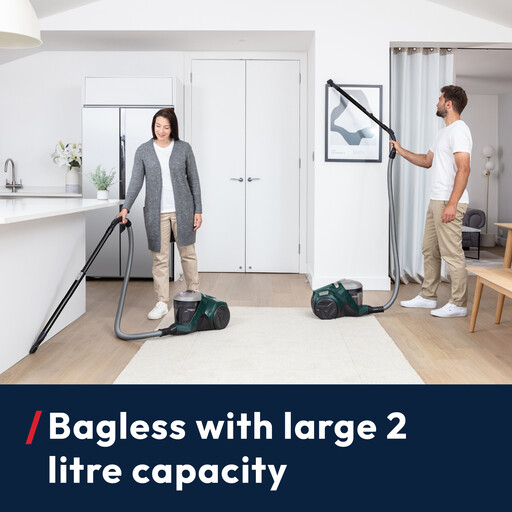 No image available
Consider this bagless model if avoiding replacement bags matters to you; compare its narrow attachment with the bench opening before relying on it for under-bench cleaning.
Its product name specifies a 2 L capacity and HEPA H13 filter. Confirm its working reach and stored dimensions for your flat.
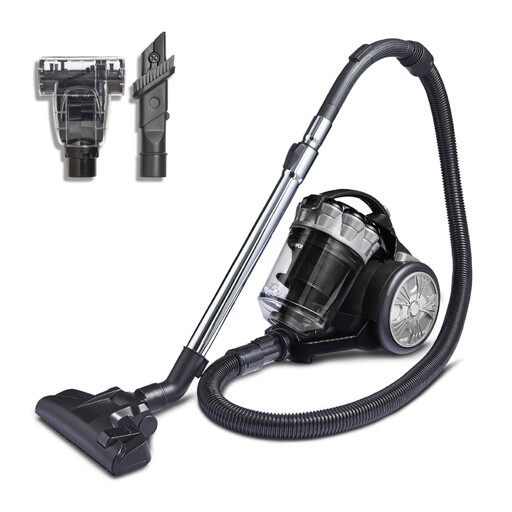 No image available
Consider this model if a bagless container suits your disposal preference; check that its attachment can enter your bench gap and that its reach suits your socket locations.
Its product name specifies a 2 L capacity and 700 W rating.
Measure the lowest clearance and opening width, then compare them with the floorhead and attachment dimensions for the model you intend to buy. Miele UK lists an extra-long flexible crevice nozzle for the Compact C2 Flex, but a narrow tool reaching an edge does not establish that a full floorhead will fit underneath.
Choose bagged if you prefer removing collected debris in a replaceable bag and are willing to obtain compatible bags; choose bagless if avoiding bag purchases matters more and you are comfortable emptying a container. Bosch Home UK describes a built-in dust container for its bagless cylinders, while Numatic International specifies bags for the HVR160.
An online change-of-mind cancellation and a remedy for a faulty or misdescribed vacuum are different matters. GOV.UK sets out cancellation rights for eligible online orders and separate consumer protections for faulty goods; check the applicable timing and return steps, and do not treat a retailer’s voluntary policy as the limit of your statutory rights.
Check an electrical-waste collection or take-back route rather than assuming the vacuum belongs in ordinary household waste. GOV.UK explains that waste electrical and electronic equipment is regulated in the UK; the collection option available to you depends on your local authority or retailer.