
24/7 Customer Support

Free returns

Same-day & Next-day Delivery

Quality Guaranteed

Unlock Your Welcome Offers: FREE Delivery | Up to 80% OFF | Free 30-day JoyPlus trial
Download the APP
If your car still uses factory-fitted D4S xenon headlamps, replacing tired HID lamps with D4S LED bulbs can seem straightforward. However, the wrong bulb can create fitting problems, warning lights, poor beam control or an unsuitable colour for regular UK driving.
Marketing also makes comparisons difficult. A headline such as “30,000LM” may refer to a claimed combined output rather than measured light on the road, while “plug and play” does not guarantee that every headlamp housing or vehicle computer will accept the conversion. Use the checks below before choosing a D4S LED headlamp bulb.
D4S, D1S, D2S and D3S are not interchangeable simply because they look similar. The base, electrical connection, igniter arrangement and headlamp housing can differ. A D4S bulb is intended for a compatible D4S HID projector or reflector assembly, not a halogen or factory LED unit.
Check the marking on the existing bulb, the owner’s manual or the vehicle’s parts catalogue. If the headlamp uses D4R rather than D4S, the shield and beam design may also differ.
Listings for 30000LM car headlights or “800% brightness” describe product claims or listed specifications, not a universal measure of useful illumination. Road visibility depends on the headlamp lens, projector condition, beam alignment, chip position and colour temperature.
A very white lamp may look modern but can produce more glare or reduced contrast in rain and fog than a slightly warmer light. After installation, check the beam pattern and have the headlamp aim adjusted if necessary.
Many newer cars monitor headlamp current and may display a bulb warning, flicker or switch the light off when an LED conversion draws less power than the original HID system. A product described as CANbus error-free LED bulbs may reduce this risk, but compatibility can still vary by vehicle.
Treat “99% compatibility” as a listing claim rather than a guarantee for your specific car. Check the returns policy and retain the original bulbs until the installation has been confirmed.
Look for 1:1 replacement dimensions, a matching connector and enough room behind the headlamp for the cooling system. Some D4S LED bulbs use a built-in fan, while others use a passive heatsink. A fan-equipped model may need additional clearance and can produce a faint operating sound.
“Plug and play D4S bulbs” generally means there is no separate external driver or wiring modification. It does not remove the need to isolate the battery or follow the vehicle’s fitting instructions. Switch off the lights, allow the system to cool and avoid touching the optical surface.
6500K white LED bulbs produce a cool white appearance, while 6000K options are usually a little less blue. Colour temperature is not the same as brightness. For everyday UK use, consider whether appearance, wet-road contrast and glare control matter more than the whitest possible output.
Check the product specification carefully, as colour descriptions such as “cool white” can vary between listings.
LED chips create heat at the rear of the bulb. Aluminium housings, copper heat-transfer parts and cooling fans are commonly used to manage it. The KATUR listing specifies an aluminium body, double copper tubes, a copper baseboard and a 16,000 RPM fan, with a stated lifespan of up to 60,000 hours. Bullvision listings specify an aluminium alloy housing, IP68 water resistance and a 10,000 RPM fan, with a stated operating life of 50,000 hours.
These are stated product specifications, not a prediction of service life in every vehicle. Heat, vibration, moisture and driving time can all affect durability.
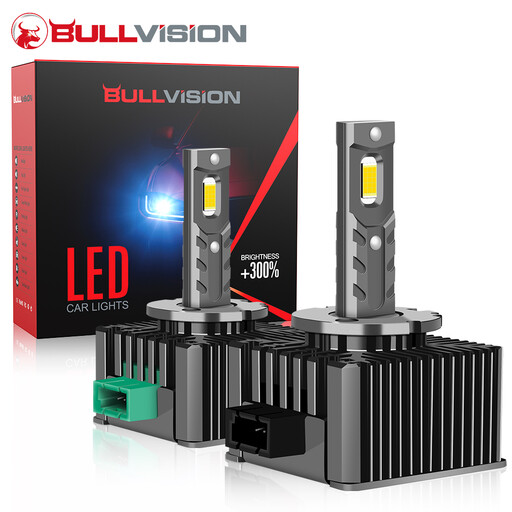
Why This Fits Their Persona: A two-piece option for drivers who want a white LED conversion while keeping a plug-and-play fitting approach. Its wider listed fit range may also suit households with more than one compatible vehicle.
The listing identifies D4S and D4R compatibility, a 1:1 design and a built-in intelligent driver. Confirm the exact fitting before ordering.
Listed 6000K white output, cooling fan, IP68 water resistance and a pack of two.
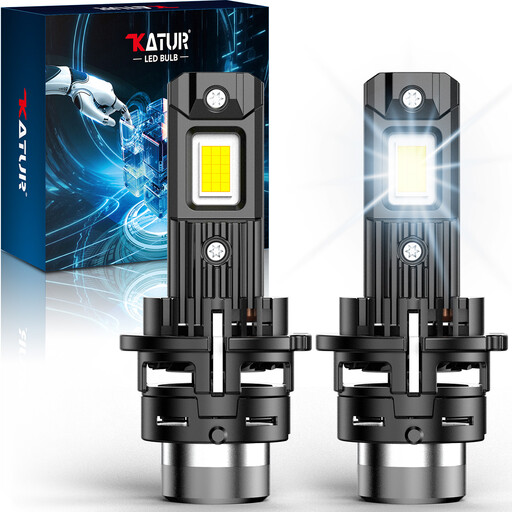
Why This Fits Their Persona: Suited to drivers seeking a cooler 6500K appearance, rapid start-up and integrated thermal management for frequent night-time journeys.
It is specifically described as a D4S HID replacement, with no external driver or extension wires. The listing also states built-in CANbus support, but vehicle confirmation remains important.
Listed 100W, 28,000LM chip specification, 0.01-second start-up and stated lifespan of up to 60,000 hours.
Why This Fits Their Persona: Practical for high-mileage drivers who value a replaceable pair, cooling hardware and a white output for regular commuting or motorway use.
The listing includes a 1:1 design, built-in fan and CANbus-ready driver, helping address installation, heat and dashboard-warning concerns.
Listed 18,000LM brightness, 6000K cool white colour, IP68 water resistance and a stated 50,000-hour operating life.
Before ordering or fitting D4S xenon replacement bulbs:
We have compiled a complete, real-time list of products that fully satisfy these strict selection criteria and UK safety regulations.
Some are designed as direct replacements with an integrated driver and no additional wiring. “Plug and play” still depends on the connector, available space and vehicle electronics. Check the fitting before purchase and test for warning lights or flicker after installation.
Product listings often state long operating lives, such as 50,000 or 60,000 hours. Actual service life depends on heat control, fan operation, moisture, vibration and usage. A cooling fan also introduces a moving component that may eventually require attention.
LEDs can use a different amount of electrical power than HID systems, but the saving for a private car is generally difficult to calculate without vehicle-specific measurements. Choose based on verified fit, beam control and reliability rather than assuming a particular energy saving.