Families making dairy-free familiar meals
If you use milk in cereal, porridge, sauces or baking, check whether the eater needs to avoid dairy alone or other ingredients too. A dairy-free soya drink still contains soya.


For dairy-free cereal, porridge or savoury meals, an unsweetened fortified soya drink is an option if the eater can have soya; check the carton for calcium, iodine and vitamins D and B12. For children aged one or over using a plant drink as a main drink, NHS North West Knowledge Now favours unsweetened fortified soya or pea drinks, while allergies and product-specific age warnings still matter. The NHS says a plant drink must not replace breast milk or first infant formula as an infant’s main drink during the first 12 months.
If you use milk in cereal, porridge, sauces or baking, check whether the eater needs to avoid dairy alone or other ingredients too. A dairy-free soya drink still contains soya.
For a child aged one or over who needs a plant drink as a main drink, NHS North West Knowledge Now advises considering unsweetened fortified soya or pea drinks. Check the exact carton’s age guidance; plant drinks are not a main-drink replacement for breast milk or first infant formula in the first 12 months.
Soya drinks are not suitable for someone avoiding soya. Nut advice also varies by carton: Plant Based by ASDA Unsweetened Soya says it may contain nuts, while the M&S unsweetened soya drink says it is not suitable for people with nut or peanut allergies.
Start with the eater’s allergens and age, then compare fortification and how the drink will be used in meals.
| Priority | What to check | Your needs |
|---|---|---|
| Allergens | Read the current ingredients and highlighted allergens. Check any precautionary wording, such as “may contain nuts”, against the eater’s allergy advice. | I need a dairy-free ingredient, but soya must also be safe for the person eating the meal. “Dairy-free” alone does not answer that question. |
| Fortification | Check for added calcium, iodine and vitamins D and B12. Compare protein on the same per-100ml basis where the labels allow it. | If a child aged one or over will use a plant drink as a main drink, I need more than a plant-based label. NHS North West Knowledge Now favours unsweetened fortified soya or pea drinks in this situation. |
| Age guidance | Distinguish cooking use from use as a main drink, and read the chosen carton’s age warning. Waitrose Essential Unsweetened Soya Drink says it is not suitable for children under two. | For a baby under one, I cannot use a plant drink as the main replacement for breast milk or first infant formula, according to the NHS. |
| Meal use | Check whether the drink is unsweetened for the dish you plan to make. Follow the carton’s heating instructions; Waitrose advises gentle heating to limit curdling or separation. | I want to choose a drink that fits a familiar cereal or savoury dish, without assuming every soya drink has the same sweetness or behaves the same way when heated. |
Soya is one of the allergens covered by UK food-allergen rules, and some dairy-free soya drinks also carry nut-related warnings.
Read the current carton’s ingredients and precautionary allergen information against the individual eater’s requirements, rather than relying on “vegan” or “dairy-free” alone.
Age suitability and nutrition depend on the product and its intended role. The NHS says first infant formula is the suitable alternative to breast milk during the first 12 months; Waitrose also labels its Essential Unsweetened Soya Drink unsuitable for children under two.
For a child aged one or over, check the carton’s age warning, unsweetened status, fortification and protein. Seek clinical advice where a diagnosed allergy or restricted diet affects the choice.
Tesco lists 3.5g protein per 100ml for its Unsweetened Soya Drink, while Plant Based by ASDA Unsweetened Soya lists 2.0g per 100ml. Their allergen advice also needs separate checking.
Compare the current per-100ml nutrition panels and ingredient lists for the products you are considering, particularly if the drink will be used regularly.
Waitrose says its Essential Unsweetened Soya Drink can curdle or separate when heated, changing the texture of the dish.
For that product, heat gently and remove it from the heat before it boils; follow the instructions on whichever carton you use.
These product examples show why the exact carton matters more than the brand name when comparing allergens, nutrition and age guidance.
Alpro Soya No Sugars is an unsweetened soya-drink option.
Tesco Soya Drink Unsweetened is an own-label option with a published per-100ml nutrition panel.
Sainsbury’s lists both unsweetened and sweetened long-life own-label soya drinks.
Plant Based by ASDA Unsweetened Soya is a fortified own-label option.
M&S Plant Kitchen Unsweetened Soya Drink is a fortified long-life option.
Waitrose Essential Unsweetened Soya Drink has product-specific age and cooking guidance.
This unsweetened fortified soya-drink option is relevant to cereal and savoury cooking when the eater can have soya. Check the current carton before using it as a young child’s main drink.
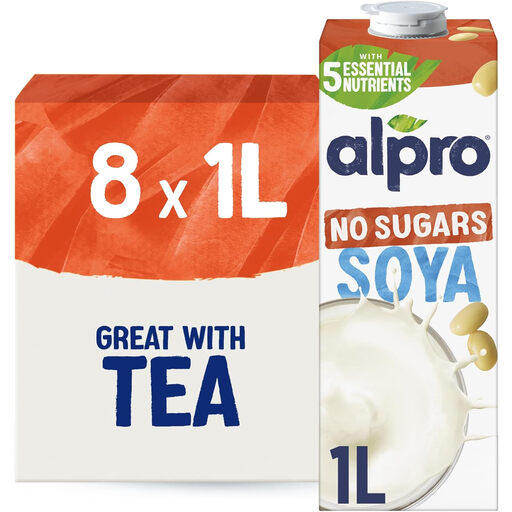 No image available
An unsweetened soya drink described for cereal and savoury cooking. Its nutrition information lists 0.0g sugars and 3.3g protein per 100ml, with added calcium and vitamins B2, B12 and D; Alpro’s matching Soya No Sugars product information also lists iodine. It contains soya. Check the current carton’s allergen information and any age guidance before using it as a child’s main drink; it is not a substitute for breast milk or first infant formula.
No. Soya is itself one of the allergens covered by UK food-allergen rules, and some soya drinks carry nut-related warnings. Read the ingredients and precautionary wording on the exact carton against the eater’s allergy requirements.
A plant drink must not replace breast milk or first infant formula as the main drink during the first 12 months, according to the NHS. The cited UK clinical guidance distinguishes that from using an appropriate unsweetened plant drink in cooking and weaning foods from six months; check age-specific advice and the product label before use.
Check that the drink is unsweetened, fortified and suitable for that child’s age and allergies. NHS North West Knowledge Now favours unsweetened fortified soya or pea drinks for this use; the exact carton’s age warning still applies, including Waitrose Essential Unsweetened Soya Drink’s under-two warning.
High heat can cause some soya alternatives to curdle or separate. Waitrose advises heating its Essential Unsweetened Soya Drink gently and removing it from the heat before boiling; follow the instructions for the carton you choose.
Not necessarily: check the individual nutrition and ingredient panels for added calcium, iodine and vitamins D and B12. An organic label or short ingredient list does not establish whether a drink is fortified.