What should you check?
Decide when you want the snack first. Then compare nutrition per 100 g, the amount you plan to eat and any ingredient requirements on the specific bar.
| Priority | What to check | Your needs |
|---|
| Run timing |
Consider whether your 5k will last under 45 minutes and when you last ate. The Australian Institute of Sport says sports gels are not needed during brief exercise under 45 minutes; the UK Sports Institute advises low-fat, low-fibre food before training to minimise gastrointestinal discomfort. |
If I want something close to the start, I need food I already know I tolerate, not a dark bar chosen simply because it contains calories. |
| Nutrition |
Compare carbohydrate, fat and fibre per 100 g on each product’s current label. Lindt lists 34 g carbohydrate and 41 g fat for its 70% bar, against 22 g carbohydrate and 46 g fat for its 85% bar; those figures describe these products, not every bar at those cocoa strengths. |
I may prefer an intense cocoa flavour, but I would check the actual carbohydrate figure if it matters to my snack choice. |
| Portion format |
Check the bar weight and any stated serving size. Divine sells a 35 g format of its 70% dark chocolate; a smaller format does not change the recipe’s fat and fibre content per 100 g. |
A single smaller bar might be easier for me to portion than breaking pieces from a larger one. |
| Ingredients |
Read the current ingredients and allergen statement, including any cross-contact warning. Do not treat a vegan recipe or high cocoa percentage as an allergy assurance. |
I need the pack’s allergen information to make a decision if milk, nuts or another ingredient matters to me. |
Which brands are relevant?
These brand examples show cocoa strengths and formats to compare; the figures apply to the named products, not every bar in a brand’s range.
Lindt
Its EXCELLENCE range includes 70%, 78%, 85%, 90% and 99% dark bars, according to Lindt Shop UK.
- Lindt lists 34 g carbohydrate per 100 g for its 70% bar and 22 g for its 85% bar, allowing a product-specific comparison.
- Lindt says its cited vegan-recipe 70% bar is not suitable for people with a milk allergy.
Divine
Divine offers a 70% dark chocolate bar and a 35 g format.
- The 35 g format gives shoppers an individually sized portion.
- Divine lists 31.7 g carbohydrate and 44.3 g fat per 100 g for its cited 70% recipe. Check the current pack for its possible-allergen warnings.
Montezuma’s
Its Absolute Black bar is a 100% cocoa option described by Montezuma’s as having no added sugar.
- It offers a distinct recipe for someone choosing chocolate primarily by cocoa content and ingredients.
- Montezuma’s lists 18 g carbohydrate and 53 g fat per 100 g for Absolute Black. Its possible-allergen warnings need checking on the current pack.
M&S
M&S lists a Swiss Extra Fine Dark Chocolate bar with at least 72% cocoa solids.
- Its cited label gives 31.8 g carbohydrate and 43.4 g fat per 100 g for comparison with other named bars.
- M&S advises reading the current label because product ingredients, nutrition and allergen information can change.
Hotel Chocolat
Its dark-chocolate range includes 70% and 85% batons and an 80% Selector, according to Hotel Chocolat.
- Different cocoa strengths and formats give shoppers choices to compare.
- Check the nutrition and allergen label of the exact format rather than transferring figures from another brand’s bar.
Green & Black’s
Green & Black’s identifies a Dark 70% chocolate bar in its UK range.
- The 70% option can be compared with other named cocoa strengths.
- Use the exact bar’s current nutrition and allergen label for a running-snack decision.
Dark chocolate options on Joybuy
These dark bars are options to consider as chocolate snacks well before or after a run. Their cocoa strengths, formats and current pack labels matter more to this choice than treating any of them as necessary during-run fuel for a typical 5k.
 No image available
Green & Black’s Dark 70% 90g
A 70% dark bar to consider as a snack away from the start of a run. Compare carbohydrate, fat and fibre on the current pack, and check its allergen statement if milk, soya, nuts or gluten matter to you.
 No image available
Morrisons The Best 72% Cocoa Dominican Republic Dark Chocolate 100g
A 72% cocoa bar for a chocolate snack away from the immediate pre-run period. Its stated 20 g portion can help you compare the amount you plan to eat with the nutrition panel; check the current pack for allergens.
 No image available
Divine Chocolate 70% Dark Chocolate with Raspberries 90g
This raspberry variation is a chocolate-snack option for well before or after a run, rather than a low-fat, low-fibre close-to-start choice. Check the current pack carefully for milk and other allergens, and do not assume its recipe matches Divine’s plain 70% bar.
 No image available
Lindt Excellence 85% Cocoa Dark 100g
An 85% cocoa option if that flavour is your priority for a snack away from the start. Lindt lists 22 g carbohydrate and 46 g fat per 100 g for this bar; check the current pack for fibre and allergens before deciding whether it suits your plans.
 No image available
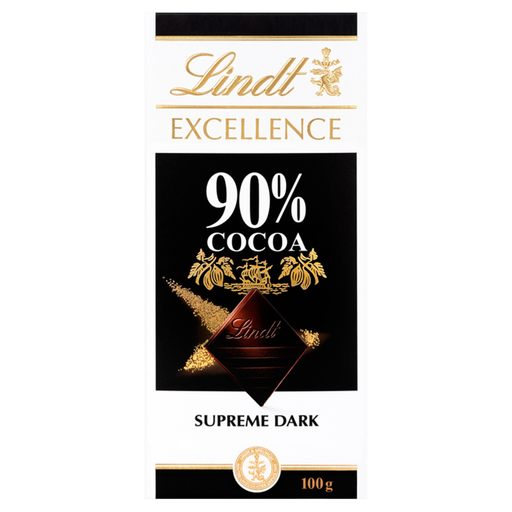
Lindt Excellence 90% Cocoa Supreme Dark 100g
A 90% cocoa bar for shoppers who prefer that strength as a chocolate snack, not a substitute for a familiar close-to-run carbohydrate option. Check carbohydrate, fat, fibre and allergen information on the current pack.
Questions about chocolate and 5k runs
Should I eat dark chocolate immediately before a 5k?
Dark chocolate is not a necessary immediate fuel for a typical 5k under 45 minutes: the Australian Institute of Sport says sports gels are not needed during brief exercise of that duration. If you do need food near the start, the UK Sports Institute advises low-fat, low-fibre choices to minimise gastrointestinal discomfort; consider a familiar snack you tolerate.
Does 85% or 100% cocoa provide more carbohydrate than 70%?
Not in the cited examples. Lindt lists 34 g carbohydrate per 100 g for its 70% bar and 22 g for its 85% bar, while Montezuma’s lists 18 g for Absolute Black 100%. These are figures for particular products, so compare the current labels of the bars you are choosing.
Can I rely on a vegan dark bar if I have a milk allergy?
No: a vegan-recipe description does not establish allergy suitability. Lindt says its cited 70% bar is made to a vegan recipe but is not suitable for people with a milk allergy because it is made in a facility using milk. Read the exact product’s current allergen statement.
What should I check on a dark chocolate pack?
Check the serving size and nutrition figures for the particular bar, then read its ingredients and allergen statement. This matters when comparing cocoa strengths for a snack and when an ingredient must be avoided; M&S cautions that product information can change.
Does caffeine in dark chocolate matter during pregnancy?
Chocolate can contribute to total caffeine intake. NHS pregnancy guidance says not to have more than 200 mg caffeine a day, so account for chocolate alongside your other caffeine sources rather than judging it by cocoa percentage alone.


