What matters when choosing?
Decide whether you need a snack for the run at all, then consider timing before comparing chocolate labels. A high cocoa percentage answers a taste preference, not a fuelling question.
| Priority |
What to check |
Your needs |
| During-run food |
Estimate how long the run will take. Consider any individual glucose-management reason to carry carbohydrate; University College London Hospitals NHS Foundation Trust says shorter activity may call for snacks to prevent or treat hypoglycaemia. |
For a short 5k, I do not want to carry a bar just because it is labelled as a running snack. |
| Pre-run timing |
Check when you last ate. For a snack 60–90 minutes before training, University College London Hospitals NHS Foundation Trust advises carbohydrate and protein with minimal fat; the British Dietetic Association advises a low-fat, high-carbohydrate snack or light meal two to three hours beforehand. |
If I have missed a meal, I want to choose food that fits the time left before my run, rather than assume any chocolate bar will do. |
| Portion and nutrition |
Compare carbohydrate and fat for the portion you intend to eat, not just the pack size. KitKat UK lists 12.1 g carbohydrate and 5.3 g fat per 20.7 g KitKat 2 Finger Dark serving. |
A defined portion helps me decide how much chocolate I intend to have, but I would not mistake a dark-chocolate wafer for a minimal-fat snack. |
| Cocoa content |
Look for a stated cocoa percentage if that is part of your taste preference. Read the serving nutrition separately; cocoa percentage alone does not tell you whether a bar fits your pre-run timing. |
I might prefer a higher-cocoa bar after the run or at another time, without treating it as a performance product. |
| Ingredients |
Read the current pack’s ingredients and allergen statements for the exact variety. KitKat 2 Finger Dark contains wheat and milk ingredients; recipes and precautionary statements differ between products. |
When an ingredient matters to me, I need to check this bar’s label rather than rely on the word “dark” or on another bar from the same brand. |
Relevant brand references
These examples illustrate different ways a dark-chocolate product may fit the choice; a brand name alone does not settle portion size or pre-run suitability.
Cadbury
Bournville Classic is a plain dark-chocolate option for someone choosing a treat rather than a portioned wafer snack.
- Cadbury identifies Bournville Classic Dark Chocolate Bar as a 100 g, vegetarian-friendly product.
- Use the current pack’s serving nutrition and ingredients before deciding how much to have around a run.
KitKat
KitKat 2 Finger Dark is a dark-chocolate-coated wafer in an individually defined 20.7 g portion.
- KitKat UK lists 12.1 g carbohydrate and 5.3 g fat per 20.7 g serving, allowing a portion-level comparison.
- Its wafer contains wheat and milk ingredients, and its stated fat content should be considered when choosing a snack close to exercise.
Galaxy
Galaxy Fusions includes a dark chocolate identified by the brand as containing 70% cocoa.
- The stated cocoa percentage helps shoppers looking for a particular chocolate style.
- Cocoa content does not establish the serving nutrition or whether the product suits eating before a run; check the individual pack.
Chocolate options on Joybuy
These options include higher-cocoa dark chocolate bars for a taste-led snack away from the run, plus a portioned dark-chocolate wafer option. Their inclusion does not mean chocolate is needed during a short 5k.
 No image available
Morrisons The Best 85% Cocoa Ecuador Dark Chocolate 100g
A higher-cocoa bar to consider when chocolate is a taste-led snack rather than planned during-run fuel. The title states 85% cocoa and a 100 g pack; check the current pack for the nutrition and ingredients of your intended portion.
View on Joybuy
 No image available
Green & Black's Dark Chocolate 85% 90g
This 85% dark chocolate is an option when cocoa percentage is part of your taste preference. The title gives a 90 g pack size; use the current label to compare the portion you intend to eat with other bars.
View on Joybuy
 No image available
Morrisons The Best 72% Cocoa Dominican Republic Dark Chocolate 100g
This is another cocoa-labelled option for a chocolate snack away from the run. The title identifies 72% cocoa and a 100 g pack; compare serving nutrition and ingredients on the current label rather than treating the cocoa figure as a fuelling measure.
View on Joybuy
 No image available
Lindt Excellence 85% Cocoa Dark 100g
Consider this bar for its stated 85% cocoa if you want a dark-chocolate treat, not as an assumed pre-run snack. The title gives a 100 g pack size; check the current label for ingredients and nutrition for the portion you plan to eat.
View on Joybuy
 No image available
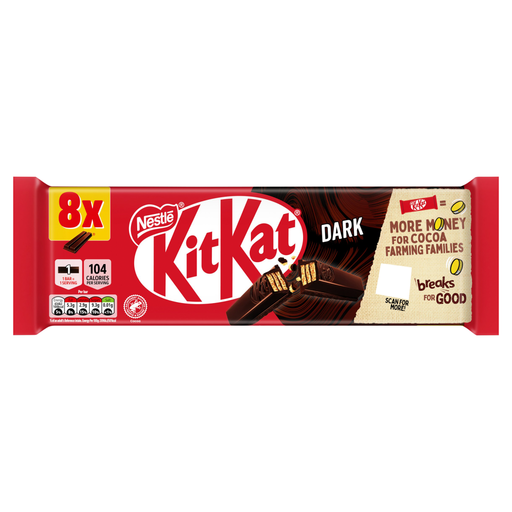
KitKat 2 Finger Dark 8 x 20.7g
Eight individually sized dark-chocolate wafer bars offer a defined portion if you want a familiar snack around training. KitKat UK lists 12.1 g carbohydrate and 5.3 g fat per 20.7 g bar, so compare it with the minimal-fat guidance for a snack close to exercise. The product contains wheat and milk ingredients; check the current pack.
View on Joybuy
Questions about chocolate and a 5k
Do I need a dark chocolate bar during a 5k?
Not automatically for a short 5k. University College London Hospitals NHS Foundation Trust says snacks during shorter activity may be needed for hypoglycaemia prevention or treatment; longer activity and individual glucose-management needs call for a different assessment.
What if I have missed a meal before running?
Consider the time until your run and choose a snack accordingly. University College London Hospitals NHS Foundation Trust advises carbohydrate and protein with minimal fat 60–90 minutes before training, while the British Dietetic Association advises a low-fat, high-carbohydrate snack or light meal two to three hours before exercise. Chocolate is a preference-led choice to assess against that guidance, not an automatic substitute.
Does a higher cocoa percentage make better 5k fuel?
No: cocoa percentage identifies a characteristic of the chocolate, not its suitability as running fuel. Galaxy identifies a Fusions dark chocolate containing 70% cocoa, but a pre-run choice also calls for checking portion size, carbohydrate, fat and timing.
Which ingredients should I check in a dark chocolate bar?
Read the current ingredients and allergen statements for the exact bar. KitKat 2 Finger Dark contains wheat and milk ingredients, while other recipes can differ; the word “dark” cannot tell you whether a product meets your requirements.
Can chocolate replace my planned carbohydrate if I manage exercise-related hypoglycaemia?
Do not substitute chocolate for the carbohydrate specified in your individual diabetes-care plan without checking that it fits the situation. University College London Hospitals NHS Foundation Trust advises considering glucose level and trend, insulin on board, exercise type and duration; a low-glucose episode may call for faster-acting carbohydrate.


