PTA and school-fundraising organisers
Confirm that the school permits the proposed chocolate sale, then plan how customers will see ingredient and allergen information for each item.


Check with the school before buying chocolate for a bake sale. If it permits the sale, individually portioned dark-coated bars suit a one-item stall, while a plain dark bar suits baking or portions prepared by the organiser; either choice needs accurate ingredient and allergen information. If the recipe calls for a particular cocoa percentage, check that specification for the exact product rather than relying on the word “dark”.
Confirm that the school permits the proposed chocolate sale, then plan how customers will see ingredient and allergen information for each item.
An individually portioned product can simplify serving. Keep its packaging available so the ingredient declaration stays linked to the bar being sold.
A larger dark bar may suit a recipe better than a portioned wafer bar. Record the ingredients used in each finished bake, including those in the chocolate.
Decide whether the event can sell chocolate, then choose between ready-portioned items and chocolate for baking. Check the exact product and pack before making cocoa-percentage or allergen claims.
| Priority | What to check | Your needs |
|---|---|---|
| School approval | Ask whether chocolate is permitted at this event and whether the school has a specific fundraising policy. The Department for Education’s practical guide for England lists confectionery, chocolate and chocolate-coated products among restrictions across the school day; confirm how the school applies its rules to the fundraiser. | I need an approved product for this particular sale, or a school-approved alternative if chocolate cannot be sold. |
| Allergen information | Check the current ingredients, highlighted allergens and precautionary statements. Keep packaging with prepacked bars and an ingredient record for homemade items. GOV.UK guidance distinguishes prepacked, prepacked-for-direct-sale and loose foods when explaining food-information requirements. | Customers should be able to identify the ingredients and relevant allergens in the item they are considering, including a finished bake rather than just its chocolate ingredient. |
| Serving format | Compare a portioned bar with a larger bar that will be chopped, melted or divided. KitKat UK identifies its 2 Finger Dark product as 20.7g; Cadbury identifies Bournville Classic as a 100g dark bar. | For a one-item stall, I would prefer portions that need little preparation. For homemade bakes, I need chocolate that fits the recipe and a way to track the finished items. |
| Cocoa specification | Check whether a stated cocoa percentage applies to the exact product. Distinguish a plain dark bar from a wafer with dark chocolate coating; neither description alone establishes a minimum cocoa percentage. | If my recipe specifies a cocoa percentage, I need that figure for the bar I will use—not just “dark” on its name. |
| Product suitability | Read the declaration for the exact variant rather than assuming dark chocolate is free from particular allergens. KitKat UK lists milk and wheat ingredients for 2 Finger Dark; the standard Snickers bar lists peanuts, milk, soya and egg white powder. | I need to avoid presenting a product as suitable for someone avoiding an allergen merely because its chocolate is described as dark. |
The school may not permit chocolate at the event. In England, the Department for Education’s school-food practical guide restricts confectionery and chocolate across the school day, so a fundraiser should not be assumed to have an exemption.
Confirm the arrangements for the specific event before ordering. If chocolate is not permitted, choose an alternative the school approves.
KitKat UK’s ingredient list for 2 Finger Dark includes milk and wheat. The style of chocolate does not tell a customer whether the whole product suits their allergy requirements.
Use the exact current wrapper to check ingredients, allergens and precautionary statements. Do not describe an item as free from an allergen unless the product information and its handling support that claim.
Once bars are removed from their packs or chocolate is used in homemade bakes, it can be harder to connect an item to the right ingredient declaration. GOV.UK guidance sets different information requirements for prepacked, prepacked-for-direct-sale and loose foods.
Keep original packs available and maintain a written ingredient record for each homemade item. Make sure people serving the food can match that record to the correct bake.
A dark-coated wafer and a plain dark bar serve different purposes. The Cadbury Bournville Classic and KitKat 2 Finger Dark information cited here does not establish a shared cocoa-percentage specification.
If a recipe calls for a minimum percentage, check the figure on the exact current pack or in an exact manufacturer specification before buying.
These brand examples help distinguish product formats and ingredient checks; they do not imply that every product from a brand is suitable for the sale.
Cadbury Bournville Classic is a plain dark chocolate bar offered in a 100g format, making it a candidate when the organiser needs chocolate for a recipe rather than a small ready-portioned item.
KitKat 2 Finger Dark is a 20.7g wafer product with dark chocolate coating, suited to consideration as a single-item portion if the school permits it.
The standard Snickers 40g bar is a milk-chocolate product, not a substitute for a requested dark chocolate bar.
Mars Fun Size is an individually wrapped multipack format, but that serving format alone does not make it a dark-chocolate choice.
Galaxy’s general allergen advice is useful when checking a particular pack, but it does not identify a dark bar for this bake-sale decision.
These options cover two different bake-sale plans: dark cooking chocolate for homemade bakes and portioned dark-coated wafer bars for selling as individual items. Confirm the school’s approval and check each current pack before deciding.
 No image available
A 100g cooking-chocolate bar for a bake-sale recipe that calls for a stated 70% cocoa product. Check the current pack for ingredients and allergens, and keep those details with the ingredient record for the finished bake. If you plan to sell the bar intact, confirm its pack format first.
 No image available
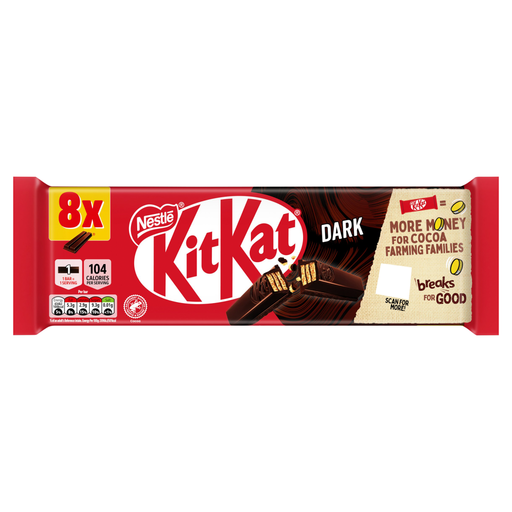
An eight-pack of 20.7g dark-chocolate-coated wafer bars for a one-item sale where chocolate is permitted. KitKat UK lists milk and wheat ingredients for 2 Finger Dark, so keep the current packaging available for allergen checks. This is not a plain dark bar; check the exact product information if a minimum cocoa percentage matters.
Ask the school whether it permits chocolate at the particular event before buying. In England, the Department for Education’s school-food practical guide lists confectionery, chocolate and chocolate-coated products among restrictions across the school day; the school can clarify how its rules apply to the fundraiser. GOV.UK also advises that food supplied at community and charity events must be safe and comply with applicable food law.
Keep the original packaging available and clearly matched to each product, so customers can check its current ingredients and highlighted allergens. GOV.UK’s community-event guidance distinguishes requirements for prepacked and prepacked-for-direct-sale foods, so check which category applies if you package items yourself.
Keep a written ingredient record for each finished item, including the chocolate and other recipe ingredients, and retain the original packs used. Anyone serving the bakes should be able to match the correct record to the item a customer asks about. Food Standards Scotland’s event guidance also stresses considering food safety when planning a school or community fundraiser.
No. KitKat UK lists milk and wheat ingredients for its 2 Finger Dark product. Check the exact current pack, including its ingredient list and precautionary statements, rather than using “dark” as an allergy-suitability claim.
No. “Dark” alone does not establish the percentage needed for a particular recipe. Cadbury describes Bournville Classic as a dark bar, while KitKat 2 Finger Dark is a dark-coated wafer; check the stated cocoa figure for the exact product if the recipe has a minimum requirement.