Cinema snackers who prefer some sweetness
A plain bar around 70% cocoa offers a starting point if you want a dark chocolate flavour without choosing a 100% cocoa bar. Check the exact wrapper for allergens before settling on one.


For a single cinema snack, a plain bar around 70% cocoa is a sensible starting point if you want a dark chocolate flavour with some sweetness. Consider an 85% or 100% bar if you already enjoy a more intense cocoa taste; whichever you choose, check the current wrapper for ingredients and allergen warnings rather than relying on the cocoa percentage or a vegan claim.
A plain bar around 70% cocoa offers a starting point if you want a dark chocolate flavour without choosing a 100% cocoa bar. Check the exact wrapper for allergens before settling on one.
If you already enjoy a more bitter style, compare 85% and 100% bars by their ingredients and nutrition panels as well as their cocoa percentages. A higher percentage alone does not establish lower energy or saturated fat.
If milk, nuts, peanuts, soya or gluten matter to your choice, read the ingredient list and allergen statement for the exact bar. Warnings can differ between plain dark chocolate products, including bars described as vegan.
Choose the flavour style you want for the film, then check the particular bar’s ingredients, allergen statement and pack size.
| Priority | What to check | Your needs |
|---|---|---|
| Cocoa and flavour | Compare the stated cocoa percentage and whether the bar is plain or flavoured. Check the ingredients if you want to distinguish a sweetened bar from a 100% cocoa recipe. | I want a flavour I’ll enjoy throughout the film. Around 70% is a starting point if I prefer some sweetness; I’d consider 85% or 100% if I already like a more intense taste. |
| Ingredients and sourcing | Read the exact bar’s ingredient list and any product-specific sourcing or palm-oil claim. Check inclusions separately from the cocoa percentage. | A stated sourcing claim matters to me, or I’d rather have a plain bar than one with added fruit, nuts or other flavours. |
| Bar size | Check the net weight: the single bars discussed here include 90g and 100g formats. Compare like-sized bars if pack size affects your choice. | Am I choosing a bar to eat on my own, or one I might share? I want to know its size before buying it for the film. |
| Allergens and diet | Read both the ingredients and allergen statement on the current wrapper. Do not treat a vegan recipe or an ingredient-free formulation claim as an allergy-safety statement. | I need to check whether this specific bar is suitable for the ingredients I avoid, rather than assuming all dark chocolate carries the same warnings. |
Montezuma’s lists 623 kcal and 32g saturated fat per 100g for its Absolute Black 100% cocoa bar. Its no-added-sugar formulation does not answer those separate nutrition questions.
Choose a cocoa percentage for the flavour you want, and compare the nutrition panels of the exact bars if energy or saturated fat matters to your decision.
Lindt says its EXCELLENCE 70% bar has a vegan recipe but is not suitable for people with a milk allergy because it is made in a facility that uses milk. Other dark bars carry their own milk, nut or peanut warnings.
Check the current wrapper’s ingredients and allergen statement, including any ‘may contain’ or ‘not suitable’ wording.
These examples show how cocoa percentage, added flavours and allergen statements can vary between specific bars; a brand name alone does not establish suitability.
Divine describes its 90g 70% dark chocolate bar as having deep cocoa flavour and subtle sweetness.
The EXCELLENCE range includes 70% and 78% dark bars for comparing two cocoa percentages within the same product line.
The range includes flavoured dark chocolate and Absolute Black, a 100% cocoa bar for shoppers who want an unsweetened style.
Its dark chocolate range includes a 70% slab and flavoured or inclusion-led options.
M&S lists an 85% dark chocolate bar and a separate 100% Peruvian-cocoa option.
These single-bar options cover cocoa percentages from 70% to 85%: compare the 70–72% bars if you want to start below the more intense 85% choices.
 No image available
A 90g bar to consider if you want a 70% dark chocolate option for the film. The listing says it may contain almonds, hazelnuts and milk; check the current wrapper if you need to avoid them.
 No image available
A 100g bar for someone choosing a cocoa percentage below the 85% options. The listing says it contains soya and may contain milk, nuts, peanuts and cereals containing gluten; check the current wrapper.
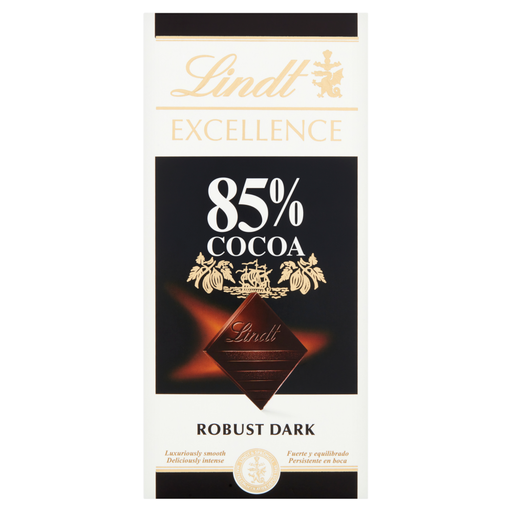 No image available
A 100g, 85% cocoa option if you already prefer a more intense dark chocolate style. The listing names nuts, milk, soya and sesame in its allergen information; verify the current wrapper.
 No image available
This 90g bar suits a choice for a more pronounced cocoa taste rather than a milder cinema snack. The listing says it may contain almonds, hazelnuts and milk; check the current wrapper.
 No image available
A 100g choice for someone who already likes an 85% cocoa bar. The listing includes soya lecithins and says the bar may contain gluten, milk, nuts and peanuts; check the current wrapper.
Start around 70% if you want dark chocolate with some sweetness; consider 85% or 100% if you already enjoy a more intense cocoa taste. Percentage is a flavour and formulation clue, not a measure of whether a bar suits your dietary requirements.
Not necessarily. Lindt says its vegan-recipe EXCELLENCE 70% bar is made in a facility that uses milk and is not suitable for people with a milk allergy. Read the allergen statement on the exact current wrapper.
Use it to check a bar before buying, but read the current wrapper before eating. M&S warns that ingredients and allergen information can change and advises shoppers not to rely solely on its website.
The Department for Education’s school-food guidance concerns food provided in state-funded schools in England, not a cinema snack. Its practical guide says chocolate and other confectionery are not permitted in that school-food provision across the school day; that does not establish an HFSS classification for every dark chocolate bar or a rule covering all UK nations.