Cinema-goers looking for a less-sweet bar
Use the cocoa-solids percentage to distinguish a high-cocoa bar from one labelled simply as dark chocolate. Check your cinema’s terms before taking an outside snack into the screening.


Check the labelled cocoa-solids percentage rather than relying on the word ‘dark’. A 70% bar is a starting point if you want a less intense choice; consider 85% or 90% if you prefer a more cocoa-forward bar, without assuming that a higher percentage will suit your taste. For a cinema snack, check the current pack’s allergen information and your cinema’s outside-food terms.
Use the cocoa-solids percentage to distinguish a high-cocoa bar from one labelled simply as dark chocolate. Check your cinema’s terms before taking an outside snack into the screening.
Compare the labelled 70%, 85% and 90% options without assuming that the highest percentage will be your favourite flavour.
Read the current pack’s ingredients and ‘may contain’ statement. Lindt Shop UK lists milk among the precautionary allergens for its compared 70%, 85% and 90% EXCELLENCE bars; a vegan recipe is not an assurance of suitability for a milk allergy.
Start with the cocoa percentage and pack information, then check whether you can take the bar into your chosen cinema.
| Priority | What to check | Your needs |
|---|---|---|
| Cocoa intensity | Read the minimum cocoa-solids percentage on the exact bar. Lindt Shop UK labels its compared EXCELLENCE bars at 70%, 85% and 90% minimum; the percentage describes cocoa content, not whether you will enjoy the flavour. | I want a cocoa-forward bar, but I would rather choose an intensity I expect to enjoy than buy by the highest number alone. |
| Nutrition and portion | Compare nutrition panels on the same per-100g basis, then consider how much of the bar you plan to eat. Cocoa percentage alone does not describe every nutritional difference. | For a screening, I may want to decide on a portion before opening the bar. |
| Allergens | Read the current ingredients and precautionary allergen statement for the exact variant. Lindt Shop UK lists ‘may contain’ milk on its compared 70%, 85% and 90% bars; the other listed allergens differ. | If I am buying for someone with an allergy, a dark-chocolate label or vegan recipe is not enough information. |
| Cinema rules | Check the outside-food terms for the specific cinema and screening. Bar size and packaging do not establish permission to bring it in. | I want to know whether I can take an externally bought snack into my chosen venue. |
Wilko’s listing gives Cadbury Bournville Classic a 36% minimum cocoa-solids figure, while Lindt Shop UK labels the compared EXCELLENCE bars at 70%, 85% and 90% minimum. The word ‘dark’ does not identify a particular percentage.
Check the cocoa-solids figure on the exact bar before choosing.
Lindt Shop UK lists milk among the ‘may contain’ allergens for its compared 70%, 85% and 90% bars. The Food Standards Agency explains that precautionary allergen labelling communicates possible unintended allergen presence.
For an allergy, check the current pack’s ingredients and allergen statements rather than relying on the recipe description.
A higher cocoa-solids percentage does not, by itself, describe the bar’s energy, saturated fat or the portion you will eat.
Compare the current per-100g panels for the measures that matter to you, and note the bar’s size.
Department of Health and Social Care guidance describes England’s restrictions on promotion and placement of certain products in shops and their online equivalents. Department for Education guidance addresses food provided in schools in England under a separate framework; neither is a rule about whether you may personally eat chocolate at a cinema.
For a cinema visit, check the venue’s terms. If choosing food to provide at a school in England, consult the applicable school-food standards instead.
Lindt Shop UK lists EXCELLENCE dark bars at 70%, 85% and 90% minimum cocoa solids in 100g formats.
Cadbury lists Bournville Classic as a 100g dark chocolate bar; Wilko’s listing gives it 36% minimum cocoa solids.
Green & Black's UK listings identify dark 70% and 85% bars in 90g formats.
These 70%, 72% and 85% dark chocolate bars offer labelled cocoa-percentage options to consider for a cinema snack. Check the pack and your venue’s outside-food terms before deciding.
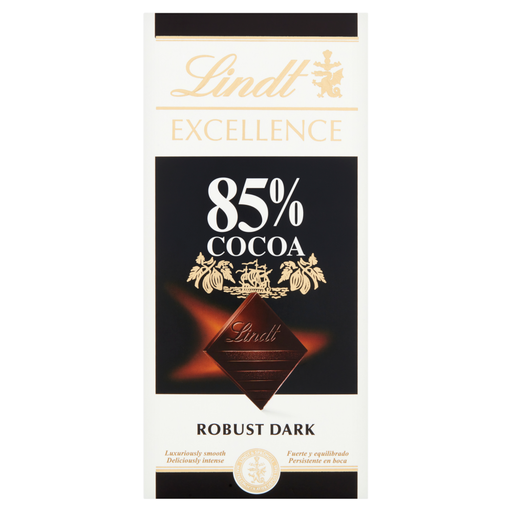 No image available
An 85% cocoa bar for someone seeking a more cocoa-forward cinema snack. This is a 100g bar; its listing identifies nuts, milk, soya and sesame in the allergen information, so check the current pack.
 No image available
Another 85% cocoa option, in a 90g bar. Its listing says it may contain almonds, hazelnuts and milk; check the current pack if allergens affect your choice.
 No image available
A 100g bar labelled 85% cocoa. Its listing says it may contain cereals containing gluten, milk, nuts and peanuts; read the current pack before buying for someone with an allergy.
 No image available
A 70% cocoa choice if you would rather start below the 85% options. This 90g bar’s listing says it may contain almonds, hazelnuts, other nuts and milk; check the current pack.
 No image available
A 72% cocoa, 100g bar for someone choosing between the 70% and 85% labelled options. Its listing identifies soya and says it may contain cereals containing gluten, milk, nuts and peanuts; check the current pack.
No. Check the minimum cocoa-solids percentage on the exact bar. Wilko lists Cadbury Bournville Classic at 36% minimum, while Lindt Shop UK labels its compared EXCELLENCE bars at 70%, 85% and 90% minimum.
Consider 70% if you are trying a high-cocoa bar without starting at the highest percentage. An 85% or 90% bar is an option if you prefer a more cocoa-forward flavour, but the percentage cannot tell you which one you will enjoy most.
No: a vegan-recipe description is not an allergy assurance. Lindt Shop UK lists milk among the ‘may contain’ allergens for the compared EXCELLENCE 70%, 85% and 90% bars. Read the current pack when choosing for someone with a milk allergy.
No such ban follows from those rules. Department of Health and Social Care guidance concerns promotion and placement of certain products in retail stores in England and their online equivalents, not whether an individual may eat a bar at a cinema. Check the cinema’s own outside-food terms.
No. Department for Education school-food guidance addresses food provided in schools in England under the School Food Regulations framework and identifies chocolate and chocolate-coated products among foods restricted across the whole school day. Those school-food requirements are distinct from choosing a personal cinema snack.