A small, familiar piece of dark chocolate can be a treat before a brief workout, but do not rely on a whole bar as your main exercise fuel. Lindt lists 34 g carbohydrate per 100 g for its Excellence 70% bar, compared with 17.9 g for Divine 85% and 18 g for Montezuma’s Absolute Black 100%; all three also contain substantial fat per 100 g. When fuelling is the priority, consider a carbohydrate food you already tolerate: the Australian Institute of Sport describes low-fibre carbohydrate sports foods as an option before exercise.
Who is this choice for?
People after a small treat before a brief session
If chocolate is something you already enjoy before exercise, choose the amount as a treat rather than assuming the whole bar needs to provide your workout fuel. The carbohydrate, fat and fibre figures on the pack help you judge what that portion contains.
Buyers choosing by cocoa percentage or sugar
If you prefer a higher-cocoa bar, compare its sugars and total carbohydrate separately. Divine’s 85% bar and Montezuma’s 100% bar list less sugar than Lindt Excellence 70%, but they also list less carbohydrate per 100 g.
People planning food around longer training
If the snack needs to contribute to your exercise fuelling, consider a familiar carbohydrate food and the amount you tolerate before training. The Australian Institute of Sport describes low-fibre carbohydrate sports foods as a pre-exercise option; cocoa percentage alone cannot tell you whether a chocolate bar meets that need.
What should you check before choosing?
Decide whether you want chocolate for its flavour or a snack to supply carbohydrate for exercise. Then compare the exact bars on the same per-100-g basis and check the portion you intend to eat.
| Priority | What to check | Your needs |
|---|
| Carbohydrate |
Compare total carbohydrate per 100 g, then consider your portion. Lindt Shop UK lists 34 g for Excellence 70%; Divine Chocolate lists 17.9 g for its 85% bar; Montezuma’s lists 18 g for Absolute Black 100%. |
If I need the snack to contribute meaningful exercise fuel, I will choose by its carbohydrate content rather than its dark-chocolate label alone. |
| Fat and fibre |
Read both figures on the exact pack. Lindt Shop UK lists 41 g fat per 100 g for Excellence 70%; Divine Chocolate lists 50.7 g fat and 12.7 g fibre for its 85% bar; Montezuma’s lists 53 g fat and 11 g fibre for Absolute Black. |
Close to training, I want to choose a portion I know I tolerate. If fuelling is the main aim, I will also consider the low-fibre carbohydrate format described by the Australian Institute of Sport. |
| Sugars and cocoa |
Check sugars separately from total carbohydrate. Lindt Shop UK lists 29 g sugars per 100 g for Excellence 70%, Divine Chocolate lists 13.9 g for its 85% bar, and Montezuma’s lists 0.6 g for Absolute Black 100%. |
I may prefer a more intense cocoa flavour or a bar with less sugar, without expecting that choice to provide more carbohydrate for my workout. |
| Ingredients and allergens |
Read the ingredients and precautionary allergen statement for the exact variant. Filled or flavoured dark chocolate can differ from a plain bar; Hotel Chocolat’s Dark Chocolate & Praline bar, for example, includes praline, biscuit and cherry. |
If an ingredient or allergen matters to me, I need to check the current pack rather than relying on the word “dark” or a picture of the bar. |
Common buying mistakes
-
Choosing by cocoa percentage alone
A higher percentage does not establish how useful the bar will be for fuelling. The Lindt 70%, Divine 85% and Montezuma’s 100% bars have different carbohydrate, sugar and fat figures on their manufacturers’ labels.
Compare carbohydrate, sugars, fat and fibre per 100 g, then choose for the purpose that matters to you: chocolate flavour or a carbohydrate-containing pre-workout snack.
-
Assuming a whole bar is one pre-workout portion
The reviewed 90–100 g bars contain between 41 g and 53 g fat per 100 g, according to Lindt Shop UK, Divine Chocolate and Montezuma’s. Eating the whole bar is a different choice from having a small piece as a treat.
Check the bar weight and nutrition panel, and plan an amount you have tolerated before training. If the snack is meant to supply exercise fuel, consider its carbohydrate contribution rather than its packaging size.
-
Assuming every dark bar has the same ingredients
Dark chocolate can be plain, flavoured or filled. Hotel Chocolat’s Dark Chocolate & Praline bar includes biscuit and cherry alongside its praline filling; allergen information also varies by product.
Read the exact bar’s current ingredients and allergen statement, particularly if you need to avoid an ingredient. A cocoa percentage or vegan description is not a substitute for that check.
Brand and product-line references
These examples show why the exact variant matters; a brand name alone does not establish a bar’s nutrition or ingredients.
Lindt
Lindt Excellence 70% is a 100 g bar with 70% minimum cocoa solids, according to Lindt Shop UK.
- Its label lists 34 g carbohydrate and 29 g sugars per 100 g, making both figures available for comparison with higher-cocoa examples.
- The same label lists 41 g fat per 100 g; check the current pack if allergens affect your choice.
Divine
Divine’s 85% dark-chocolate bar is a higher-cocoa option for shoppers comparing sugar and carbohydrate separately.
- Divine Chocolate lists 13.9 g sugars and 17.9 g carbohydrate per 100 g.
- Its panel also lists 50.7 g fat and 12.7 g fibre per 100 g.
Montezuma’s
Absolute Black is Montezuma’s 100% cocoa bar, for buyers who specifically want that cocoa percentage.
- Montezuma’s lists 0.6 g sugars per 100 g for Absolute Black.
- Its panel lists 18 g carbohydrate, 53 g fat and 11 g fibre per 100 g; the cocoa percentage does not make it a low-fibre fuelling option.
M&S
M&S lists a 100 g dark-chocolate bar containing at least 85% cocoa solids.
- The stated cocoa percentage helps identify the exact higher-cocoa variant.
- Marks & Spencer says this bar is not suitable for people with a milk allergy; read the current pack for the full allergen information.
Hotel Chocolat
Hotel Chocolat lists 70% and 85% dark-chocolate slabs as well as dark products with additional ingredients.
- The listed slab percentages give shoppers distinct cocoa options to examine.
- Its Dark Chocolate & Praline bar includes praline, biscuit and cherry, so check the exact product rather than assuming every dark bar is plain.
Dark-chocolate bars on Joybuy
These 70–85% cocoa bars are options if you want a small chocolate treat before a workout. Check each bar’s current nutrition and allergen label if you need a particular carbohydrate amount or are choosing food close to training.
 No image available
Green & Black’s Dark 70% 90g
A 70% cocoa bar to consider when you want a small chocolate treat rather than your main workout fuel. Check the current pack if almonds, hazelnuts, other nuts or milk are relevant allergens.
View on Joybuy
 No image available
Morrisons The Best 72% Cocoa Dominican Republic Dark Chocolate 100g
A 72% cocoa option if you are choosing chocolate for a small pre-workout treat. Its listed allergens include soya, with precautionary information concerning gluten, milk, nuts and peanuts; check the current pack.
View on Joybuy
 No image available
Morrisons The Best 85% Cocoa Ecuador Dark Chocolate 100g
An 85% cocoa bar for someone who prefers a higher cocoa percentage but wants chocolate as a treat, not a substitute for planned fuelling. Check the current pack for its precautionary gluten, milk, nut and peanut information.
View on Joybuy
 No image available
Green & Black’s Dark 85% 90g
A 90 g bar with 85% cocoa for buyers choosing by cocoa preference. If eating it before training, decide on a portion rather than treating the bar weight as a serving; check the current pack for milk and nut warnings.
View on Joybuy
 No image available
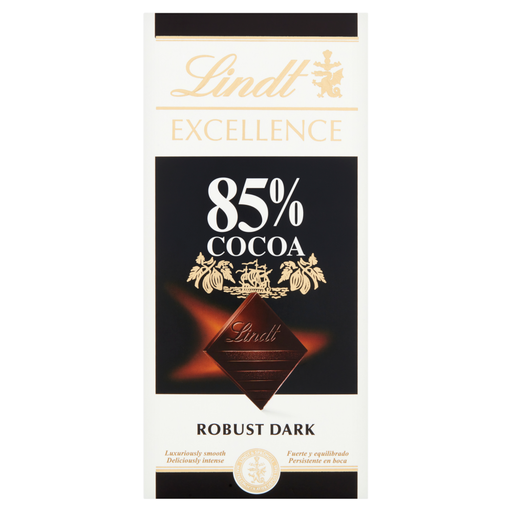
Lindt Excellence 85% Cocoa Dark 100g
A 100 g, 85% cocoa bar to consider for a small chocolate treat rather than primary exercise fuel. Read the current nutrition panel if fibre affects what you choose before training, and check its allergen information for nuts, milk, soya and sesame.
View on Joybuy
Questions about chocolate before exercise
Should I eat a whole dark-chocolate bar before a workout?
Do not assume a whole bar is the portion you need for exercise fuel. Lindt Shop UK, Divine Chocolate and Montezuma’s list 41 g, 50.7 g and 53 g fat per 100 g respectively for their 70%, 85% and 100% examples. If you want chocolate, consider a small amount you already tolerate and assess any fuelling need separately.
Does more cocoa mean a better pre-workout snack?
No: cocoa percentage alone does not establish a bar’s usefulness for fuelling. Lindt Shop UK lists 34 g carbohydrate per 100 g for Excellence 70%, while Divine Chocolate lists 17.9 g for its 85% bar and Montezuma’s lists 18 g for Absolute Black 100%. Compare the full nutrition panel and choose the cocoa percentage for the flavour you want.
Is a vegan dark-chocolate bar suitable if I have a milk allergy?
Do not rely on “vegan” wording alone to decide. Check the exact bar’s current ingredients and precautionary allergen statement for milk; Marks & Spencer, for example, states that its 85% dark-chocolate bar is not suitable for people with a milk allergy.


