Who is this for?
The useful starting point depends on whether the chocolate will go into the dough, be melted for finishing, or need to meet an eater’s allergy requirements.
Bakers following an unspecified recipe
If your biscuit recipe says only “dark chocolate”, compare plain products by cocoa percentage and intended use before choosing one. Marks & Spencer recommends 70% dark chocolate for baking and describes higher percentages as more intense and less sweet.
Bakers coating or decorating biscuits
If melting and finishing matter as much as the chocolate in the biscuit, look for a product described for those tasks. Montezuma’s describes its 74% dark couverture for melting, moulding, decorating and enrobing, as well as baking.
Bakers checking allergens
If the biscuits are for someone with an allergy, assess the exact pack rather than relying on the word “dark” or a vegan-recipe description. Lindt says its EXCELLENCE 70% bar is made to a vegan recipe but is not suitable for people with milk allergy.
What matters when choosing?
Start with the recipe’s specified cocoa percentage and the job the chocolate needs to do. Then compare the exact ingredients and allergen information on the pack.
| Priority |
What to check |
Your needs |
| Cocoa percentage |
Follow the percentage in the recipe if one is given. Otherwise, consider plain 70% chocolate; Marks & Spencer recommends it for baking and describes higher percentages as more intense and less sweet. |
I want a noticeable dark-chocolate flavour without choosing a markedly less-sweet chocolate by accident. |
| How it will be used |
Check whether the product is described for baking, melting or finishing. Montezuma’s specifies melting, coating-related work and baking for its 74% couverture; Lindt describes its EXCELLENCE 70% bar as suitable for baking. |
Chocolate chopped into dough is one decision; a coating or decoration is another. I want the stated use to match the recipe. |
| Ingredients |
Read the full ingredient list for fillings, added flavours or pieces. Compare the exact product with the plain chocolate the recipe calls for. |
If the recipe expects plain chocolate, I do not want an inclusion to change the finished biscuit’s flavour or texture. |
| Allergens |
Read the current pack’s ingredients and any precautionary allergen statement. UK government guidance says regulated allergens present in prepacked food must be clearly labelled in the ingredients list. |
I need to know whether this particular pack is appropriate for the person who will eat the biscuits, not just whether it is labelled dark or vegan. |
Which brands offer relevant options?
These examples show why the exact product matters more than the brand name alone: a cooking chocolate, couverture and ordinary bar can call for different checks.
Montezuma’s
Montezuma’s describes its Organic Dark Chocolate Couverture as a 74% cocoa product for baking and finishing work.
- The manufacturer expressly lists melting, moulding, decorating and enrobing among its uses.
- Check whether the product format and amount suit the number of biscuits you plan to make, and read its current allergen statement.
M&S
M&S places its Dark Chocolate product in its cooking-chocolate range and describes it for cookies and other desserts.
- M&S recommends 70% dark chocolate as a baking option.
- Check the exact product’s cocoa percentage, ingredients and current pack before using it for an allergy-sensitive bake.
Green & Black’s
A Tesco listing identifies Green & Black’s Organic Cooking Chocolate as a 150 g product with 70% cocoa solids.
- It is identified as cooking chocolate, rather than requiring the use of an ordinary bar to be assumed.
- Do not confuse that cooking chocolate with a different Green & Black’s bar; check the precise variant and current allergen label.
Lindt
Lindt describes its EXCELLENCE Dark 70% bar as suitable for baking and uses squares of it in a UK shortbread recipe.
- It provides an example of an ordinary dark bar with an expressly stated baking use.
- Lindt says this vegan-recipe bar is not suitable for people with milk allergy; check the current pack for all relevant allergens.
Divine
Divine identifies its plain Dark Chocolate Bar as a 90 g, 70% cocoa product.
- Its stated cocoa percentage gives a point to compare with the biscuit recipe.
- Confirm that the bar suits the recipe’s intended use rather than treating its cocoa percentage as a baking-use instruction.
Hotel Chocolat
Hotel Chocolat lists a 70% Dark Chocolate Slab Selector, a slab-format option to assess against a biscuit recipe.
- The product name identifies its 70% cocoa designation and slab format.
- Check the exact slab’s ingredients, allergens and intended use before choosing it for baking.
Dark chocolate options on Joybuy
These options cover cooking chocolate and ordinary dark bars at 70%, 72% and 85% cocoa. For a recipe that specifies a percentage, start there; for an ordinary bar, check how you plan to use it before substituting it for cooking chocolate.
 No image available
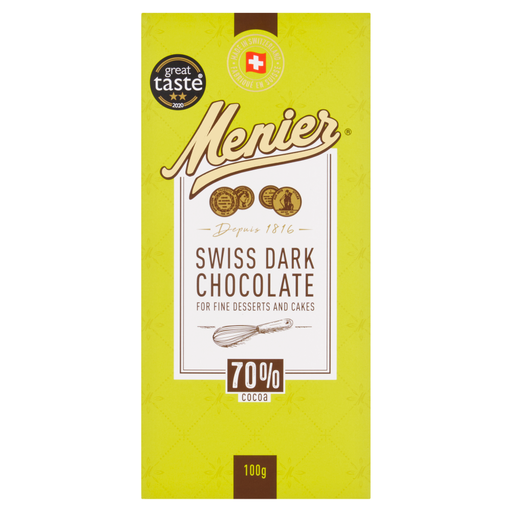
Menier Dark Cooking Chocolate 70% Cocoa 100 g
A cooking-chocolate option to consider when a biscuit recipe calls for dark chocolate without naming a percentage. The title specifies 70% cocoa and a 100 g pack; check the current pack’s ingredients and allergens before use.
View on Joybuy
 No image available
Morrisons The Best Dominican Republic Dark Chocolate 72% Cocoa 100 g
A dark bar to consider if the biscuit recipe allows a cocoa percentage other than 70%. The title states 72% cocoa and 100 g; compare the recipe’s intended percentage and check the current pack before baking for someone with an allergy.
View on Joybuy
 No image available
Green & Black’s Dark Chocolate 70% 90 g
A 70% dark bar for a recipe where you have checked that an ordinary bar suits the intended use. This 90 g product is distinct from Green & Black’s Organic Cooking Chocolate; check the exact pack’s ingredients and allergen statement.
View on Joybuy
 No image available
Lindt EXCELLENCE Dark Chocolate 85% Cocoa 100 g
Consider this 85% cocoa, 100 g bar when the recipe specifies higher-cocoa chocolate or you want to assess a more intense, less-sweet flavour. Check that this exact 85% variant suits the baking task; Lindt’s stated shortbread use concerns its different EXCELLENCE 70% bar.
View on Joybuy
 No image available
Green & Black’s Dark Chocolate 85% 90 g
A 90 g bar for a recipe calling for 85% cocoa, or for a deliberate move towards a more intense, less-sweet chocolate flavour. Confirm that this exact bar suits the intended baking use, and read its current allergen statement.
View on Joybuy
Common questions
What percentage should I use if the biscuit recipe just says “dark chocolate”?
Plain 70% dark chocolate is a starting point: Marks & Spencer recommends 70% for baking. If the recipe gives a percentage, follow it; choose a higher one when you want the more intense, less-sweet flavour Marks & Spencer describes.
Can I use an ordinary dark bar instead of cooking chocolate?
Yes, if the particular bar suits the recipe’s use. Lindt describes its EXCELLENCE Dark 70% bar as suitable for baking and cooking, and its UK shortbread recipe uses squares of that bar; do not assume the same instructions apply to every dark bar or variant.
When should I consider couverture for biscuits?
Consider couverture when melting, coating or decoration is an important part of the bake. Montezuma’s describes its 74% dark couverture for melting, moulding, decorating, enrobing and baking; for chocolate simply chopped into dough, compare the amount and format with what your recipe needs.
Is a dark chocolate made to a vegan recipe suitable for someone with milk allergy?
Not necessarily. Lindt says its vegan-recipe EXCELLENCE 70% bar is not suitable for people with milk allergy. Check the exact current pack’s ingredients and precautionary allergen statements before serving the biscuits.
What should I check on the pack before baking?
Check the cocoa percentage, ingredients, allergens, any precautionary statement and the pack weight against the recipe. For allergy decisions, use the current pack rather than assuming that another variant or an earlier product listing has the same information.


