Shoppers comparing cocoa labels
If you want dark chocolate, check whether a percentage refers to cocoa solids in the chocolate or to the amount of chocolate in the biscuit.


For a stated cocoa level, compare the chocolate component: Tesco lists at least 48% cocoa solids in its dark digestives, while the checked Sainsbury's digestives and Fox's cookies each list at least 35%. If portion size or sweetness matters more for revision breaks, compare sugar per 100g and per biscuit instead; a dark-chocolate name does not settle either question.
If you want dark chocolate, check whether a percentage refers to cocoa solids in the chocolate or to the amount of chocolate in the biscuit.
Compare the labelled sugar and biscuit size when choosing a treat for a revision break, rather than treating “dark” as a statement about sugar content.
Biscuits bought for breaks at home are a different decision from food provided to pupils by a school in England, where school-food rules apply.
Start with the chocolate declaration, then compare the biscuit’s serving information and ingredients for the person who will eat it.
| Priority | What to check | Your needs |
|---|---|---|
| Cocoa declaration | Look for minimum cocoa solids in the chocolate component. Tesco lists 48% for its dark digestives; Sainsbury's digestives and Fox's half-coated cookies list 35%. McVitie's lists dark chocolate as 30% of its digestive, which measures something different. | I want to compare the chocolate itself, rather than assume that a larger chocolate share means more cocoa. |
| Sugar and portion | Compare sugar per 100g across different biscuits, then check the amount per biscuit or labelled serving. Sainsbury's lists 22.1g per 100g for its digestive; the Fox's cookie listing gives 11.4g per 25g cookie. | A single biscuit may suit my break better than a larger cookie, so I want the serving figure as well as the pack figure. |
| Ingredients and allergens | Read the exact pack’s ingredient and precautionary allergen statements. Dark chocolate does not establish whether a biscuit contains or may contain wheat, milk, soya or oats. | If someone eating the biscuits avoids an ingredient, I need to check that particular product and the pack received. |
| Pack format | Check pack weight and, where stated, biscuit count before planning several breaks. The checked Tesco digestives are a 300g pack; the checked McVitie's 266g listing describes approximately 16 biscuits. | For several home revision breaks, I want a pack size that fits how many biscuits we expect to use. |
McVitie's lists dark chocolate as 30% of its digestive. Tesco’s 48% minimum describes cocoa solids in the chocolate component of a different biscuit; the figures cannot be compared as though they measure the same thing.
Find a cocoa-solids declaration for the chocolate component if cocoa level is your deciding factor.
The Sainsbury's listing for Fox's dark-chocolate cookies gives 11.4g sugar per 25g cookie. The chocolate description alone does not tell you how its sugar figure compares with another biscuit.
Check sugar per 100g for a common comparison and per serving for the portion you plan to eat.
England’s Requirements for School Food Regulations 2014 govern food provided to pupils at covered schools; retail rules on products high in fat, sugar or salt address a different activity.
If arranging school-provided revision snacks in England, check the applicable school-food rules rather than relying on a product’s presence in a shop.
These details concern the named products, not every biscuit made or sold by each brand.
Tesco’s 300g Dark Chocolate Digestives provide a cocoa-solids declaration for their chocolate coating.
Sainsbury's 300g Dark Chocolate Digestives offer another coated digestive with a stated cocoa minimum.
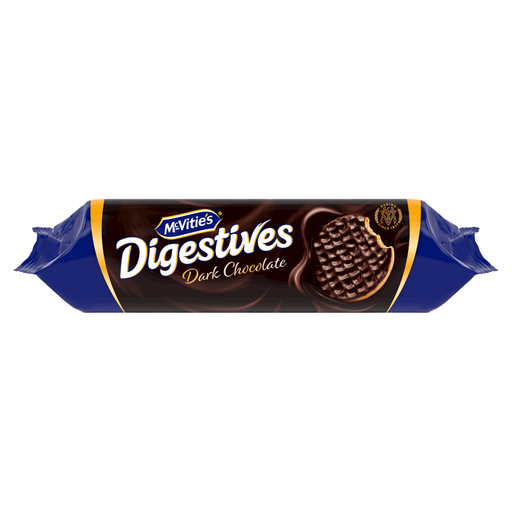
McVitie's Dark Chocolate Digestives are a wheatmeal, chocolate-topped option. Its Penguin Original and Club Orange products should not be treated as dark-chocolate alternatives on the basis of the brand name.
Fox's 175g half-coated dark-chocolate cookies provide a cookie format with chocolate chunks.
Nairn's Dark Chocolate Chip Oat Biscuits use chips rather than a chocolate coating.
These options cover dark-chocolate digestives and two oat-based biscuit styles for home revision breaks. Check the exact pack’s cocoa declaration, ingredients and serving information against your priorities.
 No image available
A two-pack digestive option for home revision breaks. Its ingredient information lists 30% dark chocolate in the biscuit; check the pack for a cocoa-solids declaration if that distinction matters to you. The product information lists wheat, milk and soya as allergens.
 No image available
A 400g digestive pack for planning several breaks. Its ingredient information lists 30% dark chocolate in the biscuit, not a cocoa-solids percentage for that chocolate. The product information lists wheat, milk and soya as allergens.
 No image available
An oat-based dark-chocolate and coconut biscuit break rather than a coated digestive. The product information lists 10% dark-chocolate chips; check the exact pack for a cocoa-solids declaration. It also states that the product is unsuitable for anyone with an allergy to avenin, a protein in oats.
 No image available
A ginger oat biscuit with a dark-chocolate coating. The product information describes a no-added-sugar formulation containing maltitol and warns that excessive consumption may have a laxative effect. It lists milk, oats, soya and wheat as allergens; check the pack before serving.
No. McVitie's uses 30% to describe dark chocolate as a share of its digestive biscuit. To compare cocoa levels, look for a separate cocoa-solids declaration for the chocolate component, as shown on the checked Tesco and Sainsbury's listings.
The checked biscuits are ready to eat. Follow the storage instructions on the pack you receive; the checked pack instructions call for cool, dry storage and an airtight container after opening.
England’s Requirements for School Food Regulations 2014 restrict biscuits provided to pupils outside school lunch and contain specific exemptions, including for certain boarding-school evening meals. Check the rules applicable to the school and occasion rather than treating a home purchase as permission for school provision. The Department for Education said proposed updated standards for September 2027 were subject to Parliamentary approval.
Check the exact product’s ingredients and precautionary allergen statements before choosing it, then check the pack received. Recipes and cross-contact statements differ, and a dark-chocolate description does not establish allergen suitability.
Do not choose them for a promised concentration effect. They can be a treat during a home revision break; for children’s snacks, the NHS suggests fruit or chopped vegetables in place of biscuits.