Parents packing a school treat
Check the school’s lunchbox rules before choosing between a digestive and a cookie. NHS-backed Just One Norfolk advises parents to check what their school permits for lunch and snacks.


Choose a dark-chocolate biscuit for a school lunchbox only if the child can eat its ingredients and the school allows it. Then compare the current pack’s allergen information and nutrition for the portion you would actually pack: the word ‘dark’ alone does not establish either suitability or sugar content.
School rules, ingredients and the child’s preferences determine whether a dark-chocolate biscuit is worth considering for a lunchbox.
Check the school’s lunchbox rules before choosing between a digestive and a cookie. NHS-backed Just One Norfolk advises parents to check what their school permits for lunch and snacks.
Read the current pack’s ingredients and precautionary statements. The McVitie’s, Sainsbury’s and Fox’s dark-chocolate products described here list wheat; the Fox’s cookie listing also says it may contain nuts and peanuts.
Check whether a label describes dark chocolate or a milk-chocolate-flavour coating. Also distinguish the proportion of a biscuit made up of chocolate from the cocoa-solids percentage within that chocolate.
Start with school acceptance and the exact ingredients, then compare like-for-like nutrition figures and the portion going into the lunchbox.
| Priority | What to check | Your needs |
|---|---|---|
| School rules and allergens | Check the school’s packed-lunch policy. Read the current pack’s ingredients, emphasised allergens and any ‘may contain’ warning. | I need a biscuit the school accepts and that meets my child’s ingredient requirements; a dark-chocolate name is not an allergen assurance. |
| Sugars and serving size | Compare sugars per biscuit or cookie for the amount being packed. For differently sized products, also compare sugars per 100 g; the NHS describes more than 22.5 g total sugars per 100 g as high. | How much would the child actually eat? I want to assess that portion rather than assume dark chocolate means less sugar. |
| Chocolate description | Check whether the coating is dark chocolate. Read whether a percentage refers to chocolate in the whole biscuit or cocoa solids within the chocolate. | I am looking for a dark-chocolate flavour, not a milk-chocolate-flavour bar or a cocoa figure applied to the wrong part of the product. |
| Pack format | Check the labelled serving and how many biscuits you intend to pack. Follow the storage directions on an opened packet. | A manageable lunchbox portion matters more to me than the size of the packet it came from. |
Neither word establishes an allergen profile or a sugar level. The named dark-chocolate products list wheat alongside other ingredients that may matter to a child.
Check the exact pack’s ingredients, precautionary statements and nutrition panel, as well as the school’s policy.
McVitie’s describes dark chocolate as 30% of its Dark Chocolate Digestive. Sainsbury’s lists dark chocolate as 27% of its digestive and specifies at least 35% cocoa solids within that chocolate. Those figures do not directly rank the cocoa content of the whole biscuits.
Note what each percentage measures before using it to choose a product.
An online title may not settle which recipe or variant its accompanying description covers. That matters when ingredients and allergens determine whether a biscuit can go in a lunchbox.
Match the product and pack size, then use the current physical pack for ingredient and allergen details.
These named products illustrate different biscuit formats; a brand name alone does not establish the ingredients of another product in its range.
McVitie’s describes a Dark Chocolate Digestive and publishes its ingredients and per-biscuit nutrition.
Sainsbury’s lists a 300 g pack of Dark Chocolate Digestives with ingredient and nutrition details.
Tesco’s listing describes Fox’s Fabulous Half Coated Dark Chocolate Cookies as a cookie option rather than a digestive.
Tesco lists its own-label Dark Chocolate Digestives in a 300 g pack.
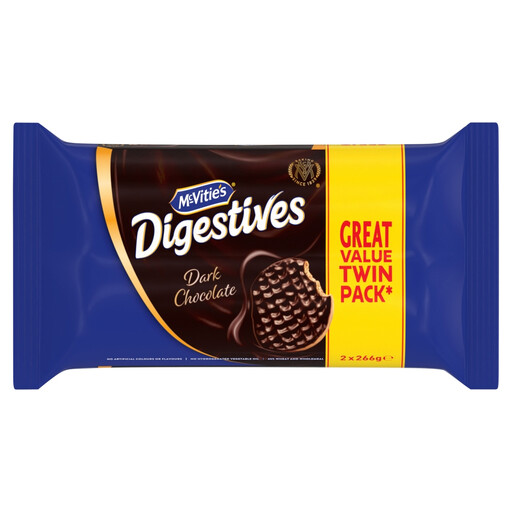
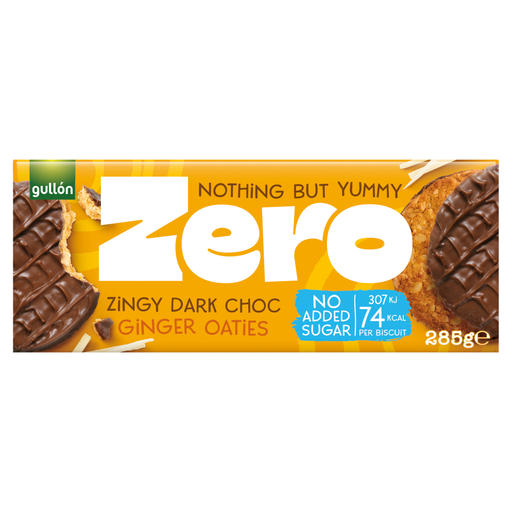
These options cover a McVitie’s dark-chocolate digestive twin pack and Gullon dark-chocolate ginger oaties. For either one, check the current pack and school rules before putting it in a child’s lunchbox.
 No image available
This twin pack suits someone choosing a dark-chocolate digestive format. Check the pack’s ingredients and per-biscuit nutrition against the child’s needs before packing a portion.
 No image available
This 285 g ginger-oatie pack is a different format from a digestive. Its product information warns that excessive consumption may have a laxative effect; check that warning, the current ingredients and the school’s policy before considering it for a child’s lunchbox.
Check the particular school’s packed-lunch and allergen policies before packing them. NHS-backed Just One Norfolk advises checking school rules; the Department for Education’s school-food guidance concerns food provided in state-funded schools in England, so it does not grant blanket permission for packed-lunch biscuits.
Check the current physical pack against the child’s requirements rather than relying on a dark-chocolate description. The named McVitie’s, Sainsbury’s and Fox’s dark products list wheat and other allergens; Tesco’s listing for the Fox’s cookies also says they may contain nuts and peanuts.
No conclusion about sugar follows from the word ‘dark’. McVitie’s lists 26.6 g sugars per 100 g for its Dark Chocolate Digestives, Sainsbury’s lists 22.1 g for its Dark Chocolate Digestives, and Tesco’s Fox’s cookie listing gives 45.4 g; compare the current labels and the portion being served.
Follow the instructions on the pack. The Sainsbury’s digestive and Fox’s cookie listings advise keeping the products in a cool, dry place and using an airtight container once opened.
Use the current pack label to check ingredients and allergens. Sainsbury’s warns that its products and ingredients can change and advises customers not to rely solely on online information; ask the retailer or manufacturer if a detail you need remains unclear.