When a biscuit recipe simply calls for dark chocolate, a plain bar around 70% cocoa is a practical starting point: Marks & Spencer recommends 70% dark chocolate for intense baking, and Lindt describes its EXCELLENCE 70% bar as suitable for baking. Consider 72% or 74% if you want a more intense, less-sweet chocolate flavour, but follow any percentage specified by the recipe and check the current pack for allergens.
Who is this for?
Recipe-led biscuit bakers
If the recipe calls for dark chocolate without specifying additions, you can look for a plain bar to chop or melt without introducing another flavour. Marks & Spencer identifies 70% dark chocolate as a choice for intense baking.
Bakers seeking a less-sweet chocolate flavour
If you want a more cocoa-forward result, compare the recipe’s percentage with plain 72% and 74% bars. Marks & Spencer says higher cocoa percentages give a more intense, less-sweet flavour.
Households checking food allergens
Check the current bar’s ingredients and precautionary allergen wording before baking for someone with an allergy. A dark-chocolate or vegan description alone does not establish suitability: Lindt says its vegan-recipe EXCELLENCE 70% bar is not suitable for people with a milk allergy.
What to check before buying
Start with the recipe’s cocoa percentage and chocolate weight, then check whether the bar is plain and whether its current allergen information suits the people eating the biscuits.
| Priority | What to check | Your needs |
|---|
| Cocoa percentage | Follow a percentage named in the recipe. Otherwise, compare a plain 70% bar with 72% or 74% if you deliberately want a different cocoa level; Marks & Spencer describes higher percentages as more intense and less sweet. | If my recipe just says dark chocolate, I want a straightforward starting point. If I prefer a less-sweet chocolate flavour, I can choose a higher percentage with the recipe’s intended balance in mind. |
| Added flavours | Read the product name and ingredients for fruit, caramel, nuts or other deliberate additions. Choose a flavoured bar only if those additions suit the biscuit recipe. | I want the chocolate to contribute dark-chocolate flavour without adding an unplanned filling or texture. |
| Allergen information | Check both the ingredients and any precautionary wording on the current pack. The Food Standards Agency explains that such wording communicates possible unintended allergen presence; a vegan claim is a separate consideration. | Someone eating these biscuits has an allergy, so I need to assess the exact bar and its current labelling before using it. |
| Bar weight | Compare the recipe’s required chocolate weight with the bar’s stated weight. The researched single-bar examples include 90g, 100g and 125g sizes. | I want one bar that provides the amount my biscuit batch calls for, rather than choosing by cocoa percentage alone. |
Common buying mistakes
-
Treating every dark bar as interchangeable
A change from 70% to 74% can alter the intended flavour balance; Marks & Spencer describes higher cocoa percentages as more intense and less sweet.
Use the percentage specified by the recipe where possible. If none is given, consider a plain 70% bar before choosing a higher percentage for its flavour.
-
Overlooking added flavours or fillings
Fruit, caramel, nuts or other inclusions add ingredients and texture beyond the dark chocolate requested by a plain biscuit recipe.
Check the bar’s name and ingredients, and choose additions only when they fit the biscuits you intend to make.
-
Assuming vegan means suitable for a milk allergy
Lindt says its EXCELLENCE 70% bar is made to a vegan recipe but is not suitable for people with a milk allergy because it is made in a facility using milk. The Food Standards Agency explains that precautionary labelling signals possible unintended allergen presence.
Check the exact product’s current ingredients and precautionary statements against the relevant allergy before using it.
-
Forgetting the recipe’s chocolate weight
A single bar may weigh 90g, 100g or 125g, so the percentage on its wrapper does not tell you whether it supplies the quantity your biscuit recipe requires.
Check the recipe quantity against the stated bar weight, then read the current pack information before baking.
Relevant brand references
Lindt
Lindt describes its 100g EXCELLENCE Dark 70% bar as suitable for baking and cooking.
- The specified bar has at least 70% cocoa solids.
- Lindt says its vegan-recipe bar is not suitable for people with a milk allergy; check its current allergen wording.
Green & Black's
The Organic 70% Dark Chocolate Bar is a plain 90g option listed by Waitrose & Partners.
- The listed ingredients are cocoa mass, cane sugar, cocoa butter and vanilla extract.
- The Waitrose listing says the bar may contain nuts and milk.
Divine
Divine’s 90g 70% dark bar is positioned around Fairtrade ingredients.
- Its product information describes a plain 70% dark-chocolate bar.
- Divine states that the reviewed bar may contain gluten, milk and nuts.
Montezuma's
Montezuma’s FitzRoy is a plain 90g organic dark-chocolate bar with 74% cocoa solids.
- Its stated cocoa percentage offers a deliberate alternative when the recipe allows a 74% bar.
- Montezuma’s says the bar may contain traces of milk, nuts and peanuts.
M&S
Marks & Spencer recommends 70% dark chocolate for intense baking and lists a 125g Swiss Extra Fine Dark Chocolate bar with 72% cocoa solids.
- The 125g bar is worth checking when the recipe requires more chocolate than a 90g bar provides.
- M&S says that bar is not suitable for people with milk, nut, peanut or soya allergies.
Hotel Chocolat
Hotel Chocolat lists a 70% Dark Chocolate Slab Selector, a solid slab format rather than a thin tablet bar.
- The stated 70% cocoa level can be compared with a recipe’s requested percentage.
- Check the current ingredients and allergen information before choosing the slab for an allergy-sensitive bake.
Dark chocolate bars on Joybuy
These single bars cover a 72% option, a 70% cooking chocolate and a plain 70% bar. Compare their stated weights with your biscuit recipe and check each current pack for allergens.
 No image available
Morrisons The Best 72% Cocoa Dominican Republic Dark Chocolate 100g
Consider this 100g, 72% bar if your biscuit recipe allows that cocoa percentage. Check the current pack for soya and precautionary gluten, milk, nut and peanut information before baking for anyone with a relevant allergy.
View on Joybuy
 No image available
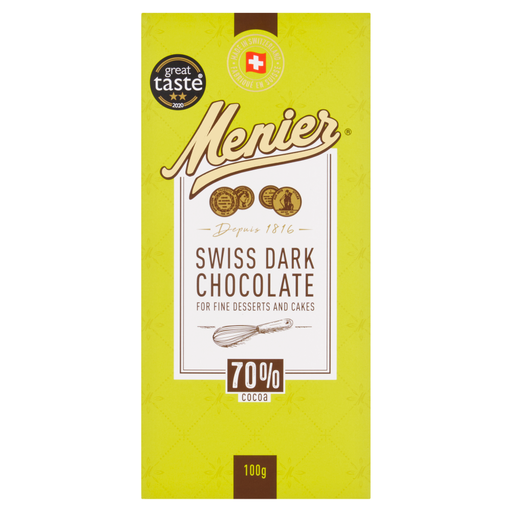
Menier Dark Cooking Chocolate 70% Cocoa 100g
This 100g cooking-chocolate bar has 70% cocoa stated in its name, making its percentage relevant when a biscuit recipe calls for 70% dark chocolate. Check the current pack for milk and precautionary egg, gluten and tree-nut information.
View on Joybuy
 No image available
Green & Black's Dark Chocolate 70% 90g
This plain 90g bar has 70% cocoa solids; compare its weight with your biscuit recipe before choosing it. Its listed ingredients are cocoa mass, cane sugar, cocoa butter and vanilla extract. Check the current pack for precautionary milk and nut information.
View on Joybuy
Questions about baking with dark chocolate
What cocoa percentage should I start with for dark-chocolate biscuits?
A plain bar around 70% cocoa is a starting point when the recipe simply says dark chocolate. Marks & Spencer recommends 70% dark chocolate for intense baking, while Lindt describes its EXCELLENCE 70% bar as suitable for baking and cooking. Follow a specific percentage if the recipe gives one.
When would I choose 72% or 74% instead of 70%?
Choose a higher percentage if you deliberately want a more intense, less-sweet chocolate flavour and the recipe allows the change. Marks & Spencer describes that flavour difference; a higher-percentage bar is not automatically a like-for-like substitute for a specified 70% bar.
Is a vegan dark-chocolate bar suitable for someone with a milk allergy?
Not necessarily. Lindt says its reviewed EXCELLENCE 70% bar is made to a vegan recipe but is not suitable for people with a milk allergy because it is made in a facility using milk. Check the exact bar’s current ingredients and precautionary allergen wording.
What does ‘may contain’ mean on a chocolate bar?
The Food Standards Agency explains that precautionary allergen labelling communicates that an allergen could be unintentionally present. Read it alongside the ingredients list when assessing a bar for allergy-sensitive biscuit baking.


