Parents choosing an occasional treat
If a child asks for chocolate after school, it helps to decide whether this is a treat or the snack you plan to offer routinely. The NHS recommends fruit and vegetables as its preferred snack choice for children.


For a regular after-school snack, NHS guidance favours fruit and vegetables; keep chocolate as an occasional treat at home. If you are choosing a bar, Cadbury Darkmilk is a 38% cocoa milk chocolate, while the cited 70% and 90% bars offer distinctly darker options. Match the cocoa strength to the person eating it, and check the current nutrition and allergen label rather than treating a higher percentage as a health guarantee.
If a child asks for chocolate after school, it helps to decide whether this is a treat or the snack you plan to offer routinely. The NHS recommends fruit and vegetables as its preferred snack choice for children.
A milder high-cocoa milk chocolate and a 70% or 90% dark bar are different choices. Compare their declared cocoa percentages and nutrition panels, then consider whether the intended eater already enjoys a strong dark-chocolate flavour.
A treat bought for eating at home is a different question from food provided at school. The Department for Education’s England school-food guidance addresses chocolate across the school day; check the applicable guidance and the school’s policy before offering it at school.
Decide first whether you are choosing a routine snack or an occasional chocolate treat. For a treat, compare cocoa strength, the nutrition label and allergens on the exact bar.
| Priority | What to check | Your needs |
|---|---|---|
| Snack occasion | Decide whether the purchase is for a regular after-school snack or an occasional treat. The NHS recommends fruit and vegetables as its preferred snack choice for children. | For an everyday snack, I would rather choose something other than chocolate. A bar may be an occasional treat at home. |
| Cocoa and flavour | Read the declared cocoa solids: Joybuy lists Cadbury Darkmilk at 38% minimum, while Lindt lists the cited EXCELLENCE bars at 70% and 90% minimum. Check whether the intended eater likes a strong dark flavour. | If the person eating it prefers milder chocolate, I would not buy a 90% bar solely because its cocoa percentage is higher. |
| Nutrition label | Compare the same per 100g measure as well as any per-serving figures. Lindt lists 29g sugars and 24g saturates per 100g for its cited 70% bar, against 7g sugars and 30g saturates for its cited 90% bar. | I want to see both sugars and saturates, rather than assuming that the bar with less sugar is preferable on every measure. |
| Allergens | Read the current ingredients and precautionary statements on the exact pack. Lindt says its cited 70% bar may contain nuts, milk, soya and sesame; its cited 90% bar is not suitable for people with a milk allergy. | When an allergen matters in my household, the current pack matters more than a cocoa percentage or a vegan-recipe description. |
| Pack choice | Check the bar size and decide how it fits the intended occasion. A pack’s weight does not itself specify a serving size. | For an occasional treat, I want a quantity that fits what I intend to offer, not a reason to make chocolate the routine snack. |
Joybuy lists Cadbury Darkmilk at 38% minimum cocoa solids; Lindt lists the cited dark bars at 70% and 90%. Those labels describe different products, not interchangeable cocoa strengths.
Read the cocoa-solids declaration, and treat Darkmilk as a high-cocoa milk-chocolate option rather than a direct substitute for a 70% dark bar.
Lindt’s cited 90% bar lists less sugar but more saturates per 100g than its cited 70% bar. Neither comparison makes chocolate the NHS’s preferred routine snack for children.
Compare both figures on the current labels. If the purchase is for regular after-school snacking, consider fruit or vegetables instead.
The Department of Health and Social Care’s HFSS promotion guidance concerns businesses operating in and selling to England. Department for Education school-food guidance addresses a different setting.
For food offered at school, check the applicable school-food guidance and school policy. Do not use retail-promotion guidance to decide what a school may provide.
Lindt says its cited 90% bar is made to a vegan recipe but is not suitable for people with a milk allergy.
Read the exact current allergen statement whenever milk or another allergen needs to be avoided.
These examples illustrate different cocoa-strength choices; a brand name alone does not establish the ingredients or nutrition of another bar in its range.
Cadbury presents Darkmilk Original as a rich but creamy option for someone moving towards a darker chocolate flavour.
The cited EXCELLENCE 100g bars give shoppers a choice between 70% and 90% minimum cocoa solids.
Tesco Groceries lists Green & Black’s Organic dark bars at 70% and 85% cocoa, both in 90g packs.
These bars represent the 70% and 90% dark-chocolate routes for an occasional treat at home. They are not alternatives to choosing a non-chocolate snack for regular after-school eating.
 No image available
A 70% cocoa dark bar for an occasional home treat where that cocoa strength appeals. The 90g bar may contain almonds, hazelnuts, other nuts and milk; check the current pack if those allergens matter.
 No image available
This 90g dark bar combines at least 70% cocoa solids with 3% freeze-dried raspberry pieces. Its product information describes it as vegan-friendly but also identifies milk in the ingredient and allergen information; check the current pack before relying on a dietary claim. It may also contain gluten and nuts.
 No image available
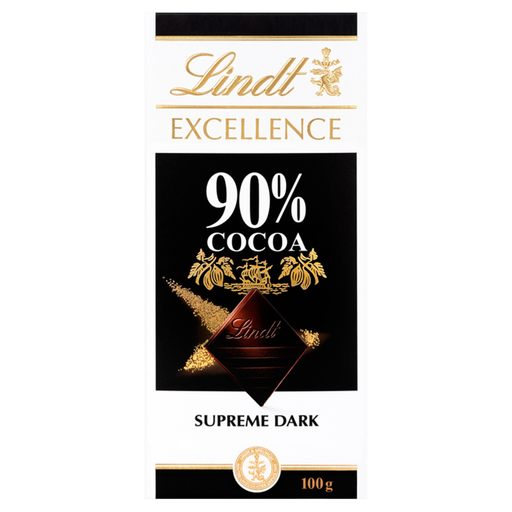
A 90% cocoa option for someone who already enjoys an intense dark-chocolate flavour. The 100g bar lists 7g sugars and 30g saturates per 100g; lower listed sugar alone does not make it a routine child snack. Check the current pack’s allergen statement before purchase.
No. Lindt lists 7g sugars and 30g saturates per 100g for its cited 90% bar, compared with 29g sugars and 24g saturates for its cited 70% bar: the figures move in different directions. For children’s routine snacks, the NHS recommends fruit and vegetables.
Do not assume that a bar bought as a treat for home is appropriate for school provision. The Department for Education’s England school-food guidance identifies confectionery and chocolate across the whole school day. Check the school’s policy and the applicable school-food guidance; rules elsewhere in the UK need checking separately.
No. The Department of Health and Social Care’s HFSS promotion guidance applies to relevant businesses operating in and selling to England; Department for Education school-food guidance addresses food at school. Use the guidance for the setting you are deciding about.
No. Lindt states that its cited EXCELLENCE 90% bar is made to a vegan recipe but is not suitable for people with a milk allergy. Check the current allergen statement on the exact bar rather than relying on the recipe description.
Read the current ingredients and precautionary allergen statement for the exact product. Joybuy identifies milk and soya in the cited Cadbury Darkmilk bar, while Lindt says its cited EXCELLENCE 70% bar may contain nuts, milk, soya and sesame seeds.