Coffee-break commuters
If you plan to carry a pack and eat it over several breaks, consider its size and how the biscuits must be stored after opening. An airtight container may be more practical than carrying an opened pack loose in a bag.


If the coating’s stated cocoa-solids level matters, Tesco’s dark chocolate digestives list a minimum of 48% in the chocolate, while Sainsbury’s list 35%; neither figure describes the cocoa content of the whole biscuit. For a coffee break on the commute, also compare pack size, storage instructions, allergens and nutrition on a consistent serving basis rather than assuming that every biscuit labelled ‘dark’ will taste or travel alike.
If you plan to carry a pack and eat it over several breaks, consider its size and how the biscuits must be stored after opening. An airtight container may be more practical than carrying an opened pack loose in a bag.
If ‘dark chocolate’ does not tell you enough, look for the coating’s minimum cocoa-solids percentage. Tesco and Sainsbury’s state one for their listed biscuits; it is a different measure from the percentage of the biscuit made up of chocolate.
If you need to check an allergen or compare sugars, read the information for the exact pack. Ingredient statements and biscuit serving sizes differ between the listed products, so check the label on the pack you receive.
Start with the coating information that matters to you, then check whether the pack and its label work for the way you take coffee breaks.
| Priority | What to check | Your needs |
|---|---|---|
| Chocolate coating | Read the chocolate percentage and the coating’s minimum cocoa-solids percentage separately. Tesco lists 30% dark chocolate with at least 48% cocoa solids in that chocolate; Sainsbury’s lists 27% and at least 35%, respectively. | I want to know what the word ‘dark’ means on this pack, without mistaking the amount of coating for its cocoa concentration. |
| Pack and storage | Check the pack weight and the instructions for an opened pack. Asda’s listing says to use an airtight container and consume its biscuits within seven days of opening. | A pack I can store between coffee breaks matters more to me than simply choosing the largest one. |
| Nutrition basis | Compare per-100g figures when biscuit serving weights differ. For the labelled serving, Tesco lists 4.2g sugars per 17g biscuit, while Sainsbury’s lists 3.5g sugars per biscuit; those per-biscuit figures are not a like-for-like weight comparison. | When I compare labels, I want to know whether the numbers describe equal amounts of biscuit. |
| Ingredients | Check the ingredients and allergen statements on the exact pack. Tesco’s listing says ‘may contain milk’; Sainsbury’s gives an additional warning for customers with an oat allergy. | I need to check the ingredients relevant to me rather than treating ‘dark chocolate’ as an allergen statement. |
The percentage of the biscuit made up of chocolate and the minimum cocoa solids in that chocolate measure different things. A larger coating share does not, by itself, tell you the coating’s cocoa-solids level.
Look for both figures on the exact product label where they are stated.
Per-biscuit nutrition figures can describe biscuits of different weights, making a direct comparison misleading.
Use per-100g nutrition for a consistent comparison, then read the per-biscuit figure for the serving you are considering.
The listed Asda, Sainsbury’s, M&S and McVitie’s formulations contain milk ingredients; Tesco’s listing says its biscuits may contain milk.
Check the ingredient and allergen statements on the pack you receive against your requirements.
These details describe specific listed dark chocolate digestives, not every product made by each brand or retailer.
A Sainsbury’s listing describes a 433g pack of McVitie’s dark chocolate digestives.
Tesco’s listed own-label dark chocolate digestives come in a 300g pack.
Sainsbury’s lists a 300g own-label dark chocolate digestive.
Asda lists a 300g dark chocolate digestive with 30% dark chocolate.
M&S lists a 300g dark chocolate digestive containing 32% chocolate.
These McVitie’s options offer two pack formats for a dark chocolate digestive coffee break. Check the details for the exact pack rather than applying figures from another size or retailer listing.
 Image unavailable
The 2 x 266g format is worth considering if you want two packs for coffee breaks. If the coating’s cocoa-solids level affects your choice, check the label for this twin-pack variant rather than using a figure from a different McVitie’s pack.
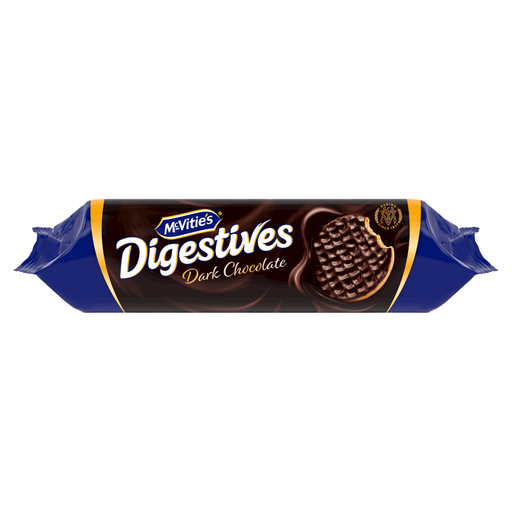 Image unavailable
This 400g pack is another McVitie’s format to consider for coffee breaks. Check its own label for the coating composition, ingredients and after-opening instructions before deciding whether it suits you.
No. On Tesco’s and Asda’s listings, 30% is the proportion of the biscuit made up of dark chocolate. Tesco separately states that its chocolate contains at least 48% cocoa solids; that figure applies to the chocolate, not the whole biscuit.
Follow the instructions on your pack and use an airtight container where directed. Asda’s listing also says to consume its dark chocolate digestives within seven days of opening, so check the instruction for the particular biscuits you buy.
Check the ingredient and allergen statements on the pack you receive, especially if a product has been substituted or its formulation has changed. The listed dark chocolate digestives have different milk statements and other allergen warnings; the word ‘dark’ is not a substitute for reading the label.