Chocolate-cheesecake bakers
If your recipe calls for a crushed chocolate-biscuit base, match its biscuit and butter quantities rather than choosing by cocoa percentage alone. Good Food’s no-bake cheesecake recipe is one example.


Start with the recipe: Good Food uses crushed chocolate digestives and melted butter for a chilled cheesecake base, but its quantities are not a substitution rule for every biscuit. If a declared cocoa level matters, Tesco lists a 30% chocolate coating with at least 48% cocoa solids in that chocolate, while Rakusen’s lists 20% chocolate with at least 52% cocoa solids; neither figure alone establishes how dark the finished base will taste. Check the current pack’s ingredients and allergens before baking.
If your recipe calls for a crushed chocolate-biscuit base, match its biscuit and butter quantities rather than choosing by cocoa percentage alone. Good Food’s no-bake cheesecake recipe is one example.
Look at both the proportion of the biscuit covered in chocolate and the minimum cocoa-solids level within that chocolate. Tesco, Rakusen’s and Sainsbury’s publish both figures for the products discussed here.
Check the exact pack and every other recipe ingredient before serving. A dark chocolate coating does not establish that a biscuit is milk-free.
Choose a biscuit that fits the recipe quantity, then compare coating declarations and ingredients according to what matters for the bake.
| Priority | What to check | Your needs |
|---|---|---|
| Recipe fit | Check whether the recipe specifies chocolate digestives, its biscuit weight and its butter quantity. Good Food’s chilled cheesecake recipe uses 300g of chocolate digestives with 130g of melted butter. | I’m making a crushed biscuit base and want to follow the quantities in my recipe rather than assume another biscuit will behave identically. |
| Chocolate and cocoa | Read the coating’s share of the whole biscuit separately from the minimum cocoa solids within that coating. Tesco lists 30% and 48% respectively; Rakusen’s lists 20% and 52%; Sainsbury’s lists 27% and 35%. | A stated cocoa-solids level matters to me, but I don’t want to mistake it for the cocoa content of the whole biscuit or a guarantee of flavour. |
| Ingredients and allergens | Read the current pack’s ingredients and precautionary statements, then check the rest of the recipe. McVitie’s lists butter oil from milk; Tesco says its product may contain milk. | I’m baking for someone with an allergy, so the word “dark” is not enough to decide whether the finished dessert is suitable. |
| Pack quantity and storage | Compare pack weight with the recipe’s required weight. Follow the chosen pack’s storage directions after opening; ASDA advises an airtight container and use within seven days for its 300g product. | If my recipe needs 300g of biscuits, I want to know whether one pack covers it and how to keep any remainder. |
Rakusen’s says chocolate makes up 20% of its biscuit and contains at least 52% cocoa solids. Tesco lists 30% chocolate with at least 48% cocoa solids within it. The cocoa-solids figures describe the chocolate, not the finished biscuits.
Read both declarations separately; neither one predicts the flavour of a finished biscuit base on its own.
McVitie’s lists butter oil from milk, ASDA declares milk, and Tesco gives a may-contain-milk statement for the products discussed here.
For anyone with an allergy, assess the actual pack and every ingredient in the bake before serving.
Good Food’s cheesecake recipe calls for 300g of chocolate digestives, while Tesco lists the Rakusen’s dark chocolate product in a 200g pack.
Compare the recipe weight with the pack weight before ordering.
A 200g pack alone will not cover a recipe calling for 300g of biscuits.
These declarations concern the named dark chocolate digestives, not every biscuit made by each brand.
Tesco Dark Chocolate Digestives 300g discloses both the coating proportion and its minimum cocoa-solids level.
Rakusen’s Chocolate Digestives give a cocoa-solids declaration and are listed by the manufacturer as kosher.
Sainsbury’s Dark Chocolate Digestives 300g also states both chocolate and cocoa-solids percentages.
McVitie’s Dark Chocolate Digestives are offered in different pack formats, including the Joybuy products below.
ASDA Dark Chocolate Digestives 300g have a stated chocolate proportion and pack-specific storage directions.
M&S Dark Chocolate Digestives 300g list demerara sugar among their ingredients.
These McVitie’s dark chocolate digestives offer two pack quantities to consider when a baking recipe specifies a biscuit weight. Compare the quantity and current ingredients with your recipe and any allergen requirements.
 Image unavailable
The two 266g packs provide enough biscuits by weight for a recipe calling for 300g, with biscuits left over. McVitie’s lists a 30% dark chocolate coating for its Dark Chocolate Digestives and butter oil from milk in the ingredients. Check the current pack if an allergen matters.
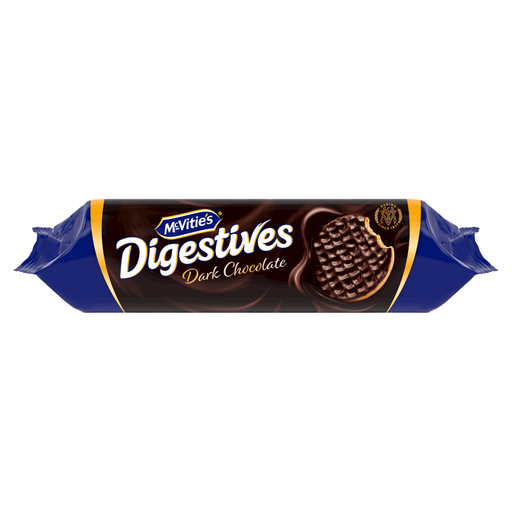 Image unavailable
This 400g pack covers a recipe calling for 300g of biscuits by weight. McVitie’s lists a 30% dark chocolate coating for its Dark Chocolate Digestives and butter oil from milk in the ingredients. Check the current pack and follow the recipe’s biscuit-to-butter quantities.
Yes. Good Food’s no-bake cheesecake recipe uses 300g of crushed chocolate digestives with 130g of melted butter for its base. Follow the quantities in your chosen recipe rather than treating those amounts as a rule for every biscuit.
No. Rakusen’s says chocolate makes up 20% of its biscuit and that the chocolate contains at least 52% cocoa solids. The two percentages describe different things.
Follow the directions on the pack you bought. For its 300g dark chocolate digestives, ASDA advises an airtight container after opening and consumption within seven days; another product’s instructions may differ.