What should you check?
Start with the coating if cocoa content matters, then compare a biscuit-sized portion and the practical details of taking some from an opened pack.
| Priority | What to check | Your needs |
|---|
| Cocoa declaration |
Find the minimum cocoa-solids percentage for the coating, not the percentage of the biscuit that is chocolate. Tesco Groceries states 48% for the chocolate on its checked 300 g pack; Sainsbury’s states 35% for its checked 300 g pack. |
I want a stated cocoa content so I can compare the chocolate coatings on the same basis. |
| Portion and nutrition |
Check the serving size and nutrition per biscuit. Tesco Groceries lists 85 kcal and 4.2 g sugars for one 17 g biscuit; Sainsbury’s lists 79 kcal and 3.5 g sugars per biscuit. For other pack sizes, compare per 100 g figures on the same basis. |
If I am eating a biscuit on the way out, I want to know what my portion contributes and decide what else to have for breakfast. |
| Ingredients and allergens |
Read the current pack’s ingredients and allergy advice. Tesco Groceries says its checked pack may contain milk; Sainsbury’s says its checked pack is not suitable for customers with an oat allergy due to manufacturing methods. |
I need to check the exact pack I will eat, rather than rely on the word ‘dark’ or an earlier online description. |
| Storage after opening |
Check how to store the remainder. The checked Tesco, Sainsbury’s and M&S listings call for an airtight container; ASDA says to consume its checked 300 g pack within seven days of opening. |
When I take a few biscuits out, I want to know how to keep the rest according to that pack’s instructions. |
Brand and product-line references
These details describe the specified dark chocolate digestive listings, not every product made by each brand.
Tesco
The checked Tesco Dark Chocolate Digestives 300 g pack gives a cocoa-solids declaration for its coating and nutrition per biscuit.
- Its dark chocolate states 48% minimum cocoa solids; one 17 g biscuit is listed at 85 kcal and 4.2 g sugars.
- The 48% figure describes the chocolate, not the whole biscuit. The allergy advice says the product may contain milk.
Sainsbury’s
The checked Sainsbury’s Dark Chocolate Digestives 300 g pack also declares cocoa solids in its coating.
- Its dark chocolate states 35% minimum cocoa solids, and the listing gives 79 kcal and 3.5 g sugars per biscuit.
- The listing says the product is not suitable for customers with an oat allergy due to manufacturing methods.
ASDA
The checked ASDA Dark Chocolate Digestives 300 g pack provides per-biscuit nutrition and an after-opening instruction.
- ASDA lists 82 kcal per biscuit and says to consume the opened pack within seven days.
- Dark chocolate makes up a stated 30% of the biscuit; that figure does not specify the coating’s cocoa-solids percentage.
McVitie’s
McVitie’s lists a dark chocolate digestive with nutrition information per biscuit.
- The manufacturer lists 83 kcal and 4.4 g sugars per biscuit for its checked product.
- Its stated 30% dark chocolate describes the proportion of the biscuit, not a cocoa-solids declaration for the coating.
M&S
M&S describes its checked dark chocolate digestives as containing demerara sugar for added crunch.
- The listing states that chocolate makes up 32% of the product and provides nutrition per 100 g.
- The chocolate proportion is not a cocoa-solids percentage, and the checked listing does not give nutrition per biscuit.
Dark chocolate digestives on Joybuy
These McVitie’s dark chocolate digestive packs are options to consider if you want biscuits to take with you. Check the exact pack’s cocoa declaration and nutrition if either detail determines your choice.
 No image available
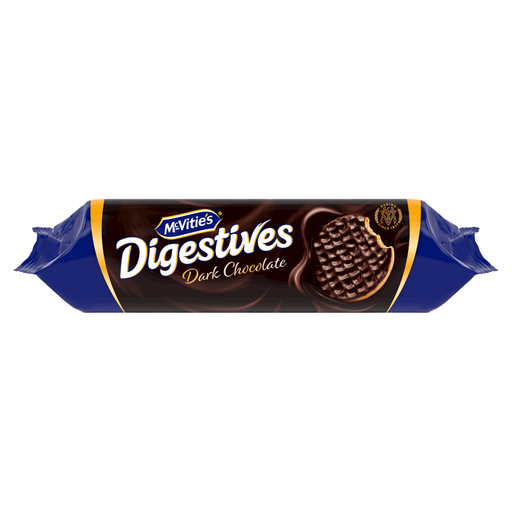
McVitie’s Digestives Dark Chocolate Twin Pack 2 x 266g
The twin-pack format may suit you if you want to take biscuits on more than one morning. Check the nutrition for the portion you take and read the current pack’s wheat, milk and soya allergy information before eating.
View on Joybuy
 No image available
McVitie’s Digestives Dark Chocolate 400g
This 400 g pack is another dark chocolate digestive option if a particular cocoa-solids declaration is not essential to your choice. Check the pack for a coating cocoa percentage if it matters to you, and read its nutrition and wheat, milk and soya allergy information before eating.
View on Joybuy
Questions about choosing and taking them out
Does 30% dark chocolate mean 30% cocoa?
No. On the checked McVitie’s and ASDA products, 30% describes the proportion of the biscuit that is dark chocolate. For cocoa content in the coating, look for a separate cocoa-solids declaration: Tesco Groceries states 48% minimum for its checked chocolate coating, and Sainsbury’s states 35% minimum for its checked coating.
Can I take dark chocolate digestives out without preparing them?
Yes, the checked products are ready-to-eat biscuits. If you take some from an opened pack, follow that pack’s storage instructions; ASDA specifies consuming its checked 300 g pack within seven days of opening.
Are dark chocolate digestives a balanced breakfast on their own?
Do not assume that a dark chocolate digestive alone makes a balanced breakfast. The NHS Eatwell Guide describes a balance of different foods across a day or week, while NHS guidance on sugar identifies biscuits and chocolate among foods containing free sugars.
What should I check if I have a food allergy?
Read the ingredients and allergy statements on the current physical pack before eating. The checked products differ in their milk and precautionary wording, and Sainsbury’s says its checked digestives are not suitable for customers with an oat allergy due to manufacturing methods.
Will every pack have a traffic-light nutrition label?
No. GOV.UK describes the UK colour-coded front-of-pack nutrition scheme as voluntary. Use the nutrition information available on the current pack when comparing biscuits, keeping the per-biscuit and per 100 g figures on their respective bases.


