Cocoa-focused hosts
If the chocolate’s cocoa content matters to you, look for a declared cocoa-solids percentage. Read it separately from the proportion of chocolate in the biscuit.


If a declared cocoa-solids figure is your priority, compare Tesco and Sainsbury’s dark chocolate digestives: Tesco Groceries states a minimum of 48% cocoa solids in its chocolate, while Sainsbury’s states a minimum of 35% in its chocolate. Neither figure describes the whole biscuit or establishes how it tastes with coffee. For a coffee morning, also compare pack servings and check the physical packaging for ingredients and allergen warnings before serving.
If the chocolate’s cocoa content matters to you, look for a declared cocoa-solids percentage. Read it separately from the proportion of chocolate in the biscuit.
Recipes and precautionary allergen warnings vary. Keep the original packs available so guests can check the ingredients relevant to them.
Compare the serving estimate or biscuit count for the precise pack you intend to put out. Equal pack weights do not necessarily mean equal listed serving estimates.
Start with the chocolate declaration if cocoa content drives your choice, then check the pack format and ingredients for the people you are serving.
| Priority | What to check | Your needs |
|---|---|---|
| Cocoa declaration | Compare cocoa-solids minima within the chocolate, not with whole-biscuit figures. Tesco Groceries states 48% minimum cocoa solids in chocolate comprising 30% of its biscuit; Sainsbury’s states 35% minimum in chocolate comprising 27% of its biscuit. | I want a declared figure for the chocolate rather than assuming that a dark coating tells me its cocoa content. Those figures alone cannot tell me which biscuit I would prefer with coffee. |
| Texture with coffee | Read texture descriptions as descriptions, not coffee-dunking test results. Tesco calls its biscuit crumbly and crunchy; Ocado’s M&S listing attributes a crunchier texture to demerara sugar. | If I plan to dunk biscuits, texture matters to me, but I will not treat a description or a result for a different biscuit variant as a tested advantage here. |
| Ingredients and allergens | Check the exact pack’s ingredient list and precautionary warnings, including those concerning milk, soya and wheat. Keep the packaging available when serving; the Food Standards Agency recommends this for community and charity events in England, Wales and Northern Ireland. | Guests need to be able to inspect the label for their own requirements. A dark chocolate coating does not mean a biscuit is milk-free. |
| Portions and storage | Check whether the listing gives a biscuit count or a serving estimate. Tesco Groceries lists 16 biscuits for McVitie’s 266g pack; Sainsbury’s lists approximately 18 servings for its 300g pack, while Ocado lists approximately 17 for M&S 300g. Follow the chosen pack’s after-opening instructions. | For a larger gathering, I would plan from the count or serving size on the pack I buy, rather than weight alone. Storage instructions also matter if there are leftovers. |
That makes the cocoa content of the chocolate sound like a percentage of the entire biscuit. Tesco Groceries, for example, gives separate figures for the chocolate’s cocoa-solids minimum and the chocolate’s share of the biscuit.
Read both figures and check that any percentages you compare describe the same part of each product.
The checked McVitie’s, Sainsbury’s, M&S and Asda product information lists milk-derived ingredients; Tesco’s listing says its biscuit may contain milk.
Keep the physical packaging for guests to check the full ingredients and warnings before eating.
Sainsbury’s and Ocado’s M&S listings give different approximate serving estimates for their respective 300g packs.
Use the serving estimate or biscuit count for the exact variant, and check the stated serving size when planning quantities.
These details concern the named dark chocolate digestives, not every biscuit made by each brand.
Tesco’s 300g dark chocolate digestives have a declared cocoa-solids minimum for their chocolate coating.
Sainsbury’s 300g dark chocolate digestives also have a declared cocoa-solids minimum.
McVitie’s dark chocolate digestives come in several pack formats; Tesco Groceries lists 16 biscuits for the 266g pack.
Ocado lists M&S dark chocolate digestives as a 300g pack with approximately 17 servings.
Asda’s 300g dark chocolate digestives are another dark-coated pack to compare by ingredients and storage instructions.
These McVitie’s dark chocolate digestive packs offer two quantities to consider for a coffee morning. Compare their pack sizes and check the physical label for guests’ allergens; neither product card supplies a comparable cocoa-solids declaration.
 Image unavailable
The twin-pack format gives you two 266g packs when planning for guests. McVitie’s describes its dark chocolate digestives as containing 30% dark chocolate; that is not a cocoa-solids figure. Check the physical packs for full ingredients and allergen warnings before serving.
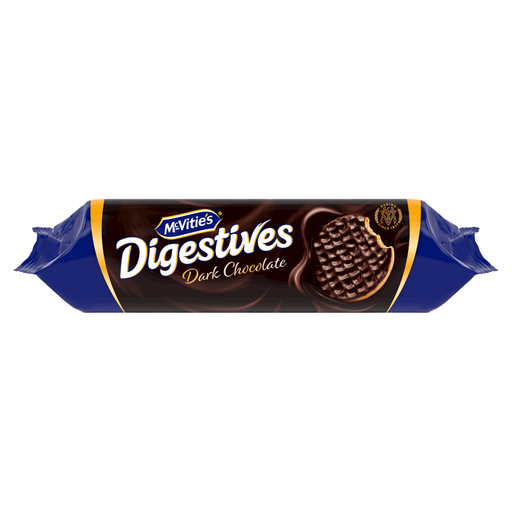 Image unavailable
The 400g pack is a different quantity to weigh against the twin pack for your gathering; check its own label for the serving information you need. McVitie’s describes the dark variant as containing 30% dark chocolate, which does not state the chocolate’s cocoa-solids content. Check the physical pack for full ingredients and allergen warnings.
No. Tesco Groceries states that dark chocolate makes up 30% of its biscuit and that the chocolate contains at least 48% cocoa solids. The two percentages have different bases.
No. The checked McVitie’s, Sainsbury’s, M&S and Asda product information lists milk-derived ingredients, while Tesco’s listing warns that its product may contain milk. Check the physical pack against each guest’s requirements.
Follow the instructions on the pack you bought. The checked Sainsbury’s and M&S listings specify an airtight container after opening; Asda additionally says to consume its biscuits within seven days of opening.
For community or charity events in England, Wales and Northern Ireland, Food Standards Agency guidance updated in September 2026 recommends keeping food packaging so guests can check it. If you are unsure whether your particular food activity requires registration, ask the local authority; it may decide that very limited, infrequent activity does not require it.