If cocoa information drives your choice of dark chocolate digestive, compare both the proportion of chocolate in the biscuit and the minimum cocoa-solids percentage of that chocolate: Tesco declares 30% dark chocolate with at least 48% cocoa solids, while Sainsbury's declares 27% with at least 35%, according to their product information. For tea-time crunch, M&S describes added demerara sugar; for a kosher requirement, Rakusen's is labelled KLBD and pareve, but the exact pack's ingredients and precautionary allergen statements still matter.
Who is comparing these biscuits?
The useful starting point depends on whether you care most about a declared cocoa level, the format of a tea-time pack or a particular dietary label.
Shoppers comparing cocoa declarations
If the word “dark” is not enough to guide your choice, look for both the chocolate percentage and a minimum cocoa-solids figure. The latter describes the chocolate component, not the biscuit as a whole or how it will taste.
Everyday biscuit-tin buyers
If you buy digestives regularly for tea, compare pack weight and the current price per kilogram rather than pack price alone. Think about how quickly you will use an opened pack, too.
Shoppers checking dietary labels
Vegetarian or kosher wording answers only the requirement it states. Read the ingredients and any “may contain” statement on the exact pack when wheat, milk, soya or other allergens are relevant.
What should you check before choosing?
Start with the label detail that matters to you, then compare pack format and current unit price; a chocolate percentage and a cocoa-solids minimum answer different questions.
| Priority | What to check | Your needs |
|---|
| Cocoa declaration |
Compare the percentage of the biscuit that is chocolate separately from the minimum cocoa solids in that chocolate. Tesco Groceries lists 30% dark chocolate with at least 48% cocoa solids; Sainsbury's lists 27% with at least 35%. |
I want a stated cocoa minimum, rather than choosing by the word “dark”. These figures describe ingredients, not a measured flavour or dunking result. |
| Texture with tea |
Check the described coating and ingredients. M&S describes demerara sugar as adding crunch; a tea-time description does not establish how long a biscuit will hold together when dunked. |
Crunch alongside a hot drink matters more to me than having a published cocoa-solids minimum. |
| Dietary labels |
Read the exact pack's ingredients, allergen statement and any relevant certification. The Food Standards Agency explains that precautionary allergen labelling communicates possible unintended allergen presence. |
I need to check whether this particular pack meets my dietary requirements; “dark”, “vegetarian” and “pareve” are not substitutes for its full allergen information. |
| Pack and value |
Compare pack weights and the current price per kilogram on the same basis. Check whether a displayed offer needs a loyalty card, and follow the pack's storage instructions after opening. |
A pack that suits how often we have biscuits with tea matters to me more than a lower shelf price on a different-sized pack. |
Which assumptions can mislead you?
-
Assuming “dark” means a particular cocoa level
Tesco and Sainsbury's publish minimum cocoa-solids figures for their dark chocolate, whereas the M&S and McVitie's product information considered here gives chocolate percentages without comparable cocoa minima. The product names alone cannot settle that comparison.
If cocoa content is your priority, check for a stated minimum for the chocolate component as well as the proportion of chocolate in the biscuit.
-
Treating one dietary claim as an answer to every requirement
A vegetarian biscuit can contain milk, and Rakusen's pareve-labelled product also carries precautionary statements for milk, egg and tree nuts.
Check the ingredients, precautionary wording and any certification on the exact pack against the requirement that matters to you.
-
Comparing pack prices without checking weight
A 200g pack, a 266g pack and a 300g pack are not directly comparable by shelf price. A conditional promotion can also change which price you see.
Compare the current price per kilogram, distinguish regular prices from offers, and choose a pack size you can store appropriately after opening.
What do the brand labels tell you?
These examples show different label details worth comparing; a brand name alone does not establish the cocoa level, texture or dietary suitability of every product it makes.
Tesco
Tesco's 300g dark chocolate digestives give shoppers two distinct cocoa figures to compare.
- Tesco Groceries lists 30% dark chocolate and a minimum of 48% cocoa solids in that chocolate.
- The biscuit is half-coated; its label lists wheat and soya and says it may contain milk.
Sainsbury's
Sainsbury's 300g own-label pack provides both a chocolate percentage and a cocoa-solids minimum.
- Its product information lists 27% dark chocolate with at least 35% cocoa solids in the chocolate.
- It contains wheat, milk and soya; Sainsbury's also says it is not suitable for customers with an oat allergy because of manufacturing methods.
McVitie's
The McVitie's 266g dark chocolate digestives listing offers a branded biscuit with a declared chocolate proportion.
- Tesco Groceries lists its dark chocolate content as 30%.
- That listing does not give a minimum cocoa-solids figure, so its chocolate cannot be compared on that measure with products that declare one.
M&S
M&S describes its dark chocolate digestives as an option to eat with tea or coffee.
- M&S describes demerara sugar as adding crunch and lists chocolate as 32% of the biscuit.
- Its product information does not give a minimum cocoa-solids figure; the ingredients include wheat, milk fat, soya and barley malt extract.
Rakusen's
Rakusen's 200g dark chocolate digestives are relevant when a kosher label is part of the buying decision.
- The product is labelled kosher, KLBD and pareve, and suitable for vegetarians.
- It is marked as not for Passover use and may contain egg, milk and tree nuts.
Dark chocolate digestives on Joybuy
These McVitie's options cover a twin pack and a single 400g pack for the tea-and-biscuits occasion. Check the label of the pack you choose for cocoa and dietary details; the brand's other pack sizes do not establish the specifications of these variants.
 No image available
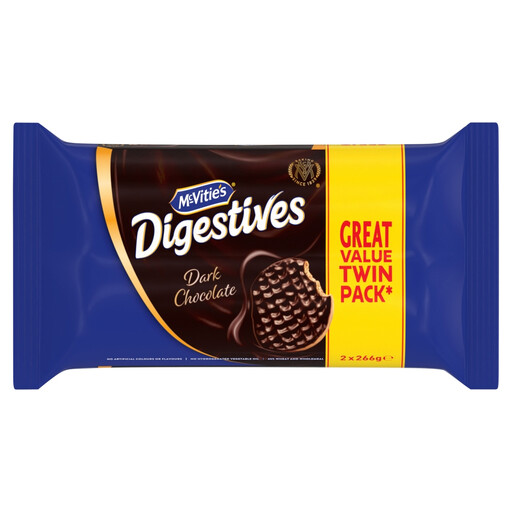
McVitie's Digestives Dark Chocolate Twin Pack, 2 x 266g
For biscuits across several tea breaks, this option is a twin pack of two 266g packs.
Check the actual pack's cocoa declaration before choosing it for a particular cocoa level. The product information flags wheat, milk and soya, so read the pack's allergen statement if these matter to you.
View on Joybuy
 No image available
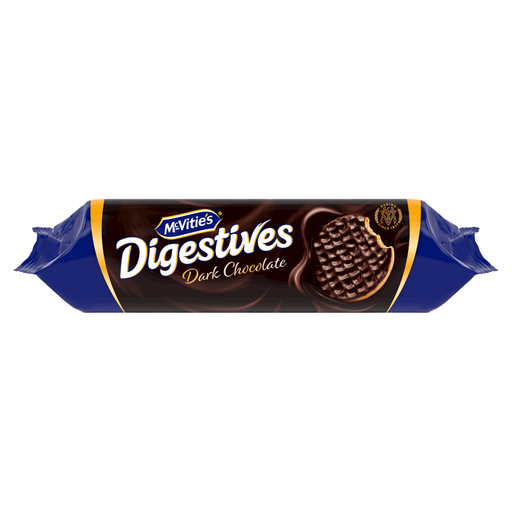
McVitie's Digestives Dark Chocolate 400g
If you prefer one larger pack for the biscuit tin, this option is labelled 400g.
Check its own chocolate and cocoa-solids declarations rather than applying figures from another pack size. The product information flags wheat, milk and soya; consult the exact pack for its full allergen statement.
View on Joybuy
Questions about dark chocolate digestives
Does “dark chocolate digestive” tell me how much cocoa it contains?
No. Compare the proportion of chocolate in the biscuit with any stated minimum cocoa solids in that chocolate. Tesco Groceries lists 30% dark chocolate with at least 48% cocoa solids for its own-label product; Sainsbury's lists 27% with at least 35%. A chocolate percentage on its own does not supply a cocoa-solids minimum.
Are dark chocolate digestives necessarily dairy-free or vegan?
No. The Sainsbury's, McVitie's and M&S products described here include milk-derived ingredients, while Tesco's own-label label says it may contain milk. Rakusen's is labelled pareve but also carries a precautionary milk statement. Check the exact pack's ingredients and allergen wording for your requirement.
What should I check if a biscuit allergen matters to me?
Read the ingredients and allergen information on the exact pack, including any “may contain” wording. The Food Standards Agency explains that precautionary allergen labelling communicates possible unintended presence of a regulated allergen; it is different from an ingredient declaration.
How should I store dark chocolate digestives after opening?
Follow the storage instructions on your pack. Tesco, Sainsbury's, M&S and Rakusen's give guidance to keep their products cool and dry and to use airtight storage after opening.


