Hosts comparing cocoa content
If cocoa character is your priority, look for a cocoa-solids declaration for the chocolate. The percentage of the biscuit covered in chocolate answers a different question.


If a declared cocoa-solids figure matters most, Tesco lists a 48% minimum for the chocolate on its dark-chocolate digestives, while Sainsbury's lists 35%. Those figures describe the chocolate, not the whole biscuit: also check the coating proportion, pack quantity, allergens and storage directions before choosing what to serve outdoors.
If cocoa character is your priority, look for a cocoa-solids declaration for the chocolate. The percentage of the biscuit covered in chocolate answers a different question.
Keep the packaging or its ingredient information available when serving biscuits loose. Check the exact pack and guests' requirements rather than assuming that dark chocolate is free from milk or other allergens.
Consider pack weight alongside any stated biscuit or serving count, then follow the pack's storage directions before and during the gathering.
Start with the chocolate declaration if cocoa content drives the choice, then check whether the quantity and ingredient information work for your guests.
| Priority | What to check | Your needs |
|---|---|---|
| Cocoa content | Compare cocoa-solids minimums for the chocolate where declared. Tesco states 48%; Sainsbury's states 35%. | I want a stated measure of the chocolate's cocoa content rather than relying on the word ‘dark’. |
| Amount of coating | Read the dark-chocolate percentage in the ingredients separately. Tesco lists 30% of the biscuit; Sainsbury's lists 27%. Neither figure is its cocoa-solids percentage. | How much of each biscuit is chocolate matters to me as well as what the chocolate contains. |
| Quantity | Check pack weight and any stated biscuit or serving count. Sainsbury's describes approximately 18 servings in its 300g pack; McVitie's lists 16 biscuits for the recipe shown on its product page. | I'm putting biscuits out for a group and need to judge how many packs to buy. |
| Allergens | Read the exact pack's ingredients and precautionary statements. Tesco says its product may contain milk; Sainsbury's also gives an oat-allergy warning linked to manufacturing methods. | Guests need to be able to check the biscuits actually served, particularly if I take them out of their packets. |
| Texture and storage | M&S attributes added crunch to demerara sugar in its recipe. Follow each pack's storage directions; ASDA specifies a cool, dry place away from direct sunlight and an airtight container after opening. | I'd like a texture my guests may enjoy, without leaving the biscuits in unsuitable conditions outdoors. |
A biscuit listed as 30% dark chocolate is not thereby made with chocolate containing 30% cocoa solids. The two percentages describe different parts of the recipe.
Compare cocoa-solids declarations with cocoa-solids declarations, and use the chocolate's share of the biscuit to assess coating quantity.
Dark-chocolate digestive listings can include milk ingredients or a precautionary milk statement, as well as other allergens.
Check the pack you serve against each guest's requirements, and keep its ingredient information available if the biscuits are put out loose.
These product-line details help distinguish the listed biscuits; a coating percentage alone does not establish which chocolate has more cocoa solids.
Dark-chocolate digestives offered in several pack sizes.
A 300g own-label dark-chocolate digestive with separate figures for cocoa solids and coating quantity.
A 300g own-label option with declared cocoa solids, coating proportion and approximate servings.
A 300g own-label dark-chocolate digestive with a stated coating proportion.
A 300g dark-chocolate digestive whose listed recipe includes demerara sugar.
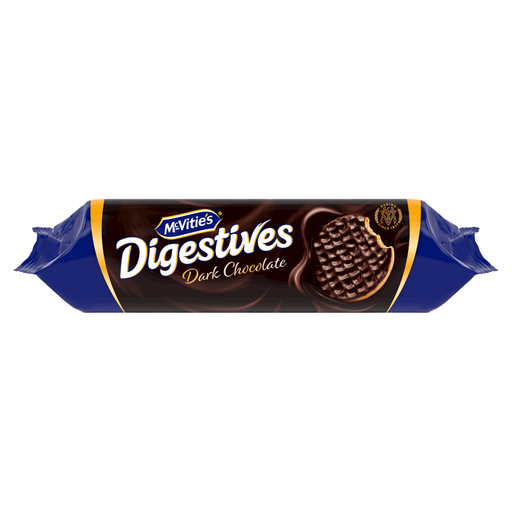
These McVitie's dark-chocolate digestive packs offer two quantities for a garden-party spread. Choose by the amount you need, and check the exact pack if a cocoa-solids declaration or particular allergen information is essential.
 No image available
The two 266g packs let you open one at a time when serving a group. Check the pack's cocoa and allergen declarations before serving guests with specific requirements.
 No image available
This single 400g pack is another quantity to consider for a shared table. If cocoa content or allergens affect your choice, check the declarations on the pack you buy.
No. It describes the chocolate's share of the biscuit, whereas a cocoa-solids minimum describes the chocolate itself. Tesco lists 48% minimum cocoa solids in its chocolate and 30% dark chocolate in its biscuit; Sainsbury's lists 35% and 27% respectively.
No. The listed McVitie's and Sainsbury's recipes include milk ingredients, and Tesco says its product may contain milk. Check the exact pack and the guest's specific allergens before serving.
Follow the pack's storage directions and keep its ingredient information available if you serve the biscuits loose. ASDA specifies storage away from direct sunlight and an airtight container after opening; check the directions for whichever product you choose.
No. The Department of Health & Social Care's guidance on HFSS promotion and placement concerns specified activities by businesses selling in England, not food served at an ordinary private party. It does not, by itself, establish an HFSS classification for a particular packet of biscuits.
Check whether England's school-food standards apply to the food provided at that event. The Department for Education's practical guide addresses chocolate-coated products across the school day; its proposed changes for September 2027 are subject to Parliamentary approval, so they should not be treated as rules already in force.