Shoppers looking for a stated cocoa level
If cocoa content matters more than the word “dark”, Tesco states a minimum of 48% cocoa solids in its chocolate. Check the current pack for the figure you require.


Choose by the information on the pack, not by assuming that “dark” means a particular cocoa level or less sugar. Tesco states that the chocolate in its dark chocolate digestives contains at least 48% cocoa solids; McVitie's and M&S describe dark chocolate coatings without stating a cocoa-solids percentage in their product information. For an afternoon portion, compare the nutrition on the same serving basis and check the current allergen label.
If cocoa content matters more than the word “dark”, Tesco states a minimum of 48% cocoa solids in its chocolate. Check the current pack for the figure you require.
McVitie's lists 83 kcal per biscuit and Tesco lists 85 kcal per biscuit in their product information. Check biscuit size and use the per-biscuit panel when deciding on a serving.
The product information for these dark chocolate digestives lists wheat, milk or soya as ingredients or possible allergens. Read the current pack for the particular biscuit you intend to buy.
Start with the cocoa information if flavour is your deciding factor, then compare portions and check the ingredients on the exact pack.
| Priority | What to check | Your needs |
|---|---|---|
| Cocoa content | Look for a cocoa-solids percentage, not just the proportion of the biscuit coated in chocolate. Tesco states at least 48% cocoa solids in its dark chocolate; McVitie's and M&S state coating proportions but no cocoa-solids figure in their product information. | I want a stated cocoa threshold rather than relying on a “dark chocolate” description. |
| Portion and nutrition | Compare per-biscuit figures for biscuits of similar size, or use per-100g figures for a consistent basis. McVitie's lists 83 kcal and Tesco 85 kcal per biscuit; both list 2.1g saturated fat per biscuit. | For a biscuit with tea or coffee, I want to know what the portion I plan to eat contains. |
| Ingredients and allergens | Read the current ingredients and allergen statement. McVitie's lists wheat, milk and soya; Tesco lists wheat and soya and says it may contain milk; M&S lists wheat, milk, soya and barley malt extract. | I need to check whether the particular pack fits my ingredient requirements, rather than assuming dark chocolate is milk-free. |
A dark chocolate description does not establish a cocoa-solids percentage or a sugar comparison with another biscuit.
Check the cocoa-solids figure if you have a threshold in mind, and compare sugar figures on the same per-100g or per-biscuit basis.
Ingredients and allergen statements can change, and the dark chocolate digestives described here list or flag wheat, milk and soya differently.
Read the physical pack each time, especially if you are changing product or pack size.
England's rules on promotions of certain foods by qualifying retailers address a different question from school-food requirements. A promotion rule alone does not determine whether a particular biscuit can be served in a school meal.
For school catering, check the school-food requirements that apply in the relevant nation and setting rather than relying on an assumed HFSS classification.
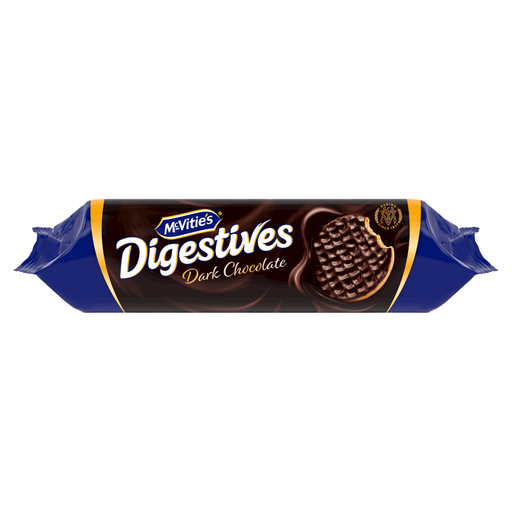
A wheatmeal dark chocolate digestive for shoppers who prefer the familiar McVitie's format with tea or coffee.
An own-label dark chocolate digestive with a stated cocoa standard for its chocolate.
An own-label digestive that M&S describes as having dark chocolate and demerara sugar for added crunch.
These are McVitie's dark chocolate digestives in a twin pack and a 400g pack for shoppers considering that format for an afternoon snack.
 No image available
For an afternoon biscuit with tea or coffee, this format contains two 266g packs. Check the current pack for per-biscuit nutrition, any cocoa-solids figure you require, and its wheat, milk and soya information.
 No image available
For an afternoon snack, this is a single 400g pack rather than the twin-pack format. Check its current serving information and wheat, milk and soya statement; the word “dark” alone does not establish a cocoa-solids percentage.
No particular cocoa-solids percentage follows from the word “dark”. Tesco states that its dark chocolate contains at least 48% cocoa solids; McVitie's and M&S do not state a cocoa-solids figure in their product information. If the figure matters to you, check the current pack.
The chocolate description alone cannot establish that comparison. McVitie's lists 4.4g sugars per biscuit and Tesco lists 4.2g for their dark chocolate digestives; compare the nutrition panels of the particular dark and milk chocolate products on the same basis.
Check the current pack for cereals containing gluten, milk and soya. McVitie's lists wheat, milk and soya; Tesco lists wheat and soya and says it may contain milk; M&S lists wheat, milk, soya and barley malt extract. Ingredients can change, so use the label on the biscuit you buy.