Night-shift treat planners
You want biscuits for a break and need to decide how many to take, alongside food for the rest of your shift.


If a declared cocoa figure matters to you, check whether it describes the chocolate coating or the whole biscuit: Tesco states that the coating on its 300g dark chocolate digestives contains at least 48% cocoa solids. For a night-shift break, also compare sugars and saturates per 100g, choose a pack size you can portion and check the current allergen label.
You want biscuits for a break and need to decide how many to take, alongside food for the rest of your shift.
You want to know whether a percentage refers to cocoa solids in the coating or to the amount of chocolate in the biscuit.
You need to check the current pack for wheat, milk and soya information rather than assume all dark chocolate digestives have the same recipe.
Start with the label detail that matters to you, then compare nutrition on the same basis and plan how you will use the pack across shifts.
| Priority | What to check | Your needs |
|---|---|---|
| Break-time portions | Check the pack size, per-biscuit information where given and instructions for storing an opened pack. | I want to take a planned portion to work rather than carry an open packet through several breaks. |
| Cocoa labelling | Tesco states a minimum of 48% cocoa solids in the chocolate on its 300g digestives. A figure such as McVitie's 30% dark-chocolate ingredient describes how much of the biscuit is chocolate, not the coating's cocoa-solids content. | If a stated cocoa percentage is important to me, I need to check what it measures; it cannot, by itself, settle which biscuit I will prefer. |
| Sugars and saturates | Compare both figures per 100g on the current packs, rather than comparing a per-biscuit figure with a per-100g figure. Serving sizes can differ. | I want to compare the biscuits on the same weight basis, especially if I expect to take them to work regularly. |
| Ingredients and allergens | Read the physical pack's ingredients and precautionary statements for wheat, milk and soya. Asda lists milk fat; Tesco says its dark chocolate digestives may contain milk. | I need a pack whose current label meets my ingredient or allergy requirements, not just a dark-chocolate description online. |
McVitie's lists dark chocolate as 30% of its biscuit, while Tesco's minimum 48% cocoa-solids figure describes its chocolate coating. Those percentages measure different things.
If the coating's cocoa content affects your choice, look for an explicit cocoa-solids statement for that product.
A chocolate-coated biscuit is one possible break-time food, but it does not tell you what you will have for other breaks. The British Dietetic Association discusses drinks, lighter meals or snacks during night shifts.
Decide how many biscuits to take and plan the rest of your shift food separately.
Dark-chocolate labels do not establish whether a particular biscuit contains milk or carries a precautionary milk statement.
Check the current physical pack's ingredient and allergen information before choosing a biscuit you need to avoid an ingredient in.
These product lines offer different label details to compare; a brand name alone does not establish the coating's cocoa content or the pack's allergen information.
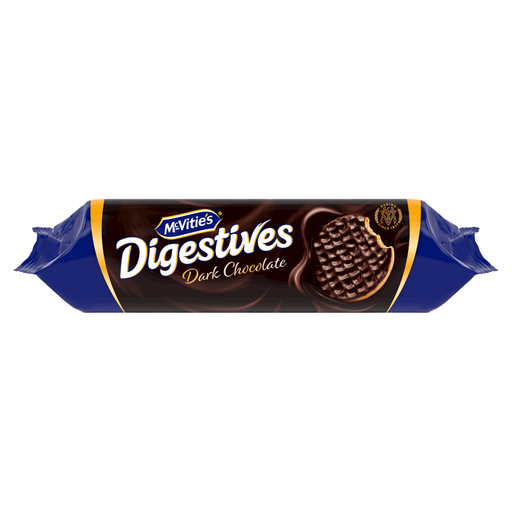
McVitie's lists dark chocolate digestives in several pack sizes.
Tesco lists a 300g own-label dark chocolate digestive.
Asda lists a 300g own-label dark chocolate digestive.
M&S describes its 300g dark chocolate digestives as having demerara sugar for crunch.
These McVitie's dark chocolate digestive packs offer two sizes to consider for night-shift breaks. Check the current pack if its cocoa or allergen details will determine your choice.
 No image available
The two 266g packs let you open one at a time if you are taking biscuits across shifts. Check the physical pack for its cocoa statement, storage instructions and current allergen information.
 No image available
This single 400g pack is another size to portion for breaks. Check how the pack says to store it after opening, and read its current wheat, milk and soya information if those ingredients matter to you.
Plan food for the shift rather than relying on biscuits as the only thing you take. The British Dietetic Association discusses breaks with drinks, lighter meals or snacks during night work, and an NHS dietitian advises planning food ahead.
Not necessarily: the coating's cocoa description does not state the sugar content of the whole biscuit. The checked McVitie's, M&S, Tesco and Asda dark variants list between 24.7g and 29.2g sugars per 100g, so compare the current nutrition panels on that basis.
No. A 30% dark-chocolate ingredient figure describes the proportion of the biscuit made up of chocolate. A cocoa-solids percentage describes the chocolate itself; Tesco states a minimum of 48% cocoa solids in the coating on its 300g digestives.
Follow that packet's storage instructions after opening. Asda says to keep its dark chocolate digestives cool and dry, then store them airtight and consume them within seven days of opening; the Tesco and M&S listings also specify airtight storage after opening.
Read the physical packet before eating the biscuits if an ingredient or allergen matters to you. Recipes and online listings can change; contact the seller if the item delivered is not what you ordered.