Cocoa-led shoppers
If the word ‘dark’ is not specific enough for you, look for a cocoa-solids figure for the chocolate itself. Tesco and Sainsbury's publish different minimum figures for their coatings; those figures are not a taste ranking.


If a stated cocoa concentration matters most, start with the chocolate coating: Tesco lists at least 48% cocoa solids and Sainsbury's at least 35%, neither of which describes the whole biscuit. For a morning tea break, also consider the biscuit style, compare sugars per 100g and check the exact pack's allergy information; a dark coating does not by itself mean low sugar or milk-free.
If the word ‘dark’ is not specific enough for you, look for a cocoa-solids figure for the chocolate itself. Tesco and Sainsbury's publish different minimum figures for their coatings; those figures are not a taste ranking.
For a regular tea break, you may care about the biscuit's stated texture, serving size and sugars. Compare nutrition per 100g when biscuits differ in weight, then use the per-biscuit figure to understand the portion you plan to serve.
Check the ingredients and precautionary statements on the pack you intend to buy. Milk, cereals and soya appear in different declarations across these products, and Sainsbury's also warns customers with an oat allergy about its manufacturing methods.
Start with what you mean by ‘dark’, then check the biscuit and the label details that matter for your tea break.
| Priority | What to check | Your needs |
|---|---|---|
| Cocoa specification | Tesco Groceries states at least 48% cocoa solids in the chocolate on its 300g digestive; Sainsbury's states at least 35% for its 300g product. Their chocolate makes up 30% and 27% of the respective biscuits. Keep coating concentration separate from coating quantity. | I want a stated cocoa-solids minimum, rather than choosing by the word ‘dark’ alone. Neither figure tells me how the complete biscuit will taste. |
| Biscuit style | Tesco describes its biscuit as crumbly and crunchy and suggests dunking it. M&S describes a demerara-sugar biscuit with a crunchier texture. These are seller descriptions, not comparative texture or dunking tests. | Alongside tea, I may prefer one stated biscuit style over another without assuming either will hold together longer when dunked. |
| Sugars and portion | Compare sugars per 100g across packs, then check the weight and sugars per biscuit for the portion you serve. Listings from Sainsbury's, Tesco Groceries, ASDA Groceries, Tesco Groceries for McVitie's, and Ocado for M&S respectively give 22.1g, 24.7g, 25g, 26.6g and 29.2g sugars per 100g for the specified products. | For my tea break, I want to understand both a like-for-like nutrition comparison and what the labelled biscuit portion contains. ‘Dark’ is not a substitute for reading the sugars figure. |
| Allergen declarations | Read both the ingredients and any ‘may contain’ or manufacturing warnings on the exact pack. ASDA lists milk, soya and wheat for its digestive; Tesco says its product may contain milk; Sainsbury's warns customers with an oat allergy. | If an allergy affects my choice, I need the declaration for the biscuit I will actually serve, not an assumption based on its chocolate colour. |
| Pack format | Check the stated weight and whether the listing is for one pack or several. The examined own-label products are 300g packs, while the examined McVitie's listing is 266g; the Joybuy options below have their own stated pack formats. | I want a pack format that fits how often I serve biscuits, without confusing a twin pack with a single pack. |
Tesco Groceries states that dark chocolate is 30% of its digestive and that this chocolate contains at least 48% cocoa solids. The two percentages have different denominators.
If cocoa concentration is your deciding factor, find the cocoa-solids statement for the chocolate rather than using the proportion of chocolate in the whole biscuit.
Dark chocolate digestives still have labelled sugars, and milk can be an ingredient or appear in a precautionary warning. For example, ASDA lists milk in its product and Tesco says its product may contain milk.
Compare sugars per 100g and read the actual pack's ingredients and allergy advice before serving it to someone with a relevant allergy.
Coating and ingredient details below refer to particular listed biscuits, not every product made by each brand.
Its 300g dark chocolate digestives have a stated cocoa-solids minimum for the chocolate.
Its listed 300g dark chocolate digestives disclose both coating cocoa solids and nutrition per biscuit.
ASDA describes its 300g dark chocolate digestives as crisp, with a dark chocolate topping.
M&S describes a demerara-sugar biscuit style for its dark chocolate digestives listed by Ocado.
McVitie's offers a dark chocolate digestive with a wheatmeal-biscuit style.
The Crawford's Digestives 400g listing from Iceland Foods describes plain digestives.
These McVitie's dark chocolate digestive listings offer a twin pack and a 400g pack for a morning tea break. Choose by the pack format you need, and check each pack's nutrition and allergen label for the variant you buy.
 No image available
For tea breaks where pack format matters, this listing is for two 266g packs of dark chocolate digestives. Check the packs' cocoa-solids statement, sugars and allergen declarations if those details determine your choice.
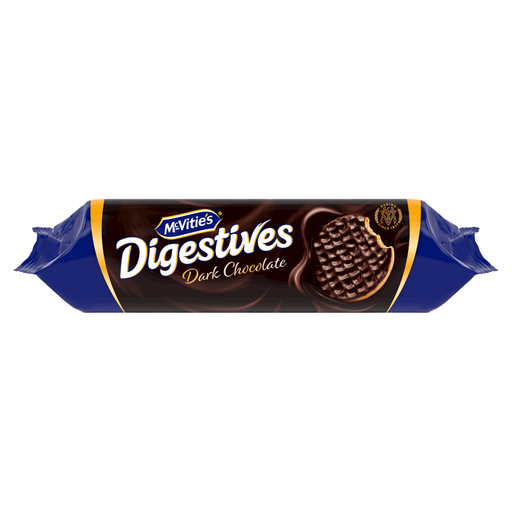 No image available
This 400g dark chocolate digestive listing is a single-pack alternative to the twin pack. Use this variant's label for its sugars, cocoa-solids information and allergen declarations rather than applying figures from another pack.
No. Tesco Groceries says the chocolate contains at least 48% cocoa solids and separately states that dark chocolate makes up 30% of its 300g digestive. The first figure describes the chocolate; the second describes its share of the biscuit.
No. ASDA's and M&S's listed dark chocolate digestives contain milk, while Tesco's listing says its product may contain milk. If you need to avoid milk, check the ingredients and precautionary wording on the specific pack; GOV.UK explains that specified allergens in prepacked food ingredients must be clearly labelled.
Follow the directions on that pack. The listed Tesco, Sainsbury's, M&S and McVitie's products advise using an airtight container after opening; ASDA Groceries also advises consuming its listed digestive within seven days of opening. Check the pack's storage instructions and best-before date.