Hosts looking for a declared cocoa level
If the word “dark” is not enough to make the choice, compare the chocolate’s stated cocoa-solids minimum. Tesco declares 48% and Sainsbury’s declares 35% for their respective 300g digestives.


Tesco’s dark chocolate digestives suit a host who wants a declared cocoa-solids minimum: Tesco states 48% for the chocolate, compared with Sainsbury’s 35%. Sainsbury’s declares 3.5g sugars per biscuit, while M&S describes a demerara-sugar crunch but gives a chocolate ingredient share rather than a cocoa-solids figure. For a shared table, check the current packs for allergens before serving.
If the word “dark” is not enough to make the choice, compare the chocolate’s stated cocoa-solids minimum. Tesco declares 48% and Sainsbury’s declares 35% for their respective 300g digestives.
Pack weight and format matter when deciding how many biscuits to bring and how much to put out at once. Tesco and Sainsbury’s each list a 300g pack.
Check each physical pack before putting biscuits on a communal table. The compared labels identify wheat or gluten and soya, while milk is present or may be present depending on the product.
Start with the chocolate declaration if a darker cocoa profile matters, then compare pack format and the labels relevant to everyone sharing the biscuits.
| Priority | What to check | Your needs |
|---|---|---|
| Cocoa declaration | Tesco declares at least 48% cocoa solids in its dark chocolate; Sainsbury’s declares at least 35%. M&S lists chocolate as 32% of its recipe, a different measure that cannot establish its cocoa-solids level. | I want a stated cocoa minimum rather than choosing by the word “dark” on the pack. |
| Pack format | Check the net weight and whether the biscuits come in one pack or several. The listed Tesco and Sainsbury’s packs are 300g; the McVitie’s options below are 400g and 2 x 266g. | For a shared table, I want to decide how much to bring and whether to open one pack at a time. |
| Allergens | Read the current ingredient and precautionary statements on every pack. Tesco lists wheat and soya and may contain milk; Sainsbury’s lists wheat, milk and soya and warns people with an oat allergy. | Guests need to be able to identify which biscuits, if any, meet their allergen requirements. |
| Nutrition and serving | Compare nutrition on the same per-biscuit or per-100g basis; Sainsbury’s declares 3.5g sugars per biscuit. Keep the packaging available when biscuits are transferred to a serving container. | I want to see the relevant label information and keep it accessible beside the shared food. |
Tesco states a 48% cocoa-solids minimum and Sainsbury’s states 35%. M&S gives chocolate as a share of the recipe, which is not the same measurement.
Compare cocoa-solids declarations where available; do not substitute a chocolate ingredient percentage for them.
The compared biscuits have differing milk statements, and Sainsbury’s also carries an oat-allergy warning.
Keep each original pack beside its biscuits and check the current label before serving anyone with an allergy.
Department for Education guidance concerns food supplied in state-funded schools in England. England’s School Food Regulations define confectionery to include products wholly or partly coated with chocolate.
If a school is providing the food, ask its organiser or catering provider which requirements apply. Do not assume that school-food rules govern a private street party.
Tesco’s 300g dark chocolate digestives provide a stated cocoa-solids minimum for the chocolate coating.
Sainsbury’s 300g dark chocolate digestives state both a cocoa minimum and sugars per biscuit.
M&S describes its dark chocolate digestives as combining a chocolate coating with demerara sugar for added crunch.
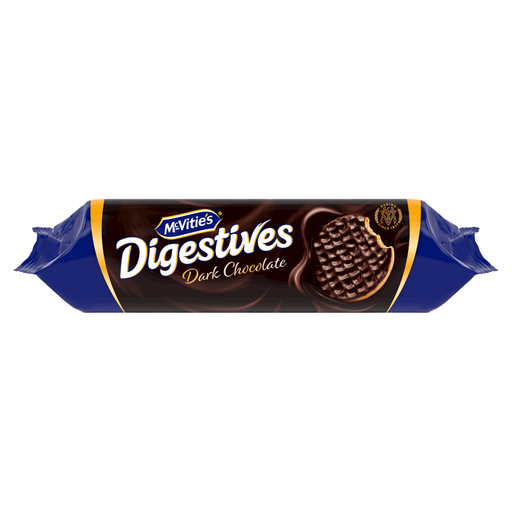
McVitie’s dark chocolate digestives appear in the product options below as a 400g pack and a twin pack of 2 x 266g.
These McVitie’s dark chocolate digestive packs offer two formats for a shared street-party table. If a declared cocoa-solids minimum is your deciding factor, check the current pack rather than assuming the formats have the same declaration.
 No image available
Two 266g packs let you choose how many to open for the shared table. Check the current packaging for its cocoa declaration and for wheat, milk and soya information before serving.
 No image available
This is a single 400g pack for a shared biscuit table. If cocoa-solids content matters to your choice, check its declaration on the current pack, along with the wheat, milk and soya information.
Tesco declares at least 48% cocoa solids in the dark chocolate on its 300g digestives, while Sainsbury’s declares at least 35% on its 300g product. M&S lists chocolate as 32% of the recipe, which is not a cocoa-solids figure.
Keep them cool and dry before serving, and keep biscuits left in an opened pack in an airtight container, in line with the compared retailers’ storage advice. Bringing out smaller amounts while keeping the rest sealed also leaves the original packaging available for ingredient checks.
Suitability depends on the exact pack and the guest’s allergens. Tesco lists wheat and soya and may contain milk; Sainsbury’s lists wheat, milk and soya and warns people with an oat allergy; M&S lists gluten, milk and soya. Check the physical pack used at the party and keep its label available.
The Department for Education’s school-food guidance addresses food supplied in state-funded schools in England, not every private street party. England’s School Food Regulations define confectionery to include products wholly or partly coated with chocolate. If the event’s food is supplied by a school, check the applicable requirements with its organiser or catering provider.