Hosts comparing cocoa disclosure
If the word “dark” is not enough to guide your choice, Tesco and Sainsbury’s each state a cocoa-solids minimum for the chocolate on their 300g packs.


If a declared cocoa-solids minimum matters, Tesco’s 300g dark-chocolate digestives state at least 48% in the coating, while Sainsbury’s 300g pack states at least 35%, according to their respective listings. Those figures describe the chocolate, not the whole biscuit or which flavour guests will prefer. For a party, also consider how you will serve the packs and check their ingredient and allergen labels.
If the word “dark” is not enough to guide your choice, Tesco and Sainsbury’s each state a cocoa-solids minimum for the chocolate on their 300g packs.
You can set out dark-chocolate digestives alongside a clearly identified plain option. Crawford’s describes a plain wholemeal-wheat digestive; it is not a dark-chocolate choice.
Read the packs you receive before serving. McVitie’s lists butter oil containing milk in its dark-chocolate digestives, and Tesco states that its pack may contain milk.
Start with the measurement that matters to you: cocoa solids in the coating, chocolate as a share of the biscuit, and pack size answer different questions.
| Priority | What to check | Your needs |
|---|---|---|
| Cocoa disclosure | Look for a cocoa-solids minimum on the exact pack. Tesco states 48% and Sainsbury’s 35% for their respective dark-chocolate coatings; neither figure measures the whole biscuit. | I want a declared cocoa figure rather than choosing by the word “dark” alone. |
| Amount of chocolate | Check the chocolate’s share of the biscuit separately from its cocoa content. Tesco states 30%, Sainsbury’s 27% and M&S 32% for their listed biscuits. | If the amount of coating matters to me, I need to compare that measurement on its own—not treat it as a cocoa-solids figure. |
| Serving a group | Compare pack weights and any stated biscuit counts when deciding how many packs to open. McVitie’s lists a typical 16 biscuits per pack for its Dark Chocolate Digestives. | I would like to put out enough biscuits without opening every pack at once. |
| Ingredients and storage | Read each delivered pack’s ingredients and allergen precautions. For opened packs, follow its storage directions; M&S advises an airtight container. | Some guests may need ingredient information, and I may serve biscuits in stages through the evening. |
Tesco lists both 30% dark chocolate in the biscuit and a 48% minimum cocoa-solids content in that chocolate. The percentages have different denominators.
If cocoa content guides your choice, look for the cocoa-solids statement on the exact pack.
McVitie’s lists butter oil containing milk, while Tesco states that its dark-chocolate digestives may contain milk.
Check each delivered pack and keep its identifying packaging available when serving guests with allergies.
A cocoa-solids figure in a Joybuy description of a McVitie’s twin pack is not stated on the examined McVitie’s product page, which instead specifies the amount of dark chocolate in the biscuit.
If that cocoa figure would decide your purchase, check the exact pack rather than using it to place the twin pack alongside Tesco’s or Sainsbury’s declared cocoa minimums.
These pack descriptions help distinguish the options; a brand name alone does not establish cocoa content or allergen suitability.
Tesco’s listed 300g dark-chocolate digestives disclose both the coating’s cocoa minimum and its share of the biscuit.
Sainsbury’s listed 300g pack also gives a cocoa-solids minimum for its dark-chocolate coating.
M&S describes its 300g dark-chocolate digestives as containing demerara sugar for added crunch.
McVitie’s manufacturer listing describes its Dark Chocolate Digestives and gives a typical biscuit count.
Asda’s listed 300g dark-chocolate digestives include specific directions for an opened pack.
Crawford’s describes a plain wholemeal-wheat digestive that could be served as a separately identified option.
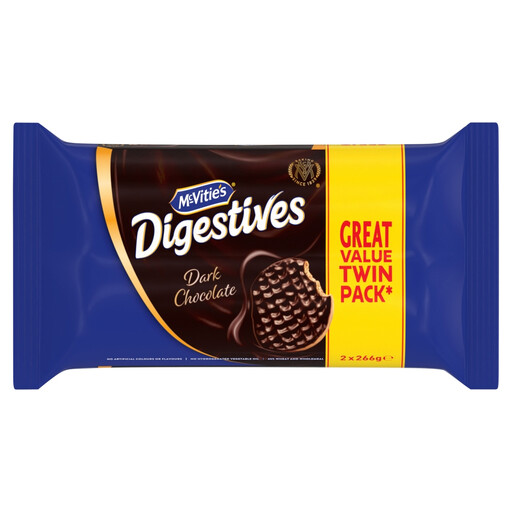
This twin pack is an option for serving McVitie’s dark-chocolate digestives at a party; choose by its pack format and ingredients rather than an assumed cocoa-solids minimum.
 No image available
The two 266g packs can be opened at separate points during a party. Check the delivered packs before serving guests with allergies: McVitie’s Dark Chocolate Digestives ingredient list includes butter oil (milk).
No. McVitie’s lists butter oil containing milk, and Tesco says its pack may contain milk. For a guest with an allergy, check the ingredients and precautionary statements on the pack you receive before serving.
Follow each pack’s directions. M&S and Sainsbury’s advise storing opened biscuits in an airtight container; Asda also says to consume its biscuits within seven days of opening.
Check the date and storage instructions on the packs you receive. UK government guidance says a best-before date concerns quality, whereas a use-by date concerns safety.
No: the Department for Education’s school-food guidance concerns food provided in state-funded schools in England, not a private gathering. If the event is school-provided, assess the applicable rules separately; England’s 2014 school-food regulations include chocolate-coated products in their definition of confectionery. Department for Education guidance dated 14 September 2026 describes proposed updated standards for September 2027 as subject to Parliamentary approval.