Families stocking a holiday cupboard
If biscuits will be shared at home, compare the portion stated on each pack and check its nutrition and allergen declaration before serving.


For a family snack cupboard, compare dark chocolate digestives by their per-biscuit labels rather than assuming that “dark” means less sugar or saturated fat. Sainsbury’s lists lower figures per biscuit than the compared Tesco and McVitie’s packs, although its biscuit is smaller; Tesco states a minimum cocoa-solids content for its chocolate. These are home-snack choices, not options for food supplied by a state-funded school in England during the school day, when school-food standards prohibit chocolate-coated products.
If biscuits will be shared at home, compare the portion stated on each pack and check its nutrition and allergen declaration before serving.
A stated cocoa-solids minimum tells you more about the chocolate specification than the word “dark” alone. Check that the figure applies to the exact pack you are buying.
Home snacks and food supplied to pupils are different decisions. Department for Education school-food standards prohibit chocolate-coated products in food provided by state-funded schools during the school day.
Start with where the biscuits will be served, then compare the exact packs by biscuit size, label information and ingredients.
| Priority | What to check | Your needs |
|---|---|---|
| Serving and nutrition | Read sugars and saturates per biscuit alongside biscuit weight. Sainsbury’s lists 3.5g sugars and 1.9g saturates per 16g biscuit; Tesco lists 4.2g and 2.1g per 17g biscuit; Tesco Groceries lists 4.4g and 2.1g per 16.7g McVitie’s biscuit. | I want to compare what one biscuit contributes before deciding how many to put out. Different biscuit weights matter when comparing these per-biscuit figures. |
| Chocolate specification | Look for a cocoa-solids minimum for the chocolate itself. Tesco Groceries states at least 48% for Tesco Dark Chocolate Digestives; Sainsbury’s states at least 35% for its dark chocolate. | If I am choosing for a particular dark-chocolate flavour, I want a specification for the exact product, rather than relying on its name. |
| Allergen declaration | Read the ingredients, highlighted allergens and any “may contain” wording on the physical pack. Check the current pack even if you have bought the product before. | When biscuits are shared with children or visitors, I need to know whether the current declaration is suitable for everyone who may be offered one. |
| Where they will be served | Distinguish a family home snack from food supplied by a state-funded school in England during the school day. Department for Education school-food standards prohibit chocolate-coated products in the latter setting. | For the cupboard at home, I can make a pack choice. If I am arranging school-provided food in England, I need a different snack that meets the applicable standards. |
The compared dark chocolate digestives have different sugar figures, while the Tesco and Sainsbury’s per-biscuit panels both mark saturated fat as high.
Check sugars, saturates and biscuit weight on the pack; decide the serving by the labelled portion, not the coating description.
Department for Education standards prohibit chocolate-coated products in food supplied by state-funded schools in England during the school day. That restriction is distinct from buying biscuits for home.
For that school setting, select an alternative that meets the applicable standards. Check the relevant rules separately for other settings and UK nations.
Allergen declarations and precautionary wording differ between products and can change, so a listing may not describe the pack in your hand.
Read the physical pack, including any “may contain” statement, before offering the biscuits to someone with an allergy.
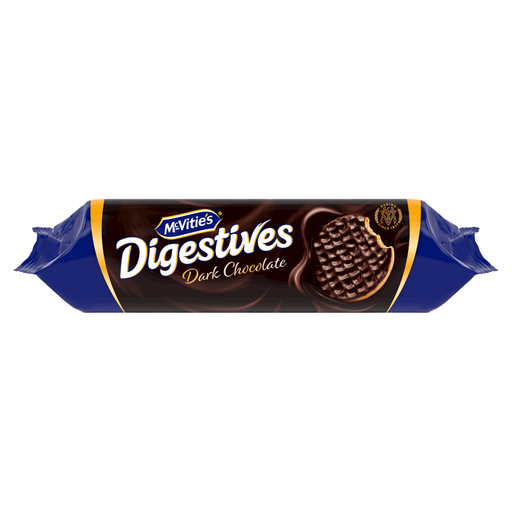
McVitie’s describes its Digestives Dark Chocolate as wheat biscuits topped with dark chocolate. The supplied product information covers a 266g pack and a larger 400g format.
Tesco’s own-label Dark Chocolate Digestives come in a 300g pack with a stated cocoa specification for the coating.
Sainsbury’s own-label 300g pack is another dark chocolate digestive with per-biscuit nutrition and a stated cocoa-solids minimum.
M&S describes its Dark Chocolate Digestives as having a dark-chocolate coating and demerara sugar for crunch.
These McVitie’s pack formats suit a family choosing dark chocolate digestives for the cupboard at home. Check the current pack’s nutrition and allergen information before serving.
 No image available
The twin-pack format is an option when stocking a shared home snack cupboard.
It contains two 266g packs. Check the current pack for per-biscuit nutrition and allergen information.
 No image available
This single 400g pack is another format for keeping dark chocolate digestives at home during the school holidays.
If a particular cocoa-solids figure matters to you, check the exact pack. Read its current nutrition and allergen declarations before serving.
No. The coating description does not establish a sugar level. Sainsbury’s lists 3.5g sugars per 16g biscuit, Tesco lists 4.2g per 17g biscuit, and Tesco Groceries lists 4.4g per 16.7g McVitie’s biscuit. Compare both the figure and the biscuit size on the exact pack.
Not as food supplied by a state-funded school during the school day: Department for Education school-food standards prohibit chocolate-coated products in that setting. This England-specific restriction is not a rule against families buying biscuits for home snacks during the holidays.
Read the allergen declaration on the exact physical pack, including precautionary wording, before offering it. The compared listings differ: Tesco says its product may contain milk, while Sainsbury’s warns that its product is not suitable for customers with an oat allergy because of manufacturing methods.
Keep it in a cool, dry place and use an airtight container after opening to help maintain its quality. Storage does not change the pack’s allergen declaration or nutrition figures.