Shoppers comparing cocoa declarations
If the word ‘dark’ is not enough to make your choice, look for a minimum cocoa-solids figure on the exact product. Rakusen's, Tesco and Sainsbury's each publish one for the chocolate in their digestives.


If a stated minimum cocoa-solids figure matters to you, compare the exact labels: Rakusen's lists 52% minimum in its chocolate ingredient, Tesco lists 48%, and Sainsbury's lists 35%. Those figures do not tell you how the biscuits will fare in summer heat; follow the pack's storage directions and check its current allergen information before taking it away.
If the word ‘dark’ is not enough to make your choice, look for a minimum cocoa-solids figure on the exact product. Rakusen's, Tesco and Sainsbury's each publish one for the chocolate in their digestives.
If biscuits will travel in an outdoor bag or car, plan where to keep them cool, dry and out of direct sunlight. GOV.UK's heatwave advice also recommends keeping a cool bag for picnic food closed.
If wheat, milk, soya or possible cross-contact matters to someone eating the biscuits, read the current pack rather than relying on the product name. Allergen statements differ between products.
Decide which label details matter to you, then check how you will store the pack during the trip.
| Priority | What to check | Your needs |
|---|---|---|
| Cocoa declaration | Look for a minimum cocoa-solids figure for the chocolate ingredient. Read it alongside the chocolate's proportion of the whole biscuit: Rakusen's lists 20% chocolate with 52% minimum cocoa solids, while Tesco lists 30% dark chocolate with 48% minimum cocoa solids. | I want a stated cocoa minimum, rather than choosing from the word ‘dark’ alone. The two percentages on each label describe different parts of the recipe, not one measure of the whole biscuit. |
| Summer storage | Follow the exact pack's storage directions and keep it away from direct sunlight where instructed. For a picnic in very hot weather, GOV.UK advises using a separate cool bag for food and keeping it closed. | My biscuits may spend time in a travel bag or outdoors, so I need somewhere cool and dry to keep the pack. |
| Ingredients and allergens | Read the current ingredients and allergen panel, including any ‘may contain’ statement. Check a dietary claim against the exact product, not the brand as a whole. | Someone eating these biscuits needs ingredient information that applies to the pack we actually take away. |
| Pack format | Check the stated weight and whether you are choosing a single or twin pack. Read the instructions for storing any biscuits left after opening. | For a short trip, I would rather choose an amount we can use and store as the pack directs. |
The published minimums differ: Rakusen's states 52% cocoa solids in its chocolate ingredient, Tesco 48%, and Sainsbury's 35%.
If that figure drives your choice, compare declarations for the exact products and note how much chocolate each recipe contains.
A cocoa-solids figure describes an ingredient; it does not measure how a finished biscuit will cope with a hot car or direct sun.
Follow the pack's storage instructions and keep picnic food in a closed cool bag when conditions call for one.
Dark chocolate digestives can contain wheat, milk and soya, while possible cross-contact statements are product-specific.
Read the physical pack before eating, including its ingredients and any ‘may contain’ wording relevant to the person eating it.
These examples show why an exact product label is more useful than a brand name alone when comparing cocoa declarations, ingredients and storage directions.
Rakusen's Chocolate Digestives provide an explicitly stated minimum cocoa-solids figure.
Tesco Dark Chocolate Digestives are a 300 g own-label option with a stated cocoa minimum.
Sainsbury's Dark Chocolate Digestives offer another 300 g own-label format with a printed cocoa minimum.
Asda Dark Chocolate Digestives are a 300 g own-label option whose storage directions matter for summer trips.
M&S Dark Chocolate Digestives state the chocolate proportion of the recipe.
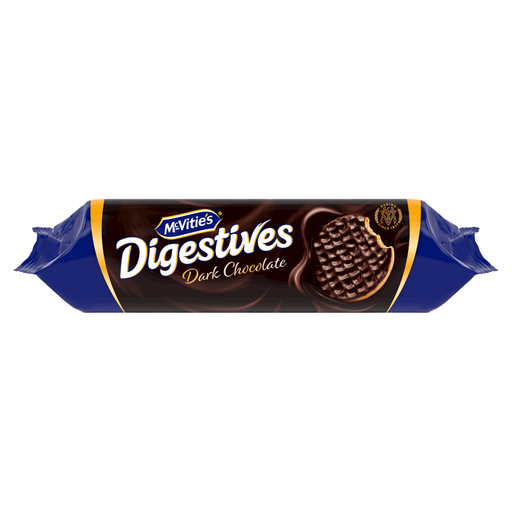
McVitie's offers a branded dark chocolate digestive in a 266 g format.
These McVitie's dark chocolate digestive packs give you two pack formats to consider for a summer trip. Compare their current labels if a stated cocoa minimum or particular allergen information matters to you.
 No image available
The twin-pack format may suit a trip where you plan to take two 266g packs. Check the current pack for its cocoa declaration, storage directions and allergen information before choosing it for your group.
 No image available
This 400g pack is a single-pack alternative for the trip. Keep it cool and dry as directed, and check its current cocoa and allergen declarations if either affects your choice.
Check the minimum cocoa-solids declaration for the chocolate in the exact product. Rakusen's states 52%, Tesco 48% and Sainsbury's 35%; also check each recipe's chocolate proportion, because the cocoa minimum alone does not describe the whole biscuit.
A cocoa-solids percentage is not a heat-resistance rating for the finished biscuit. Follow its storage directions and keep the pack cool, dry and away from direct sunlight where the label instructs.
Keep the pack shaded and follow its storage instructions. In very hot weather, GOV.UK advises using a separate cool bag for picnic food and keeping the bag closed.
Do not assume they are suitable from the product name. Check the current physical pack for ingredients, declared allergens and any ‘may contain’ statement relevant to that person; the products described here include wheat and can list milk, soya or other cereals.
Choose the format that fits how many biscuits your group expects to use and how you can store them. Check the pack's directions for keeping biscuits after opening, particularly if they will spend time in warm accommodation or an outdoor bag.