What matters when choosing?
Choose the type of snack first; if you are buying an occasional biscuit, compare like-for-like nutrition figures and check its ingredients and the rules of any setting where it will be eaten.
| Priority | What to check | Your needs |
|---|
| Everyday snack |
Consider whether a biscuit would become a frequent between-meals snack. NHS guidance suggests fruit, vegetables, plain unsweetened yoghurt and toast among alternatives for young children. |
For the usual snack, I'd rather have an option that follows NHS snack guidance than rely on a chocolate biscuit. |
| Nutrition figures |
Compare grams per biscuit on the same basis, and use per-100g figures when biscuit sizes differ. Sainsbury's lists 3.5g sugars and 1.9g saturates per biscuit, Asda 4.2g and 2.1g, and McVitie's 4.4g and 2.1g, according to their respective product listings. |
If I buy an occasional dark digestive, I want to compare what each listed biscuit contains. Adult reference-intake percentages are not toddler targets. |
| Cocoa wording |
Check whether a cocoa-solids figure describes the chocolate component or the whole biscuit. Sainsbury's states a minimum of 35% cocoa solids for its dark chocolate component, which makes up 27% of that biscuit. |
I want to know what a dark chocolate claim actually describes, rather than assume the entire biscuit has a high cocoa content. |
| Ingredients |
Read the current pack for wheat, milk and soya, plus any precautionary allergen statements. Sainsbury's warns that its product is not suitable for people allergic to oats; Asda says its product may also contain rye, barley and oats. |
Where an allergy or another ingredient restriction matters, I need the pack declaration for the particular biscuit I'm considering. |
| Food-setting policy |
Check the individual nursery or school policy before packing food. The NHS advises notifying a nursery or childminder about a child's food allergy. |
Before putting a biscuit in a lunchbox, I want to know whether the setting accepts it and how it handles allergens. |
Relevant brand references
These product-listing details help distinguish the checked dark digestives; they do not indicate which brands are available on Joybuy.
Sainsbury's
Its 300g dark chocolate digestives listing gives nutrition per biscuit and states that the dark chocolate component contains at least 35% cocoa solids.
- The listing declares 3.5g sugars and 1.9g saturates per biscuit, lower than the comparable Asda and McVitie's biscuits checked here.
- It lists wheat, milk and soya ingredients and says the product is not suitable for people allergic to oats because of manufacturing methods.
Asda
Its 300g dark chocolate digestives listing describes a biscuit containing 30% dark chocolate.
- The listing gives 4.2g sugars and 2.1g saturates per biscuit for comparison with other per-biscuit declarations.
- Ingredients include wheat, milk fat and soya lecithin; the listing says the product may also contain rye, barley and oats.
McVitie's
The checked 266g dark chocolate digestive listing describes a 30% dark chocolate component.
- It declares 4.4g sugars and 2.1g saturates per 16.7g biscuit, allowing a per-biscuit comparison with the checked own-label products.
- The listed per-biscuit sugars exceed those of the checked Sainsbury's and Asda products. Its allergen advice identifies wheat, milk and soya.
M&S
Its 300g dark chocolate digestives listing describes a 32% chocolate coating and demerara sugar for crunch.
- The listing provides per-100g figures: 29.2g sugars and 12.4g saturates.
- Ingredients include wheat flour, milk fat, soya lecithin and barley malt extract. The per-100g figures should not be compared directly with another product's per-biscuit figures.
Joybuy product options
The Joybuy option below is a dark chocolate oat-and-ginger biscuit, not a digestive. Its sweetener and age warnings need particular attention if the purchase is for toddler snack time.
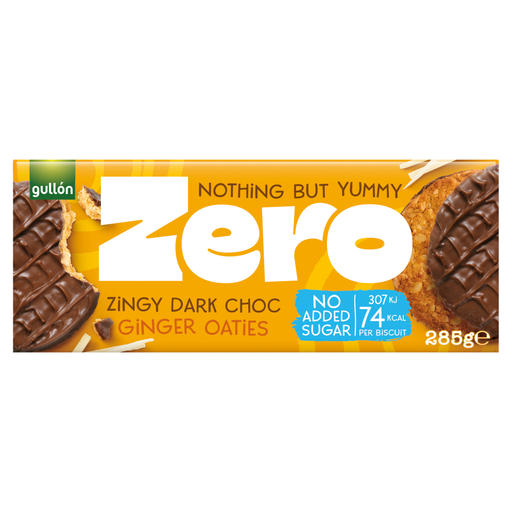 Image unavailable
Gullon Zero Dark Chocolate Ginger Oaties 285g
This oat-and-ginger biscuit is not a digestive. Its product information lists maltitol and warns that excessive consumption may have a laxative effect. A retailer listing says it is not suitable for children under 3. It contains wheat, milk, soya and oats and may contain nuts; check the current pack before considering it for a child.
View on Joybuy
Questions about toddler snack time
Should a dark chocolate digestive be an everyday toddler snack?
For routine snacks, choose from the alternatives suggested by the NHS, such as fruit, vegetables, plain unsweetened yoghurt or toast. Treat a dark chocolate digestive as an occasional biscuit rather than the usual snack.
Which checked dark digestive lists the least sugar per biscuit?
Sainsbury's lists 3.5g sugars per biscuit, compared with 4.2g for the checked Asda product and 4.4g for McVitie's, according to their product listings. That is a comparison of the declared biscuits, not toddler portion advice.
Does dark chocolate mean the whole biscuit is high in cocoa?
No such conclusion follows from these listings. Sainsbury's states a minimum of 35% cocoa solids for its dark chocolate component, which makes up 27% of the biscuit; the figure does not describe the cocoa content of the whole biscuit.
What should I check before packing one for nursery or school?
Check the setting's food policy and the current pack's allergen information. The NHS advises checking nursery policies and telling the nursery or childminder about a child's food allergy; the checked dark digestives contain wheat and include milk and soya ingredients.
Do HFSS rules ban parents from buying or packing dark digestives?
No general purchase or parent-packed-lunch ban follows from England's HFSS retail promotion rules. Department of Health and Social Care guidance concerns certain promotions and placements at qualifying retailers; whether a particular biscuit meets the HFSS classification requires the applicable nutrient-profiling calculation. Check the individual nursery or school policy for packed food.


