Sainsbury's has the lowest declared sugars and saturated fat per biscuit among the four compared dark chocolate digestives, although biscuit sizes differ. If a stated cocoa-solids threshold matters more, Tesco declares at least 48% cocoa solids in its dark chocolate, compared with Sainsbury's 35% minimum. For a revision-break biscuit, check the portion and allergen information on the pack you buy rather than relying on the word “dark”.
Who is comparing these biscuits?
Revision snackers choosing a chocolate biscuit
If you take breaks with a biscuit, the per-biscuit label helps you see what one piece contributes. The compared product labels declare 3.5g to 5.2g sugars and 1.9g to 2.2g saturated fat per biscuit; the biscuits are not all the same size.
Shoppers looking for a stated cocoa level
“Dark chocolate” does not give you a single cocoa figure across these products. Tesco declares at least 48% cocoa solids in its chocolate, while Sainsbury's declares at least 35%.
Households checking allergens
Read the current pack before buying for someone who needs to avoid an ingredient. Wheat and soya appear in the compared products' allergen information; milk declarations and warnings differ.
What should you check before choosing?
Start with the serving you are likely to take, then compare the chocolate declaration and allergens. Use the per-100g panel as well when biscuit weights differ.
| Priority | What to check | Your needs |
|---|
| One-biscuit portion |
Compare energy, sugars and saturated fat per biscuit, then check per 100g. The compared biscuits weigh 16g to 17.8g each. |
I want to know what one biscuit contributes when I take a revision break, without treating differently sized biscuits as identical. |
| Chocolate declaration |
Look separately for the chocolate's cocoa-solids minimum and the proportion of chocolate in the whole biscuit. Tesco states 48% minimum cocoa solids in its chocolate; Sainsbury's states 35% minimum. |
A stated cocoa threshold matters to me more than choosing from the word “dark” alone. |
| Allergens |
Read the current ingredients and precautionary statements. The compared labels identify wheat and soya; McVitie's and M&S list milk, while Tesco warns that it may contain milk. |
If I am sharing biscuits with someone who avoids an ingredient, I need to check the exact pack first. |
| Pack format |
Check the stated weight and whether the product is a single pack or a bundle. The Joybuy McVitie's options below are a 400g pack and a twin pack of 2 x 266g. |
For occasional breaks, I may prefer one pack; if several people will use it, the twin-pack format may be more practical. |
What is easy to overlook?
-
Assuming “dark” tells you the sugar content
The compared labels range from 3.5g sugars per Sainsbury's biscuit to 5.2g per M&S biscuit. The chocolate description alone does not tell you the nutrition of the whole biscuit.
Compare both per-biscuit and per-100g figures on the current packs, particularly when choosing between biscuits of different weights.
-
Treating all dark coatings as having the same cocoa level
Tesco states a 48% minimum cocoa-solids content for its chocolate and Sainsbury's states 35%. A coating's share of the biscuit is a different measure from its cocoa-solids content.
If a cocoa threshold is decisive, use an explicit cocoa-solids declaration rather than comparing coating percentages as though they measured the same thing.
-
Assuming a dark coating means no milk
McVitie's and M&S list milk, and Tesco states that its biscuits may contain milk. A dark chocolate name is not an allergen declaration.
Check the ingredients and precautionary wording on the pack you will use; Sainsbury's also warns that its product is not suitable for customers with an oat allergy because of its manufacturing methods.
-
Applying school-food rules to every revision snack
The Department for Education states that England's school food standards apply to food provided to pupils in state-funded schools. That scope does not itself establish a prohibition on a particular biscuit brought from home.
For food served at school, check the school's policy and the rules applicable in that nation; for a snack brought from home, check the school's own requirements.
How do the labelled options differ?
These details concern the named dark chocolate digestive products, not every biscuit made by each brand.
McVitie's
McVitie's Dark Chocolate Digestives are listed in several pack formats, including 266g and 400g packs.
- McVitie's declares a 30% dark chocolate ingredient and lists 83 kcal, 4.4g sugars and 2.1g saturated fat per biscuit.
- The product information lists wheat, milk and soya; check the current pack for the variant you buy.
Tesco
Tesco Dark Chocolate Digestives come in a 300g pack with an explicit cocoa-solids declaration for the chocolate.
- Tesco states that its dark chocolate contains at least 48% cocoa solids; the label lists 4.2g sugars and 2.1g saturated fat per 17g biscuit.
- The product contains wheat and soya and may contain milk.
Sainsbury's
Sainsbury's Dark Chocolate Digestives come in a 300g pack; dark chocolate makes up a declared 27% of the product.
- The label lists 3.5g sugars and 1.9g saturated fat per 16g biscuit, and at least 35% cocoa solids in the dark chocolate.
- The product contains wheat, milk and soya. Sainsbury's says it is not suitable for customers with an oat allergy because of its manufacturing methods.
M&S
M&S Dark Chocolate Digestives list a 32% chocolate coating and demerara sugar among their ingredients.
- Marks & Spencer lists 29.2g sugars and 12.4g saturated fat per 100g; Ocado lists 5.2g sugars and 2.2g saturated fat per 17.8g biscuit.
- The ingredient information includes wheat, barley, milk and soya. The coating percentage is not a cocoa-solids percentage.
McVitie's options on Joybuy
These two McVitie's dark chocolate digestive listings offer different pack formats for a revision-break biscuit. Compare their pack details with the nutrition and allergen information on the product you receive.
 Image unavailable
McVitie's Digestives Dark Chocolate Twin Pack, 2 x 266g
The twin-pack format gives a household two 266g packs for revision breaks. McVitie's lists 4.4g sugars and 2.1g saturated fat per biscuit for its Dark Chocolate Digestives; check the nutrition panel on these packs before comparing portions. The product information lists wheat, milk and soya.
View on Joybuy
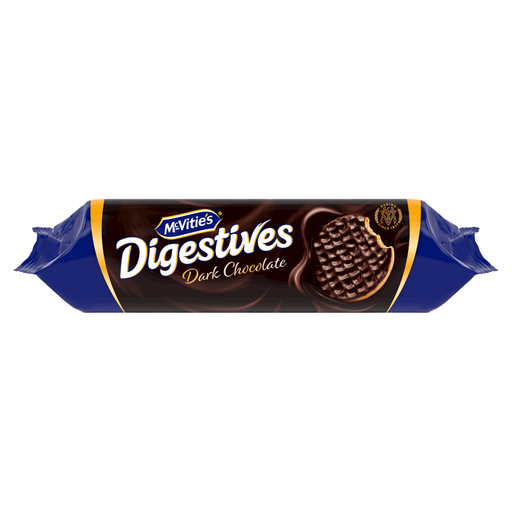 Image unavailable
McVitie's Digestives Dark Chocolate 400g
This is the single 400g pack rather than the twin pack. McVitie's lists 4.4g sugars and 2.1g saturated fat per biscuit for its Dark Chocolate Digestives; use this pack's label to confirm its serving information. The product information lists wheat, milk and soya. If a particular cocoa-solids threshold matters, check the pack's chocolate declaration.
View on Joybuy
Questions about revision-break biscuits
Does dark chocolate mean a digestive contains less sugar?
No. Among these four products, Sainsbury's lists 3.5g sugars per biscuit and M&S lists 5.2g. Read the whole biscuit's nutrition panel, not just the chocolate description, and use per-100g figures when comparing different biscuit sizes.
Which biscuit states a cocoa-solids percentage?
Tesco states that its dark chocolate contains at least 48% cocoa solids, while Sainsbury's states at least 35%. Those figures describe the chocolate, not the percentage of the whole biscuit that is chocolate.
What should I check before sharing a pack?
Check the current pack's ingredients and allergen statements. The compared product information identifies wheat and soya, McVitie's and M&S list milk, Tesco warns that it may contain milk, and Sainsbury's warns customers with an oat allergy about its manufacturing methods.
Are dark chocolate digestives prohibited at school?
The Department for Education says England's school food standards apply to food provided to pupils in state-funded schools; that does not establish a blanket rule for every dark chocolate digestive or every snack brought from home. Check the school's policy and the rules applicable to the setting rather than assuming the same requirement applies across the UK.


