Shoppers comparing cocoa declarations
If the composition of the coating guides your choice, look for its minimum cocoa-solids figure separately from the percentage of chocolate in the biscuit.


If a declared cocoa-solids figure matters, Tesco lists a 48% minimum for the chocolate on its 300g digestives, while Sainsbury's lists a 35% minimum for its 300g biscuits. Neither figure describes the cocoa content of the whole biscuit. If quantity matters more, consider whether you will use both packs in a twin pack, and check ingredients and nutrition rather than assuming that 'dark' means milk-free or says anything definite about sugar content.
If the composition of the coating guides your choice, look for its minimum cocoa-solids figure separately from the percentage of chocolate in the biscuit.
Pack size and storage after opening matter when you are deciding between a single pack and enough biscuits to last across the week.
A dark-chocolate name does not settle milk-allergen questions or describe the biscuit's sugars and saturated fat. Check the exact pack before choosing a snack to share.
Compare the coating declaration first if cocoa content drives the choice, then check pack quantity, nutrition and ingredients for the way your household will use the biscuits.
| Priority | What to check | Your needs |
|---|---|---|
| Cocoa declaration | Tesco lists 30% dark chocolate in the biscuit and a 48% minimum cocoa-solids content in that chocolate. Sainsbury's lists 27% dark chocolate and a 35% minimum cocoa-solids content in its chocolate. These percentages measure different things. | I want a stated figure for the coating's cocoa solids, rather than choosing by the word 'dark' or by the amount of chocolate alone. |
| Pack quantity | Check the weight and number of packs. ASDA lists the McVitie's twin pack as 2 × 266g; Tesco, Sainsbury's and ASDA each list a 300g own-label pack. Consider the storage directions once a pack is open. | Will we use two packs during the week, or would one pack fit how often we reach for biscuits? |
| Nutrition | Compare sugars and saturates per 100g for a like-for-like weight, then check the per-biscuit figures for the pack you choose. Tesco lists 24.7g sugars per 100g for its 300g dark chocolate digestives. | I want to know what the figures describe before deciding how many biscuits to serve. |
| Allergens | Read the exact pack's ingredients and precautionary statements. McVitie's lists butter oil from milk, Sainsbury's lists butteroil from cows' milk, and Tesco says its biscuits may contain milk. | If someone in the household avoids milk or another ingredient, I need to check that product's current label, not rely on its dark-chocolate name. |
The share of the biscuit made up of chocolate is different from the cocoa-solids content within that chocolate. A larger coating share does not, by itself, establish a higher cocoa-solids figure.
Look for both figures on the product information, and compare cocoa-solids declarations only when they refer to the chocolate itself.
Several of these dark chocolate digestives list milk-derived ingredients; Tesco's listing carries a 'may contain milk' warning. The name also does not tell you the biscuit's nutrition values.
Check the current pack's allergen statement, then use its per-100g nutrition panel when comparing biscuits of different sizes.
Two packs provide more biscuits, but their usefulness depends on how much the household will eat and how each opened pack must be stored.
Compare pack weights and follow the storage instructions. ASDA says to keep its own-label digestives airtight after opening and consume them within seven days.
Tesco lists a 300g own-label dark chocolate digestive with separate figures for the chocolate portion and its cocoa solids.
Sainsbury's lists a 300g own-label pack with both coating and cocoa-solids declarations.
McVitie's describes its dark chocolate digestives, while ASDA lists a 2 × 266g twin-pack format.
ASDA lists a 300g own-label dark chocolate digestive for comparison within a weekly shop.
Ocado lists M&S dark chocolate digestives and describes a crunchier texture from demerara sugar.
These McVitie's options cover a twin pack and a larger single pack for a weekly shop. Compare their formats with how much your household will use, and check the current pack if a cocoa-solids declaration affects your choice.
 Image unavailable
Two 266g packs offer a way to use one pack while keeping the other unopened during a weekly shop. The product information states that dark chocolate makes up 30% of the biscuit and lists butter oil from milk. Check the pack's cocoa-solids declaration if that figure guides your choice.
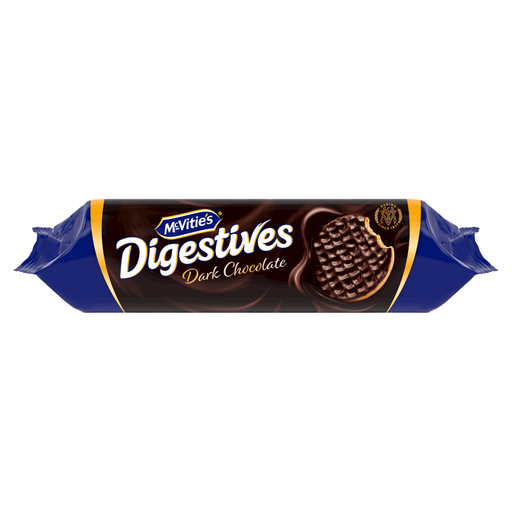 Image unavailable
This 400g option is a single pack for a household planning to use that quantity. The product information states that dark chocolate makes up 30% of the biscuit and lists butter oil from milk. Check the pack for a cocoa-solids declaration if you need one to compare coatings.
No. On these ingredient lists, 30% describes the portion of the biscuit made up of dark chocolate. The cocoa-solids declaration describes that chocolate instead; Tesco separately states a 48% minimum for the chocolate on its dark chocolate digestives.
Not necessarily. McVitie's and Sainsbury's list milk-derived ingredients in the products discussed here, and Tesco says its biscuits may contain milk. If milk is an allergen in your household, check the current pack's ingredients and precautionary statements.
Follow the instructions on the pack you buy. Sainsbury's and ASDA say to use an airtight container after opening; ASDA also says to consume its own-label digestives within seven days of opening.
Check the ingredients, allergen statements and nutrition information on the exact pack. Compare per-100g figures when biscuit sizes differ, and do not use the word 'dark' as a substitute for checking whether a product contains milk.