A keen dark-chocolate recipient
Look for a box whose contents are explicitly dark-led. If the recipient enjoys trying different recipes, check whether it contains varied chocolates rather than repeated pieces of one truffle.


For someone who already enjoys dark chocolate, consider a clearly dark-led assortment or a collection of bars with different recipes; for someone who prefers filled chocolates, consider a truffle box or a selection of centres. Check what any cocoa percentage describes, then read the ingredients and allergen information for the exact box: a dark-chocolate label does not establish that every piece is dairy-free or suitable for someone with an allergy.
The recipient’s preferences and dietary requirements are more useful starting points than the size of the box alone.
Look for a box whose contents are explicitly dark-led. If the recipient enjoys trying different recipes, check whether it contains varied chocolates rather than repeated pieces of one truffle.
A collection of bars offers a different tasting experience from a box of filled chocolates. Compare the stated flavours, cocoa percentages and number of bars or pieces before choosing a format.
Check the current ingredients, allergen declarations and any “may contain” statements for the exact product. Dark chocolate is not, by itself, a dairy-free, vegan or allergen-free designation.
Choose the type of chocolate first, then check the particular box’s contents and label before buying it as a gift.
| Priority | What to check | Your needs |
|---|---|---|
| Cocoa and recipe | Check the stated cocoa percentage and which component it describes. Compare plain chocolate, flavoured recipes and filled centres rather than treating the percentage as a score for the whole box. | I know whether the recipient likes a pronounced dark-chocolate flavour or would rather have filled chocolates. Lindt Shop UK specifies that the 70% figure for its LINDOR Dark truffles applies to the shell. |
| Gift format | Compare piece or bar count, stated contents and whether the assortment is entirely dark chocolate. Hotel Chocolat lists 58 recipes in Serious Dark Fix; Montezuma’s lists five 90 g bars in its Dark Bar Library. | For sharing, I would consider a larger selection; for tasting different bars, a library makes more sense than a box of repeated truffles. A compact box may suit a single recipient. |
| Ingredients and allergens | Read the exact product’s current ingredient list, suitability statements and precautionary allergen labelling. Check every relevant ingredient and “may contain” statement, not just the word “dark”. | If the recipient has an allergy or dietary requirement, I need the information for this particular box. The Food Standards Agency explains that “may contain” labelling communicates that a named allergen could be unintentionally present. |
| Values-led choice | Check sourcing or ingredient-policy claims against the brand or exact product, and check whether the assortment mixes milk and dark bars. | Fairtrade ingredients matter to my choice, but I still need a gift that fits the recipient’s tastes. Divine describes its cited gift box as a mixed milk-and-dark selection, not an all-dark box. |
| Current contents | Confirm the assortment and current pack information before gifting. Montezuma’s says the contents of its Dark Bar Library may change; M&S advises buyers to read the product label. | I want the flavours and dietary information I checked to match the box the recipient will actually receive. |
Lindt Shop UK states that 70% cocoa applies to the dark shell of its LINDOR Dark truffles; the truffle also has a filling. The figure does not describe the complete truffle.
Read the percentage wording alongside the ingredients and assortment description. If every piece needs to be dark chocolate, check each type in a mixed selection.
Recipes differ. The cited Lindt truffles contain milk-derived ingredients and soya and may contain nuts; Montezuma’s lists milk, wheat and soya for its Dark Bar Library, with possible nut and peanut traces.
For a recipient with an allergy or dietary restriction, inspect the current declaration for the exact box, including precautionary statements.
Hotel Chocolat’s 58-piece dark-led selection, Montezuma’s five-bar library and Lindt’s 200 g truffle box serve different gifting preferences. Quantity alone does not tell you whether the recipient wants to share chocolates, compare bars or enjoy filled truffles.
Match the format to the recipient and occasion before comparing quantities.
Montezuma’s states that its library contents may change, while M&S advises checking the product label because food information can change.
Confirm the current contents and label before purchase, particularly when a particular flavour or dietary detail is essential.
These ranges illustrate different gift formats; a brand’s wider range does not establish the ingredients or suitability of an individual box.
Its UK dark-chocolate range includes boxed selections in different sizes.
Its Dark Bar Library is a bar-based alternative to a conventional box of filled chocolates.
The UK range includes dark bars and LINDOR Dark truffles for a filled-chocolate gift.
Divine offers a boxed bar format for gifts where its stated sourcing approach is part of the choice.
Its cited 292 g Dark Chocolate Selection is a filled-chocolate option rather than a collection of plain bars.
The brand has published pages for dark-chocolate gifts and a 70% dark bar box aimed at business gifting.
These boxed options cover a filled-chocolate assortment and a smooth dark-truffle format. Compare the recipient’s preference for variety or truffles, then check the current pack for dietary suitability.
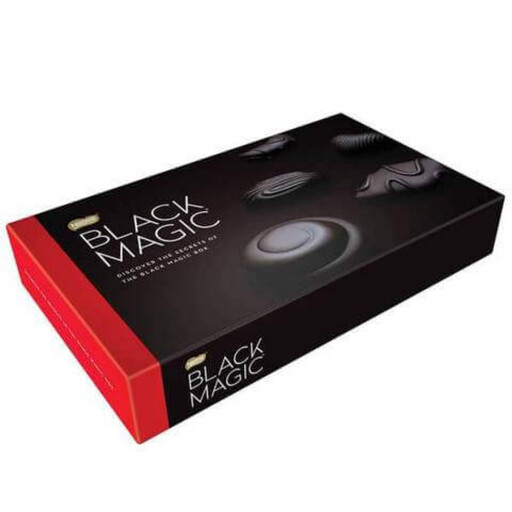 No image available
Consider this 348 g box for a recipient who enjoys a variety of filled chocolates. For an allergy-sensitive gift, check the current pack: the product information lists almonds, hazelnuts, eggs and milk, and says it may contain peanuts, other tree nuts and soya.
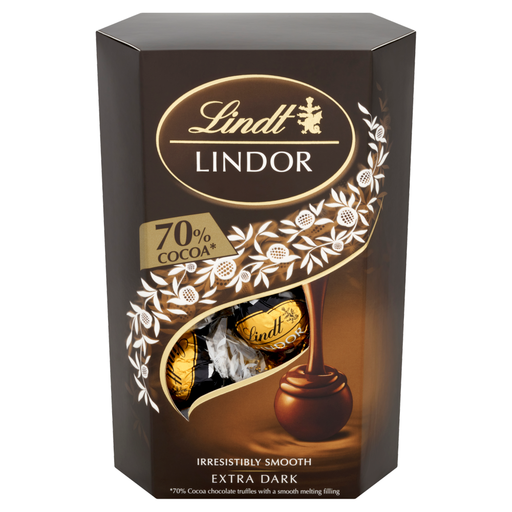 No image available
Consider this 200 g truffle box when the recipient prefers a smooth filling to a bar collection. Lindt Shop UK specifies that 70% cocoa applies to the dark shell, not the whole truffle; the cited ingredients include milk-derived ingredients, soya and barley malt extract, and the product may contain nuts. Check the current pack for dietary requirements.
No. “Dark” describes the chocolate, not a dietary guarantee. Lindt Shop UK lists milk-derived ingredients in its LINDOR Dark 70% truffles; check the exact box’s current ingredients and allergen declaration before choosing it for someone with a dietary requirement.
Start with what the recipient enjoys, and check which part of the product the percentage describes. Hotel Chocolat’s own gift guidance characterises 70% and above as bolder and 50–60% as a starting point for people accustomed to milk chocolate. Fillings and other ingredients also affect the choice, so a percentage alone cannot describe the whole assortment.
It flags that the named allergen could be unintentionally present. The Food Standards Agency explains that precautionary allergen labelling communicates this possibility; someone buying for a recipient with the named allergy should consider that statement alongside the ingredients and other suitability information.
Check the current physical pack or current supplier specification as well as the online listing. M&S advises buyers to read the product label because ingredient, dietary and allergen information can change.
For food that meets the UK definition of prepacked for direct sale, the Food Standards Agency and Food Standards Scotland state that, since 1 October 2021, the label must display the food’s name and a full ingredients list with the 14 regulated allergens emphasised. Check whether the shop’s packing and sale arrangement falls within that category rather than assuming the rule applies in the same way to every manufacturer-packed box.