For routine toddler snacks, choose options such as suitably prepared fruit or vegetables, toast or plain yoghurt rather than a dark-chocolate ginger biscuit, in line with NHS snack examples. If you are considering a biscuit as an occasional family treat, compare sugars on a like-for-like basis, assess its texture and check the exact pack’s allergens; a dark coating does not establish toddler suitability.
Who is making the choice?
Parents choosing everyday toddler snacks
If a biscuit is convenient, the first decision is whether it belongs in the regular snack routine. The NHS gives fruit, suitably prepared vegetables, toast and plain yoghurt as snack examples for children over 12 months; it also advises care with firm foods for young children.
Families comparing ginger biscuits
A plain ginger nut and a chocolate-coated ginger biscuit are different choices. Compare the portion you would serve, the sugars shown on each label and the ingredients of the particular product.
Carers packing food for a setting
Check the nursery or school’s allergy policy before packing a biscuit. For a setting in England, early-years nutrition requirements, school-food standards and retail-promotion rules are separate matters; none replaces the setting’s instructions about food brought in.
What matters when choosing?
Decide whether this is a routine toddler snack or an occasional family treat before comparing biscuit labels.
| Priority |
What to check |
Your needs |
| Snack occasion |
For routine snacks from 12 months onwards, consider the NHS examples of fruit, suitably prepared vegetables, toast and plain yoghurt. If considering a biscuit, read the ingredients and whole-product nutrition rather than judging it by the coating. |
For an everyday snack, I want to choose something other than a sweet biscuit. A chocolate-and-ginger biscuit might instead be an occasional family treat. |
| Sugars and portion |
Compare sugars per 100 g as well as per biscuit, then consider the portion being served. Waitrose & Partners lists 4.6 g sugars per No.1 Dark Chocolate & Ginger Thin and 9.9 g per biscuit in its separate eight-biscuit pack; the biscuits differ in size. |
If I am comparing biscuits, I want figures that account for different biscuit sizes—not an assumption that the darker coating means less sugar. |
| Allergens and setting |
Read the current pack’s ingredients and precautionary allergen wording. The Waitrose chocolate-coated listings warn of possible nuts, while the M&S ginger florentine lists almonds as an ingredient. Check any nursery or school policy separately. |
When an allergy or setting rule matters, I need information for the exact product I would pack. Its name alone cannot tell me whether it contains nuts. |
| Texture and serving |
Assess the biscuit’s firmness and size for the individual child. The NHS identifies firm foods as a greater choking concern and advises seated, upright, supervised eating for young children. |
A crunchy biscuit may be difficult for the child I am feeding to manage, so I need to consider texture as well as flavour. |
Mistakes to avoid
-
Treating “dark” as a toddler-suitability claim
A cocoa-solids percentage describes the chocolate coating, not the finished biscuit’s suitability for routine toddler snacks. Waitrose & Partners lists sugars in both its dark-chocolate ginger-biscuit products.
Start with the snack occasion, then check the whole product’s ingredients and nutrition label.
-
Assuming every ginger nut contains nuts
Product names do not establish allergen content. McVitie’s listed plain Ginger Nuts ingredients identify wheat; chocolate-coated biscuits can carry possible-nut warnings, while the M&S ginger florentine contains almonds.
Read the exact current pack and check the intended setting’s allergy policy.
-
Comparing sugars per biscuit without checking size
Waitrose & Partners lists different per-biscuit sugar amounts for its No.1 Thin and its separate eight-biscuit product. Those figures refer to different biscuits, not equal weights.
Use the per-100 g figures for a weight-based comparison, then consider the portion actually being served.
Relevant brand references
These product lines illustrate why a plain ginger nut, a chocolate-coated biscuit and a florentine should not be treated as the same snack.
McVitie’s
McVitie’s lists a plain Ginger Nuts biscuit rather than a dark-chocolate-coated variant.
- Its product information gives ingredients and a per-biscuit sugar figure: 2.9 g per 10.1 g biscuit.
- The manufacturer describes the biscuit as crunchy; that description does not establish that its texture suits an individual toddler.
Waitrose
Waitrose & Partners lists distinct dark-chocolate ginger-biscuit formats, including No.1 Thins and an eight-biscuit pack.
- The listings provide per-biscuit sugars and state minimum cocoa solids in the coatings: 51% for the Thins and 49% for the eight-biscuit product.
- Both listings warn of possible nuts. Their different per-biscuit sugar figures should not be read as an equal-weight comparison.
M&S
M&S lists a dark-chocolate ginger biscuit and, separately, a ginger florentine containing almonds.
- The biscuit listing provides nutrition per 100 g, including 42.1 g sugars per 100 g.
- The biscuit carries a nut-allergy caution. The almond-containing florentine is a different product, not a substitute for checking the biscuit’s own label.
Border
Border Biscuits lists a dark-chocolate ginger biscuit for those comparing chocolate-and-ginger products.
- The manufacturer identifies ginger flavour and a dark-chocolate coating.
- Those descriptions do not establish toddler suitability or a lower-sugar recipe; check the particular pack before choosing it.
A Joybuy product option
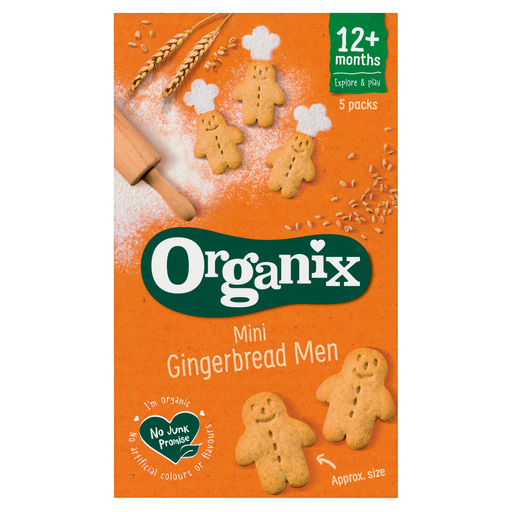
This gingerbread-biscuit option is labelled for children aged 12 months and over. It is not a dark-chocolate ginger nut; consider the snack occasion and the child’s needs before choosing it.
 No image available
Organix Mini Gingerbread Men 12+ Months, 5 x 20g
This gingerbread biscuit is an option to consider for a child aged 12 months or over, rather than a way to meet a dark-chocolate preference. The pack contains 5 x 20g; check its current ingredients and allergen information, and supervise young children while they eat.
View on Joybuy
Common questions
Does “ginger nuts” mean the biscuits contain nuts?
No conclusion about allergens follows from the name. McVitie’s listed plain Ginger Nuts ingredients identify wheat; the Waitrose chocolate-coated products warn of possible nuts, and the M&S ginger florentine contains almonds. Check the exact current pack, particularly where an allergy is involved.
Does more cocoa make a ginger biscuit suitable for a toddler?
A cocoa-solids percentage alone cannot establish that. The Waitrose & Partners dark-chocolate coatings state minimum cocoa-solids percentages, but the finished biscuits still list sugars. For routine snacks, the NHS gives examples such as fruit, suitably prepared vegetables, toast and plain yoghurt.
What should I consider if offering a young child a biscuit?
Assess its size and firmness for that child. The NHS identifies firm foods as a greater choking concern and advises that young children eat seated upright and under supervision.
Do HFSS rules ban these biscuits from every school or nursery snack?
The cited England rules do not establish a UK-wide ban on a child bringing a particular biscuit as a snack. The Department of Health and Social Care and the Department for Culture, Media and Sport describe restrictions on advertising and retail promotions of less healthy foods; those differ from the Department for Education’s England school-food standards and early-years nutrition requirements. Check the particular setting’s food and allergy policy.


