Gym-goers who want a small chocolate treat
A bar can be something to enjoy around a gym visit without being the food you rely on for a planned fuelling or recovery meal. Compare the amount you intend to eat with the nutrition figures on the pack.


For a small gym-bag treat, an 85% cocoa bar leaves some sweetness, while a 90% bar suits a preference for a more intense cocoa flavour. Lindt Shop UK lists 15g sugars per 100g for its Excellence 85% bar and 7g for its 90% bar, but cocoa percentage alone does not establish the sugar content of another product. Montezuma's Absolute Black offers 100% cocoa with no added sugar; whichever bar you choose, check the portion, saturated fat and allergen statement, and choose food for a specific exercise-fuelling or recovery purpose separately.
A bar can be something to enjoy around a gym visit without being the food you rely on for a planned fuelling or recovery meal. Compare the amount you intend to eat with the nutrition figures on the pack.
If you are deciding between 85%, 90% and 100% cocoa, compare the listed sugars per 100g as well as the ingredients and flavour you expect. The cocoa percentage is not a substitute for the nutrition panel.
Check the ingredients and precautionary allergen statement on the exact current pack, particularly when buying for someone else. A vegan recipe does not cancel a milk or nut “may contain” warning.
Decide whether the chocolate is a treat or food for a defined exercise purpose, then compare bars using the same nutrition basis and check the pack you will carry.
| Priority | What to check | Your needs |
|---|---|---|
| Cocoa and flavour | Read the cocoa percentage and ingredients. An 85% bar and a 100% cocoa bar offer different amounts of sweetness; brand flavour descriptions are preference cues, not taste tests. | I want a small piece I will enjoy, rather than choosing the highest cocoa figure regardless of flavour. |
| Sugars and portion | Compare total sugars per 100g, then use the pack’s serving figures or the amount you plan to eat. Lindt Shop UK lists 15g sugars per 100g for Excellence 85% and 7g for Excellence 90%; Montezuma's lists 0.6g for Absolute Black 100% cocoa. | If listed sugar matters to me, I want to compare the actual bars on the same basis. I also want to know how the piece I carry relates to a full bar. |
| Allergens | Check ingredients and every “may contain” statement on the current pack. The Food Standards Agency explains that precautionary allergen labelling communicates possible unintended allergen presence. | I need the exact bar to meet my allergen requirements; a vegan recipe or a previous pack is not enough to decide. |
| Snack purpose | Read energy, fat and saturates alongside sugars. For example, Lindt Shop UK lists 30g saturates per 100g for Excellence 90%, and Montezuma's lists 32g per 100g for Absolute Black. Choose a separate food with the carbohydrate or protein role you need for a planned exercise snack. | Am I packing chocolate for enjoyment, or am I relying on this snack for a particular session or recovery meal? Those are different decisions. |
| Bag storage | Check the pack’s storage directions and consider whether the bag will be left in a hot car or direct sunlight. | I want the portion I take with me to stay in a condition I will enjoy eating. |
Montezuma's lists no added sugar for Absolute Black, but its nutrition panel also lists 623kcal and 32g saturates per 100g.
Choose it for its cocoa and sugar profile if you like the flavour; use the full nutrition panel and the amount you intend to eat to make the snack decision.
Lindt’s Excellence 85% and 90% bars are described as made to vegan recipes, yet their product pages carry milk and nut precautions. The Food Standards Agency says “may contain” wording indicates possible unintended allergen presence.
For an allergy, check the ingredients and precautionary wording on the exact current pack rather than relying on the recipe description.
The compared high-cocoa bars list substantial fat and saturates per 100g. Their cocoa percentage does not establish that a small piece meets a planned fuelling or recovery need.
Decide whether you want a treat or food with a particular carbohydrate or protein role, and choose for that purpose separately.
The Requirements for School Food Regulations 2014 define chocolate as confectionery in the context of England’s school-food rules. Department for Education guidance concerns food provided in state-funded schools in England; it does not establish a single rule for every UK school setting.
If buying chocolate for school provision rather than a personal gym bag, identify the nation and school setting and check the current rules that apply there. The Department for Education says proposed England standards for September 2027 remain subject to Parliamentary approval.
These examples illustrate label differences in particular high-cocoa products; a brand name alone does not establish the nutrition or allergen details of another bar.
The Excellence range includes 85% and 90% cocoa 100g bars with nutrition panels on Lindt Shop UK.
Absolute Black is a 100% cocoa option for someone deliberately choosing a bar with no added sugar.
Tesco Groceries lists the 90g Organic and Fairtrade 85% dark chocolate bar.
M&S describes its 100g Collection bar as Fairtrade dark chocolate with at least 85% cocoa solids.
Hotel Chocolat describes its 85% Dark Chocolate Batons as a pack of 15 batons rather than a single bar.
These Joybuy options are 85% and 90% cocoa bars to consider for a small gym-bag treat. Compare their current packs for portion information and allergens before choosing.
 No image available
This 85% cocoa 100g bar fits a choice of high-cocoa chocolate to take as a treat. Check the current pack’s nutrition per portion and allergen wording against your needs.
 No image available
Consider this 85% cocoa bar if you want a 90g high-cocoa treat. Tesco Groceries lists the matching Organic and Fairtrade bar at 14g sugars and 30g saturates per 100g, with a “may contain nuts and milk” warning; check the current pack before relying on those details.
 No image available
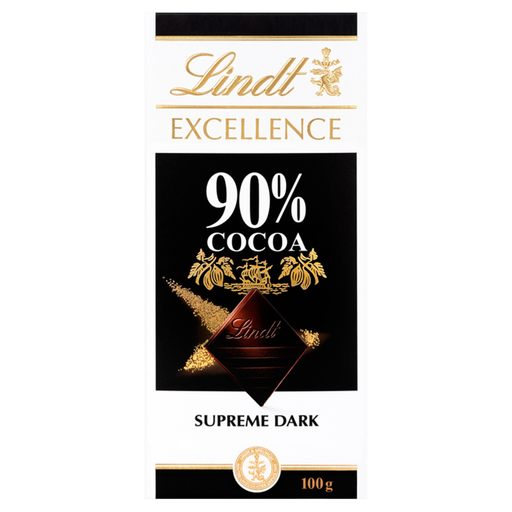
This 90% cocoa bar is an option if you prefer a more intense cocoa flavour. Lindt Shop UK lists 7g sugars and 30g saturates per 100g for its Excellence 90% bar, with may-contain warnings for nuts, milk and soya. Check the current pack and the amount you plan to eat.
 No image available
Choose between this 85% cocoa bar and a more intense option according to the flavour you want. Lindt Shop UK lists 15g sugars and 27g saturates per 100g for Excellence 85% and warns that it may contain nuts, milk, soya and sesame; check the current pack if those allergens matter.
Do not choose it on cocoa percentage alone for that purpose. The compared bars contain substantial fat per 100g, and a small piece supplies only a fraction of any per-100g protein figure. If your snack has a defined carbohydrate or protein role, choose food for that role separately.
No: read the nutrition panel for the exact bar. In these examples, Lindt Shop UK lists 15g sugars per 100g for Excellence 85% and 7g for Excellence 90%, while Montezuma's lists 0.6g per 100g for Absolute Black 100%. Those figures do not establish a rule for every dark chocolate.
A vegan-recipe description is not enough to decide. Lindt’s Excellence 85% and 90% product pages carry milk precautions; check the ingredients and “may contain” wording on the exact current pack for any allergy.
Follow the storage directions on the pack and avoid leaving the bag in direct sun or a hot car, where the chocolate could soften or melt. Consider how you will carry a small portion if you do not intend to eat the whole bar.
No single UK-wide conclusion follows from England’s rules. The Requirements for School Food Regulations 2014 define chocolate as confectionery, and Department for Education school-food guidance addresses provision in state-funded schools in England. For school provision, check the current rules for the nation and setting concerned; the Department for Education says proposed changes from September 2027 remain subject to Parliamentary approval.