Day walkers wanting a small sweet snack
A few biscuits can be one item in a food bag for a shorter walk. For a longer or harder route, plan food and fluids for the activity rather than relying on biscuits alone.


Dark chocolate digestives can be one compact snack for a walk, but they should not be the whole food plan for a long or demanding hike. Compare the amount you will take, carbohydrate per biscuit, chocolate labelling and allergens on the current pack; for hard exercise lasting longer than an hour, the British Dietetic Association notes that carbohydrate during activity can be useful.
A few biscuits can be one item in a food bag for a shorter walk. For a longer or harder route, plan food and fluids for the activity rather than relying on biscuits alone.
If cocoa content matters to you, look for a stated cocoa-solids figure. Also check the biscuit portion size: the Tesco listings for its own-label and McVitie’s 300g packs use different serving weights.
Read the physical pack for the exact variant before taking it out. The Tesco, McVitie’s and M&S products discussed here list wheat, milk or soya in their ingredients or precautionary information; the M&S recipe also lists barley malt extract.
Start with the length of the walk and the number of biscuits you intend to carry, then compare labels on the same serving or per-100g basis.
| Priority | What to check | Your needs |
|---|---|---|
| Food for the route | Check carbohydrate per biscuit and the stated biscuit weight. Tesco lists 10.8g available carbohydrate per 17g own-label biscuit; its McVitie’s 300g listing gives 10.1g carbohydrate per 16.7g biscuit. | For a short walk, I may want a few biscuits alongside other food. On a longer or harder route, I need to plan food and fluids for the activity. |
| Chocolate description | Distinguish cocoa solids in the chocolate from the percentage of the biscuit that is chocolate. Tesco states a minimum of 48% cocoa solids in the dark chocolate on its 300g pack. | If cocoa content is important to me, I want a stated measure rather than relying on the word ‘dark’. |
| Nutrition and portion | Compare fat, saturates and sugars per 100g, then check the amount you will pack. The Tesco and McVitie’s 300g listings give 23.5g and 24.2g fat per 100g respectively; their serving weights also differ. | I want to know what the portion I take contributes, without assuming that dark chocolate describes the biscuit’s overall nutrition. |
| Allergens | Read the ingredients and precautionary wording on the current pack. The researched recipes identify wheat, milk or soya; M&S also lists barley malt extract. | When an ingredient matters to me, a similarly named pack or an older retailer listing is not enough to check before I eat it. |
A few digestives provide some carbohydrate, but they do not account for everything you may need to carry on a long or demanding route.
Pack them as one snack and plan food and fluids around the expected duration and intensity. The British Dietetic Association notes a role for carbohydrate during hard exercise lasting longer than an hour.
The chocolate description does not tell you the fat, saturates or sugars in the whole biscuit. The Tesco, McVitie’s and M&S labels provide figures per 100g that can be compared on the same basis.
Check the full nutrition panel and the portion you intend to take, rather than choosing by chocolate colour alone.
Ingredients and precautionary statements differ between the products discussed here and can change with the recipe.
Read the physical pack for the exact variant before the walk, particularly for wheat, milk, soya and barley.
The McVitie’s Joybuy twin pack is 2 x 266g, while the Tesco-listed McVitie’s product is 300g. The per-biscuit figures from that 300g listing should not be assumed to describe a different pack.
Compare the exact pack size and its own ingredient and nutrition panels before choosing.
These details concern specific 300g products, not every biscuit sold under each brand.
Tesco’s 300g dark chocolate digestives listing states that the dark chocolate contains at least 48% cocoa solids.
Tesco’s listing for the McVitie’s 300g dark chocolate digestives describes a wheatmeal biscuit covered in dark chocolate.
The M&S 300g dark chocolate digestives listing describes a dark-chocolate coating and demerara sugar for crunch.
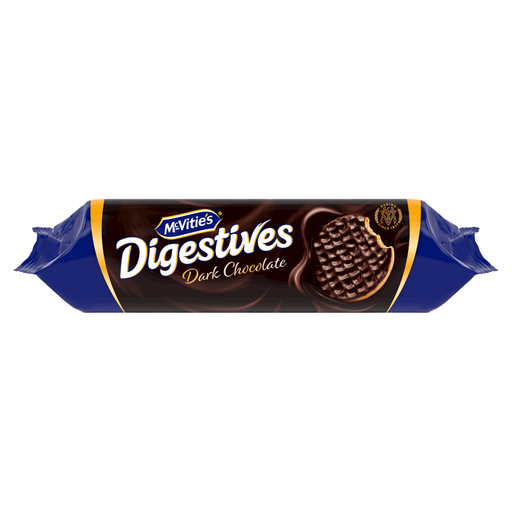
These McVitie’s dark chocolate digestive packs are options if you want biscuits as one part of your walking food. Their pack sizes differ from the 300g retailer product discussed above, so check each pack’s own label.
 No image available
The twin-pack format is an option when biscuits are one part of your food for a walk. Check the current pack’s ingredients, allergens and per-biscuit nutrition rather than applying figures from the separate 300g listing.
 No image available
This 400g pack is another way to take digestives as a supplementary walking snack. Check its own portion size, chocolate description and allergen information; the Tesco-listed 300g pack’s figures should not be transferred to it.
Do not rely on biscuits alone for a long or demanding hike. They can contribute carbohydrate, but plan food and fluids for the route; the British Dietetic Association notes that carbohydrate during hard exercise lasting longer than an hour can be useful.
Tesco’s listing for its 300g dark chocolate digestives states a minimum of 48% cocoa solids in the dark chocolate. A percentage describing how much of a biscuit is chocolate is a different measure, so check which figure a label gives.
Read the physical pack of the exact product before eating it. The researched Tesco biscuit lists wheat and soya and may contain milk; the researched McVitie’s product lists milk, soya and wheat; the M&S product also lists barley malt extract. Ingredients and allergen information can change.
The biscuit name alone does not establish a product’s classification or a UK-wide school-food restriction. The Department of Health and Social Care’s nutrient profiling model determines whether a product is classed as less healthy using a calculated score, while the Department for Education’s school-food practical guide applies to England. Check the classification of the specific product and the rules applicable to the school.