Hosts making Halloween party bags
Miniature bars give you a defined number of pieces to divide between guests. Divine lists 100 dark mini bars at 4.2g each; check whether the pack provides the individual wrapping your bags require.


Choose miniature bars when you need a defined piece for each guest; Divine’s 100-pack contains 70% dark bars weighing 4.2g each, but check the packaging if individual wrapping matters for party bags. Loose buttons suit a sharing bowl, while batons and filled selections suit a table where guests can see the assortment and its ingredient information. Check the exact pack’s allergen label before serving; food provided by a state-funded school in England during the school day is subject to separate rules that prohibit chocolate.
Miniature bars give you a defined number of pieces to divide between guests. Divine lists 100 dark mini bars at 4.2g each; check whether the pack provides the individual wrapping your bags require.
Loose buttons can go in a serving bowl, while dark batons or a filled selection offer another way to serve guests at a table. Check the cocoa content and ingredients of the particular product rather than assuming all dark assortments taste alike.
Keep the original packaging available so guests can check ingredients and allergen statements. For food provided by a state-funded school in England during the school day, Department for Education guidance says chocolate must not be served; check the applicable rules and venue policy for other school events.
Start with how the chocolate will be handed out or served. Then check the exact pack for cocoa content, allergens and any rules that apply to the event.
| Priority | What to check | Your needs |
|---|---|---|
| Portions and packaging | Compare the number and weight of pieces with your guest count. Confirm individual wrapping if the chocolate will go into party bags; a bag of loose buttons is a sharing format. | I want to give each guest a defined piece, rather than leave them to serve themselves from a bowl. |
| Cocoa content | Read both the product name and the cocoa-solids information on the pack. Montezuma’s Organic 74% Buttons are named as 74%, while the cited ingredient information states 70% cocoa solids; confirm the current label before relying on either figure. Its Absolute Black Buttons are listed as 100% cocoa. | For a mixed group, I would check what kind of dark chocolate guests actually want before making a 100% cocoa product the main supply. |
| Allergens | Read the current ingredients and precautionary allergen statement for every pack. The Food Standards Agency explains that a ‘may contain’ statement communicates possible unintended allergen presence; a vegan recipe does not establish milk-allergy suitability. | Someone attending has an allergy, so I need to keep the pack information available and arrange a separately identified alternative if this chocolate is unsuitable. |
| School provision | Establish who provides the food and whether the event falls within the school day. Department for Education guidance for state-funded schools in England says chocolate must not be served as part of that provision; check venue policy and the rules applicable elsewhere. | I’m organising a school event and need to settle what can be served before buying treats. |
A vegan recipe does not rule out allergen warnings. Lindt says its Excellence 70% bar is made to a vegan recipe but is not suitable for people with a milk allergy because it is made in a facility that uses milk.
Ask about allergies, keep the original packaging and check each product’s current label before serving it.
A sharing bag does not give you separately packaged pieces to place in party bags or hand out one at a time.
Check the piece count and wrapping before buying for hand-outs. Use loose buttons where guests can serve themselves from a table.
Montezuma’s describes its Absolute Black 100% cocoa buttons as an intense choice. That makes guest preference particularly relevant when selecting the main party chocolate.
Check whether guests want that cocoa level, or offer it alongside another dark-chocolate option.
Department for Education guidance prohibits chocolate in food provided during the school day by state-funded schools in England. That provision is different from a private party.
For a school event, establish whether the provision is covered and check venue policy before purchasing. Do not assume the England guidance settles the rules for schools elsewhere in the UK.
These brand examples illustrate different serving formats; check the particular pack you intend to buy, especially where a selection contains several recipes.
Divine Chocolate lists a pack of 100 miniature 70% dark bars, each weighing 4.2g.
Montezuma’s lists 120g bags of Organic 74% Dark Chocolate Buttons and Absolute Black 100% Cocoa Buttons.
Hotel Chocolat’s dark range lists 70% and 85% batons alongside filled dark selections.
Lindt Excellence 70% is listed as a 100g dark bar, an alternative to buying a miniature format.
M&S lists a 100g dark bar with at least 85% cocoa solids.
This dark-chocolate truffle box is an option to consider for a shared Halloween table. If you need one packaged piece per guest, confirm the piece count and wrapping before choosing it.
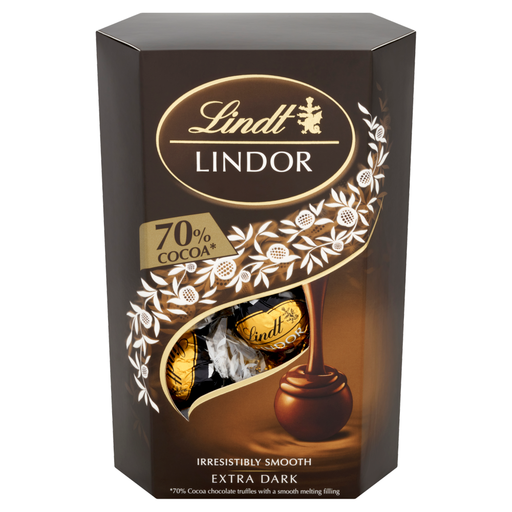 Image unavailable
The 200g dark-chocolate truffle box is a possible choice for a shared table. Its stated cocoa level is 70%. Check the piece count and individual wrapping if you plan to fill party bags; the listed ingredients include milk, barley and soya, and the product may contain nuts, so read the current pack when serving guests with allergies.
Miniature bars give you a defined piece to allocate to each bag. Divine Chocolate lists a pack of 100 mini 70% dark bars weighing 4.2g each; confirm individual wrapping on the pack if you need each piece separately packaged. Loose buttons are better treated as a sharing format.
Not necessarily: check the exact product’s allergen statement. Lindt says its Excellence 70% bar is made to a vegan recipe but is not suitable for people with a milk allergy because it is manufactured in a facility that uses milk.
Not as food provided during the school day by a state-funded school in England: Department for Education school food guidance says confectionery and chocolate must not be served across the school day. For a different type of event or a school elsewhere in the UK, check the applicable rules and the venue’s policy rather than extending that England conclusion.
No. Department of Health and Social Care guidance concerns restrictions on specified retail location and volume-price promotions of products high in fat, sugar or salt, not a general ban on consumers buying chocolate. England’s school-food rules are a separate consideration when food is provided in a regulated school setting.