Adults planning a small chocolate break
Mini bars provide a stated small unit without opening a full-size bar. A box of fingers offers separate pieces, though you should check the pack if individual wrapping matters.


For a ready-separated mid-morning treat, look at miniature bars; a finger box offers separate pieces, but do not assume they are individually wrapped. Bundles of full-size bars make more sense if you are happy to divide and store each bar yourself. For children, the NHS favours fruit and vegetables as snacks, while Department for Education guidance says state-funded schools in England must not serve chocolate during the school day.
Mini bars provide a stated small unit without opening a full-size bar. A box of fingers offers separate pieces, though you should check the pack if individual wrapping matters.
Check portion format, ingredients and the current allergen label before packing. For children’s snacks, the NHS favours fruit and vegetables and recommends checking nutrition labels when buying packaged alternatives.
Department for Education guidance says chocolate must not be served during the school day in state-funded schools in England. Choose food that meets the school’s requirements; check local rules separately elsewhere in the UK.
Start with the unit you want to eat, then check whether the pack format, label and intended setting fit that choice.
| Priority | What to check | Your needs |
|---|---|---|
| Portion format | Check the stated weight or piece count. Divine lists 100 mini 70% dark-chocolate bars at 4.2g each; Hotel Chocolat lists its 70% batons as 15 fingers. Lindt’s five-bar EXCELLENCE selection contains 100g bars. | I want a small, ready-separated piece rather than having to break up a full-size bar. |
| Pack separation | Distinguish a bundle of bars from a box of pieces. Check the current packaging if each piece needs to be individually wrapped, and consider how you will store an opened bar. | For a snack away from home, I need to know whether I can take one piece without opening the rest. |
| Recipe and allergens | Compare cocoa percentages and ingredients for the particular variant. Read the current pack’s allergen statement: Marks & Spencer says its 85% dark bar is unsuitable for people with milk, nut or peanut allergies. | I want a cocoa level I enjoy, but I cannot assume that a dark recipe meets my ingredient or allergy requirements. |
| Children and schools | Use the current nutrition label when comparing packaged snacks; the NHS favours fruit and vegetables for children’s snacks. Department for Education guidance prohibits serving chocolate during the school day in state-funded schools in England. | If I am packing food at home, I want to assess the snack and its label. If I am choosing food supplied by an English state-funded school, chocolate is not an option under those standards. |
A multipack may be a bundle of full-size bars rather than miniature pieces. Hotel Chocolat identifies 15 fingers in its 70% baton box, but that count alone does not establish individual wrapping.
Look for a stated unit weight or piece count, and check the packaging before relying on it for a lunchbox.
Cocoa percentage identifies a recipe characteristic; it does not replace the NHS’s advice to favour fruit and vegetables for children’s snacks.
When considering a packaged snack, compare its current nutrition label rather than judging it by cocoa percentage alone.
Department for Education guidance says state-funded schools in England must not serve chocolate or chocolate-coated products during the school day.
Choose an option that meets the school’s food requirements. For schools elsewhere in the UK, confirm the applicable local rules.
A dark or dairy-free recipe description does not settle whether a product carries a precautionary allergen warning. Marks & Spencer’s 85% bar, for example, is labelled unsuitable for people with milk, nut or peanut allergies.
Read the ingredients and allergen statement on the current physical pack, particularly when changing flavours or variants.
These examples show different pack formats and recipes; a brand’s presence here does not establish that every product in its range has the same format.
Divine lists both dark-chocolate bundles and a pack of 100 miniature 70% bars.
Its dark-chocolate baton range includes a 70% product listed as 15 fingers.
Lindt EXCELLENCE build-your-own selections let shoppers choose five or nine 100g bars.
Its Absolute Black taster bundle contains four 90g bars in 100% cocoa recipes.
M&S lists an 85% dark-chocolate bar among its chocolate products.
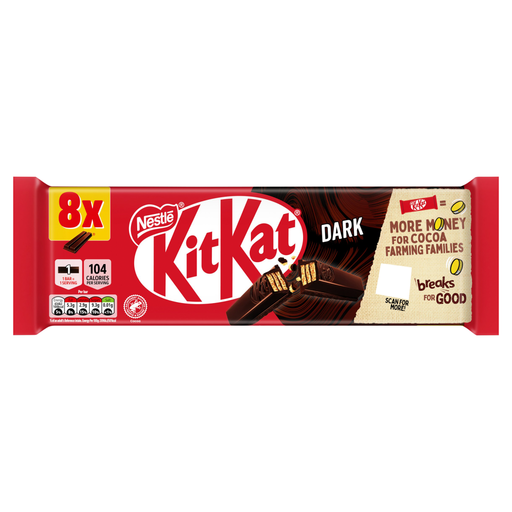
This option is a multi-unit dark-chocolate-coated wafer snack, rather than a pack of plain dark-chocolate bars. Check that distinction if the chocolate recipe or lunchbox format is central to your choice.
 No image available
The eight stated 20.7g units offer a defined size for a planned snack occasion. This is a wafer snack coated in dark chocolate, not a plain dark-chocolate bar; its product description lists milk ingredients and wheat. Check the packaging if individual wrapping or cocoa percentage matters to you.
Not necessarily: a bundle can contain several full-size bars rather than small, ready-separated servings. Check the unit weight and piece count; Divine’s 4.2g mini bars and Hotel Chocolat’s 15-finger baton box describe different formats from Lindt’s selection of 100g bars.
No. Department for Education school-food guidance says chocolate and chocolate-coated products must not be served during the school day in state-funded schools in England. That rule does not by itself determine what a parent may independently pack or what applies to schools elsewhere in the UK.
Read the ingredients and allergen statement on the current pack for the exact variant. Marks & Spencer labels its 85% dark bar unsuitable for people with milk, nut or peanut allergies; do not assume dark chocolate is free from those allergens.
No. Department for Education guidance concerns food provided in state-funded schools in England. Department of Health and Social Care guidance addresses restrictions on certain retail promotions and placements of foods high in fat, salt or sugar; it is not the basis for deciding whether an English school can serve chocolate.