Training with a high-cocoa preference
If a clearly stated cocoa percentage matters to you, treat the bar as an optional snack rather than assuming that more cocoa makes it a better carbohydrate choice before exercise.


For a snack shortly before training, a familiar carbohydrate-rich, lower-fat food is more consistent with Sports Dietitians Australia’s pre-exercise guidance than the dark chocolate bars assessed here. If you want dark chocolate for its cocoa content, a declared 70% bar meets that preference, but the assessed Lindt and Divine bars contain 41g and 44.3g fat per 100g respectively. Cocoa percentage alone does not tell you whether a bar meets your carbohydrate needs.
If a clearly stated cocoa percentage matters to you, treat the bar as an optional snack rather than assuming that more cocoa makes it a better carbohydrate choice before exercise.
If you need a snack before training, compare carbohydrate and fat per 100g and choose something you already tolerate. Sports Dietitians Australia advises familiar foods that are high in carbohydrate and low in fat before exercise.
Check the school-food requirements that apply to the setting. England’s school-food framework and its retail rules on promotions of certain products are separate matters; neither should be treated as a single UK-wide school-meal rule.
Decide whether the snack is mainly for carbohydrate before training or for the taste of high-cocoa chocolate. Then check the exact pack for its nutrition, ingredients and portion information.
| Priority | What to check | Your needs |
|---|---|---|
| Pre-workout snack | Compare carbohydrate and fat per 100g, then consider your portion and time before exercise. Sports Dietitians Australia advises familiar, well-tolerated, high-carbohydrate, low-fat foods. | I’m eating soon before training and want a familiar snack that agrees with me. I won’t assume a dark bar is the right carbohydrate choice. |
| Cocoa content | Read the declared cocoa-solids percentage, not just the word “dark”. Lindt Excellence and Divine state 70%; Tesco’s listing for Cadbury Bournville Classic states 36% minimum. | I want a stated high-cocoa bar, even if that is a different priority from getting carbohydrate before a workout. |
| Ingredients and allergens | Read the current ingredients and allergen statement for the exact variant, including any “may contain” warning. Do not use cocoa percentage to judge dietary suitability. | For me, the precise pack and its ingredient statement matter more than whether the wrapper says “dark”. |
| Individual exercise plan | If you use insulin or other glucose-lowering medication, follow your agreed exercise plan rather than choosing a bar by cocoa percentage. North Cumbria Integrated Care describes exercise-related carbohydrate and medication decisions in an individual care context. | I need to use the carbohydrate source and plan agreed with my diabetes healthcare team, not treat chocolate as a substitute. |
Montezuma’s lists 18g carbohydrate and 53g fat per 100g for Absolute Black 100% Cocoa. Sports Dietitians Australia’s pre-exercise guidance instead favours foods high in carbohydrate and low in fat.
Choose a higher cocoa percentage for that preference, not as a shortcut for choosing a carbohydrate snack. Compare both nutrients on the current pack if you plan to eat before training.
“Dark” describes the chocolate, not the full ingredient or allergen declaration. Suitability can differ between products and variants.
Check the exact pack’s ingredients, allergen statement and “may contain” warnings rather than relying on the cocoa percentage or wrapper.
England’s Requirements for School Food Regulations 2014 define confectionery to include chocolate. Department of Health and Social Care guidance on certain retail promotions also applies to England, but addresses a different setting.
For school provision, check the applicable school-food framework and UK nation. Assess any retail-promotion question separately under the current rules for the product and retailer.
Exercise-related carbohydrate and medication decisions depend on individual circumstances. North Cumbria Integrated Care’s guidance discusses them in the context of a plan agreed with a diabetes healthcare professional.
If you use insulin or glucose-lowering medication, follow your own team’s advice on exercise and the carbohydrate source to carry.
These figures describe the named bars, not every product made by each brand. The nutrition values below are per 100g so that bars with different pack sizes can be compared on the same basis.
Tesco lists Bournville Classic as dark chocolate with 36% minimum cocoa solids.
Lindt Shop UK states 70% minimum cocoa solids for its Excellence Dark 70% 100g bar.
Divine describes its 90g dark chocolate bar as a 70% cocoa product.
Absolute Black is presented by Montezuma’s as a 100% cocoa bar.
These are high-cocoa dark chocolate bars to consider if chocolate is your preference. For a snack before training, check the exact pack’s carbohydrate and fat figures rather than treating cocoa percentage as a fuelling measure.
 No image available
A 70% dark bar for a stated cocoa preference. If eating it before training, check the pack’s carbohydrate, fat and allergen information and choose a portion you know you tolerate; do not rely on cocoa percentage for a carbohydrate top-up.
 No image available
An 85% dark bar for someone prioritising cocoa content. Compare the current pack’s carbohydrate and fat figures before choosing it as a pre-workout snack, and check the allergen statement for your needs.
 No image available
This 85% cocoa bar suits a preference for a clearly named high-cocoa variant. Before eating it ahead of exercise, compare its pack nutrition with the portion you intend to have and read the allergen statement.
 No image available
A 72% cocoa option if a declared cocoa level matters to you. Check carbohydrate and fat for your intended portion before treating it as a pre-training snack, and read the current ingredients and allergen statement.
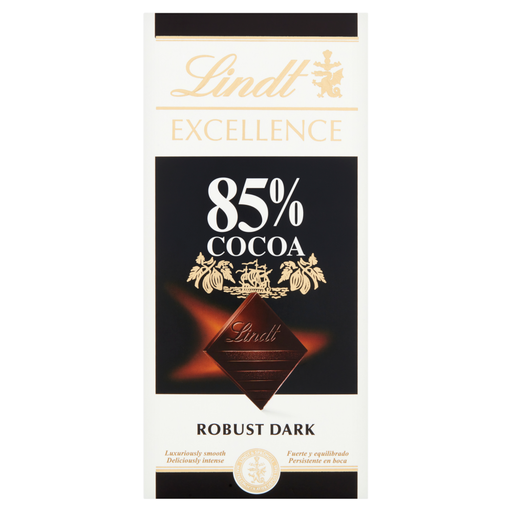 No image available
An 85% cocoa bar for a high-cocoa preference, rather than a reason to assume it supplies the carbohydrate you want before exercise. Check the current pack for portion-level nutrition and allergen information.
It is less aligned with the cited pre-exercise guidance than a familiar, carbohydrate-rich, lower-fat food. Sports Dietitians Australia recommends foods high in carbohydrate and low in fat before exercise; the assessed Lindt 70%, Divine 70% and Montezuma’s 100% bars contain 41g, 44.3g and 53g fat per 100g respectively. If you choose chocolate for its taste, consider whether you already tolerate it at that time before training.
No. Check the declared cocoa-solids percentage: Tesco lists Cadbury Bournville Classic at 36% minimum, while Lindt Excellence Dark 70% and Divine’s 70% bar state 70% cocoa. The label, rather than the word “dark”, tells you whether a bar meets your cocoa preference.
No. If you use insulin or glucose-lowering medication, follow the exercise and carbohydrate plan agreed with your diabetes healthcare team. North Cumbria Integrated Care’s patient guidance discusses exercise-related decisions in an individual care context, not chocolate as a universal choice.
No. England’s Requirements for School Food Regulations 2014 define confectionery to include chocolate, while Department of Health and Social Care guidance on certain retail promotions addresses a separate retail setting in England. Check the requirements applicable to the particular school setting or retail promotion; do not extend an England-specific conclusion across the UK.