Passengers who like high-cocoa chocolate
If you want a stated cocoa percentage without choosing a very high-cocoa bar, products in the 70–74% range give you several plain and flavoured options to compare.


For a road trip, a plain 70–74% cocoa bar is a starting point if the group wants a high-cocoa flavour; choose fingers or batons instead if dividing chocolate at stops matters more. Check the exact pack for allergens, and keep chocolate out of direct sun and warm parked cars: Callebaut says higher temperatures can soften it.
If you want a stated cocoa percentage without choosing a very high-cocoa bar, products in the 70–74% range give you several plain and flavoured options to compare.
If several people will take a piece, consider how the chocolate divides. Hotel Chocolat labels its 70% Dark Chocolate Batons as 15 fingers; a bar may need breaking and handling.
Choose by the ingredients and allergen statement on the exact pack. A vegan recipe does not, by itself, establish suitability for someone with a milk allergy.
Choose a flavour and format the group wants, then check the pack’s allergen information and plan where to keep it during the journey.
| Priority | What to check | Your needs |
|---|---|---|
| Cocoa and flavour | Compare the stated cocoa percentage and any flavour additions. Plain 70% bars, a 72% M&S bar and a 74% Montezuma's bar are among the documented options; inclusions change more than the cocoa percentage alone. | I’d rather choose a cocoa level and flavour the people travelling will enjoy than treat the highest percentage as a quality score. |
| Sharing format | Check whether the pack contains fingers or a bar, its weight and whether pieces are individually wrapped. Hotel Chocolat describes its 70% batons as 15 fingers, but that description does not establish individual wrapping. | At a planned stop, I want to divide the chocolate without opening more than the group expects to eat. |
| Heat and storage | Read the pack’s storage instructions and consider where it will sit in the car. Callebaut gives 12–18°C as an ideal storage range for pure chocolate and says higher temperatures can soften it. | If the car will be warm or parked in sunlight, I need somewhere shaded to keep the chocolate and will take it with me during long stops. |
| Allergens | Read the ingredients and precautionary statements for the exact variant. The Food Standards Agency explains that a “may contain” statement signals possible unintended allergen presence. | Someone in our group needs to avoid an allergen, so a “dark” or “vegan recipe” label alone will not settle the choice. |
Warnings differ between products. Lindt says its EXCELLENCE 70% bar has a vegan recipe but is not suitable for someone with a milk allergy; other dark products carry different allergen statements.
Read the current ingredients and allergen statement for the exact flavour and pack before choosing for someone who must avoid an allergen.
Callebaut says chocolate can soften and lose gloss above its ideal storage range, making it harder to handle as a travel snack.
Keep the pack shaded and dry, and take it with you rather than leaving it in a warm parked vehicle during a long stop.
A percentage does not tell you whether the pack is easy to share or whether its ingredients suit everyone travelling.
Choose a flavour, then check the format, ingredients, allergen statement and storage instructions.
These examples show why the exact product and variant matter; a characteristic of one bar does not apply to a brand’s entire range.
Tesco lists its Organic 70% Dark Chocolate as a 90g bar.
Divine lists a 90g 70% Dark Chocolate bar described as vegan.
Lindt EXCELLENCE Dark 70% is listed as a 100g bar made to a vegan recipe.
Montezuma's lists plain high-cocoa bars alongside dark chocolate with additions such as cherry, chilli, mint and cocoa nibs.
Hotel Chocolat lists 70% Dark Chocolate Batons as 15 fingers.
Marks & Spencer lists Swiss Extra Fine Dark Chocolate as a 125g bar with 72% cocoa solids.
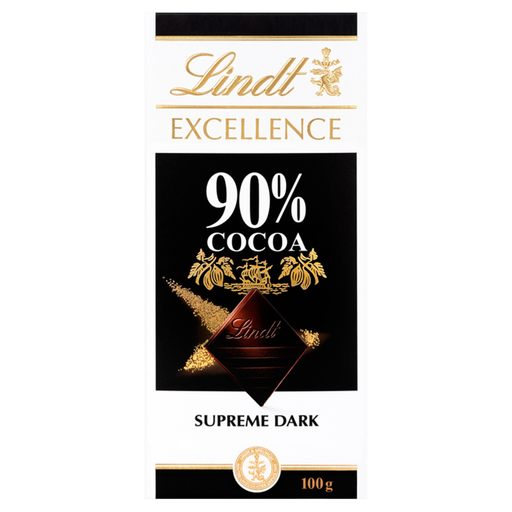
This 90% cocoa bar is an option for travellers who already prefer a higher cocoa percentage; it is not a substitute for choosing a sharing format or checking the pack for allergens.
 No image available
This 90% cocoa bar suits a trip only if the intended eaters want that cocoa level. Check the current pack’s allergen information and how the bar divides if it will be shared; keep chocolate out of a warm or sunlit car.
A 70–74% bar is a starting range if you want high-cocoa dark chocolate without choosing a 90% or 100% product. Compare flavours as well as percentages: Divine, Lindt and Green & Black's list 70% bars, while M&S lists a 72% bar and Montezuma's lists a 74% option. Check ingredients and allergens separately.
Keep it shaded and dry, and do not leave it in a warm parked car. Callebaut gives 12–18°C as an ideal range for storing pure chocolate and says higher temperatures can soften it; check the particular pack’s storage instructions too.
Not necessarily. Lindt says its EXCELLENCE Dark 70% bar has a vegan recipe but is not suitable for people with a milk allergy. Use the current ingredients and allergen statement for the exact product.
The Food Standards Agency explains that precautionary allergen labelling indicates an allergen could be unintentionally present. If someone needs to avoid that allergen, do not assume the chocolate is suitable because it is absent from the main ingredient list.
England’s Requirements for School Food Regulations 2014 define chocolate as confectionery for the school-food context; that definition is not a general prohibition on buying chocolate for an ordinary road trip. It should not be treated as a UK-wide rule for every setting.