Families baking with school-age children
Choose between chocolate for the recipe and pieces intended to remain visible after baking. Before serving, check the texture and size of any toffee pieces, as well as the current pack’s allergen information.


For a high-cocoa chocolate element, choose cooking chocolate with a stated cocoa percentage and select the toffee or caramel separately. If recognisable pieces after baking matter more, look for an inclusion explicitly described as bake stable; check its cocoa content, allergens and age warning rather than assuming it meets the same brief.
Choose between chocolate for the recipe and pieces intended to remain visible after baking. Before serving, check the texture and size of any toffee pieces, as well as the current pack’s allergen information.
Compare the exact chocolate component rather than relying on the word “dark”. Marks & Spencer lists 70% minimum cocoa solids for its cooking chocolate and Tesco lists 45% minimum for Rolo Dark; Tesco describes Riesen as toffee in 30% dark chocolate. These are different products, not interchangeable cocoa-percentage claims.
Read the current pack before using an ingredient. The products discussed here declare or warn of different allergens, including milk, soya, gluten-containing cereals, peanuts and tree nuts; one product’s label cannot stand in for another’s.
Decide whether the recipe calls for a high-cocoa chocolate base, pieces that hold their appearance in the oven, or a ready-made toffee centre; then check whether the ingredient is appropriate for the children who will eat it.
| Priority | What to check | Your needs |
|---|---|---|
| Cocoa content | Read the cocoa declaration for the exact product. Check whether it describes cocoa solids in the chocolate or the proportion of dark chocolate coating a sweet. | I want the chocolate element to have a clearly stated cocoa percentage, rather than choosing a toffee sweet because its name says “dark”. |
| Appearance after baking | Look for an explicit bake-stability statement if visible pieces matter. Waitrose & Partners describes Dr. Oetker Billionaire’s Choc Chip as retaining its colour, shape and texture when baked. | For cookies or cupcakes with distinct pieces, I would choose an inclusion with a stated baking use instead of assuming an ordinary sweet will hold its shape. |
| Toffee texture | Check whether the toffee is described as soft or chewy, and consider the size and shape of pieces before serving. A chocolate bar or plain chips will need a separate toffee or caramel ingredient if the recipe calls for one. | I want a toffee element, but need its texture and portion size to suit the children eating the finished bake. |
| Age suitability | Follow the product’s age warning. Tesco warns about small Rolo Dark sweets for children under 4; Waitrose & Partners labels Dr. Oetker’s mix unsuitable for children under 36 months. | Before children eat the bake, I need to consider the pieces in it—not just whether they can help with mixing. |
| Allergens | Read both the ingredients and “may contain” statements on the current pack. Check every component separately if combining chocolate with toffee or caramel. | If someone eating the bake has an allergy, I need to assess the exact ingredients I am using, including any separate toffee pieces. |
Dark chocolate toffees and cooking chocolate can have substantially different declarations. Tesco lists 45% minimum cocoa solids for Rolo Dark and describes Riesen as toffee in 30% dark chocolate; Marks & Spencer lists 70% minimum cocoa solids for its cooking chocolate.
If a stated high cocoa percentage is central to the recipe, check the chocolate label first. Add a separately selected toffee or caramel ingredient if you also want that element.
A soft-centred or chewy sweet is not the same proposition as an inclusion labelled bake stable. Its appearance in the finished bake may not match a recipe that relies on distinct pieces.
For that result, choose a product with an explicit bake-stability statement; Waitrose & Partners provides one for Dr. Oetker Billionaire’s Choc Chip.
The NHS identifies hard, gooey and sticky sweets as choking hazards for babies and young children and advises considering food’s size, shape and texture. Individual products can carry additional age warnings.
Follow the warning on the exact pack. Do not give toffee sweets to babies or young children, and consider piece size and texture when preparing food for older children.
Allergen declarations differ across these chocolates, sweets and baking inclusions. A recipe using two ingredients also brings together two sets of declarations.
Check the current physical pack for each ingredient before baking, particularly when milk, soya, wheat, peanuts or tree nuts matter to the household.
These examples illustrate different ingredient types; a brand name alone does not establish cocoa content, baking behaviour or suitability for a child.
Marks & Spencer describes its Dark Chocolate as suitable for cakes, cookies and desserts and states 70% minimum cocoa solids. It supplies the chocolate element, not the toffee.
Tesco describes Rolo Dark as dark chocolates with a soft toffee centre and states 45% minimum cocoa solids for the chocolate.
Tesco describes Riesen as chocolate toffee in 30% dark chocolate, making it a chewy-sweet option rather than a dedicated cooking chocolate.
Waitrose & Partners describes Billionaire’s Choc Chip as bake stable for uses including cookies, cupcakes and brownies; its chocolate is listed at 32% minimum cocoa solids.
Tesco describes its Dark Milk Chocolate Pretzel Toffee bar as milk chocolate with pretzel crumbs and caramel pieces, stating 42% minimum cocoa solids.
These are chocolate options for the baking part of the decision, not ready-made dark chocolate toffees. Choose and check a separate toffee or caramel ingredient if the recipe needs one; do not assume the chocolate will retain distinct pieces in the oven.
 No image available
Consider this cooking chocolate when the recipe needs a dark chocolate base with a stated cocoa percentage.
The named variant is 70% cocoa and 100g. It is chocolate rather than a ready-made toffee ingredient, so check a separate toffee or caramel component if needed. Check the current packs for allergens and any child-specific warnings before use.
 No image available
This dark chocolate bar offers another stated cocoa percentage for choosing the chocolate element of a bake.
The named variant is 72% cocoa and 100g. It is not a toffee product; choose a separate toffee or caramel component if the recipe calls for one. Check the current packs for allergens and any child-specific warnings.
 No image available
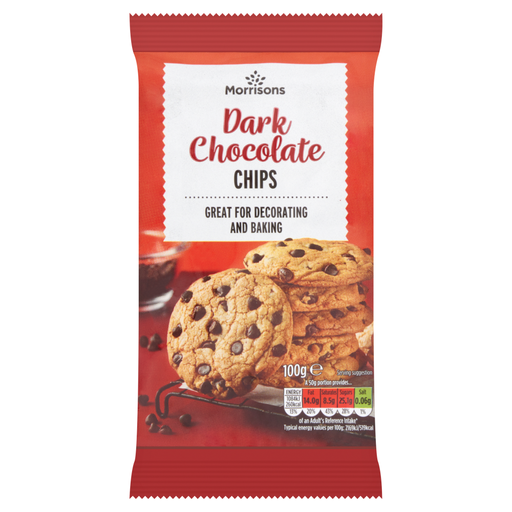
Choose chips when the recipe calls for chocolate pieces rather than a bar to portion.
This 100g product is chocolate chips, not a toffee inclusion. If distinct pieces after baking are important, check whether the product makes a bake-stability claim for the intended use. Read the current pack for allergens and any child-specific warnings.
No. Tesco lists 45% minimum cocoa solids for the chocolate in Rolo Dark and describes Riesen as toffee in 30% dark chocolate. Marks & Spencer lists 70% minimum cocoa solids for its cooking chocolate, but that product does not contain toffee. Check the declaration on the exact product you intend to use.
Look for an explicit bake-stability statement. Waitrose & Partners describes Dr. Oetker Billionaire’s Choc Chip as retaining its colour, shape and texture when baked, including in cookies, cupcakes and brownies. Do not assume an ordinary chocolate-toffee sweet will behave the same way.
Do not give hard, gooey or sticky sweets to babies or young children: the NHS identifies them as choking hazards. Follow product-specific warnings too. Tesco warns that children under 4 could choke on small Rolo Dark sweets, and Waitrose & Partners labels Dr. Oetker’s mix unsuitable for children under 36 months.
Yes. Check the current physical pack of every chocolate, toffee or caramel ingredient before baking. The products discussed have different ingredient and “may contain” declarations, including milk, soya, gluten-containing cereals, peanuts and tree nuts; a previous pack or another product’s label is not a substitute.