People counting carbohydrates
If you want a custard cream, the carbohydrate for the number of biscuits you plan to eat matters more than a colour cue or a “diabetic-friendly” description. Diabetes UK also advises paying attention to portion size.


A dark appearance or chocolate coating does not establish that a custard cream has less carbohydrate: the checked coated Tesco and M&S products are milk-chocolate varieties, not high-cocoa dark chocolate. If you are counting carbohydrates, compare the amount in the portion you intend to eat; a separately portioned dark chocolate is a different treat, not a dark custard cream.
The useful starting point is whether you want a custard cream, a coated biscuit or chocolate on its own.
If you want a custard cream, the carbohydrate for the number of biscuits you plan to eat matters more than a colour cue or a “diabetic-friendly” description. Diabetes UK also advises paying attention to portion size.
If the stronger taste of dark chocolate is what appeals to you, distinguish a separate piece of chocolate from a filled biscuit. The checked chocolate-coated custard creams from Tesco and M&S use milk chocolate.
Compare the portion first, then read the description and nutrition panel for the complete biscuit. A cocoa percentage for a coating cannot stand in for the biscuit’s carbohydrate figure.
| Priority | What to check | Your needs |
|---|---|---|
| Carbohydrate and portion | Check carbohydrate per biscuit, the biscuit’s weight and how many you intend to eat. Use per-100 g figures to compare products at a common weight. | I want to count the portion I will actually eat, rather than assume that one biscuit is the same size across packs. |
| Type of chocolate | Read whether the coating is described as milk or dark chocolate. Check any stated cocoa-solids content alongside the nutrition panel for the whole biscuit. | If I am looking for high-cocoa dark chocolate, I do not want to mistake a milk-chocolate-coated custard cream for it. |
| Sugars and saturated fat | Read the values for the stated serving and adjust for the amount eaten. Check the biscuit and filling as well as any coating. | I want to know what the complete treat contributes, not judge it by the coating alone. |
| Ingredients and allergens | Check the ingredient and allergen declarations on the pack you receive, particularly if an online listing differs. | When I need to avoid an ingredient, I need the details for the exact pack before eating it. |
The checked coated custard creams from Tesco and M&S are described as milk-chocolate products. Diabetes UK’s suggestion to consider 70% cocoa dark chocolate concerns chocolate as a separate treat, not a filled biscuit.
Read the exact coating description, then check the nutrition panel for the whole biscuit.
Tesco lists 17.5 g carbohydrate for a 27 g coated biscuit, while its Crawford’s listing gives 8.1 g for an 11.9 g plain biscuit. Those per-biscuit figures describe different-sized products, not the effect of coating alone.
Start with the number of biscuits you intend to eat; use the per-100 g values if you need a common-weight comparison.
Product details can change, so an online description may not match the pack delivered to you. That difference matters when you need to avoid a particular ingredient.
Read the delivered pack’s ingredient and allergen information before eating, and ask the seller or manufacturer about any discrepancy.
These examples describe specific listed products, not every custard cream made or sold under each name.
A plain vanilla-filled custard cream with a stated per-biscuit portion in Tesco’s listing.
Morrisons describes the Tasties custard creams as biscuits with a custard-flavoured filling.
Its listed plain and milk-chocolate-coated custard creams illustrate two different formats.
Its listed coated custard cream gives a portion figure for a larger, milk-chocolate-coated biscuit.
Its listed Outrageously Chocolatey custard creams are milk-chocolate-coated.
This plain custard-cream option is for someone who wants a filled biscuit rather than a chocolate-coated variety. Use the pack’s nutrition information to assess the portion you intend to eat.
 No image available
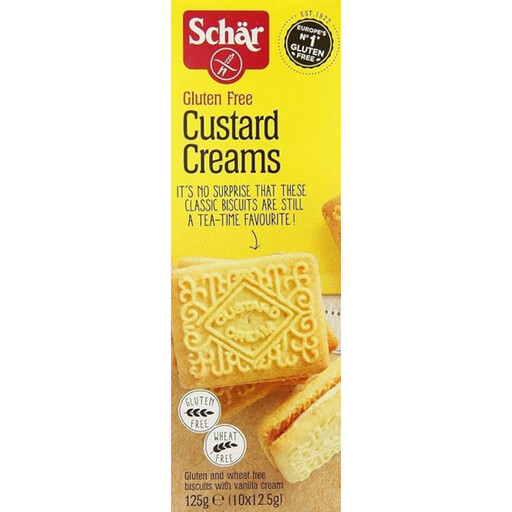
A plain custard-cream option if you want a filled biscuit rather than a chocolate coating. The pack is labelled gluten-free and weighs 125 g; check its current carbohydrate and ingredient information when choosing a portion.
No conclusion about a filled biscuit follows from the cocoa percentage alone. Diabetes UK mentions 70% cocoa dark chocolate for its stronger taste, but a custard cream also has a biscuit and filling; check the complete product’s carbohydrate figure and your intended portion.
Check the ingredient and allergen information on the exact pack before eating it. Online product details can change, so ask the seller or manufacturer if the pack and listing disagree.
Custard creams are ready-to-eat biscuits; follow the storage instructions on the pack you receive.