What should you check?
Decide whether you need a routine snack or are comparing biscuits, then check the particular product’s label and how it will be served.
| Priority |
What to check |
Your needs |
| Routine snack |
Distinguish a sweet biscuit from the NHS’s snack suggestions, such as fruit or plain unsweetened yoghurt with banana. The NHS advises avoiding sugary snacks for children aged four or younger. |
For an everyday snack, I would rather choose an option suggested for young children than rely on a biscuit’s colour or flavour. |
| Allergens |
Read the current pack’s ingredients and precautionary information. Checked custard creams list milk and wheat; ASDA’s milk-chocolate-coated version also lists soya. |
If the child has an identified allergy, I need to check the particular pack and variant before serving it. |
| Chocolate and nutrition |
Check whether the coating is described as milk or dark chocolate, then compare sugars and saturates on the same per-100g basis. ASDA Groceries lists 29g sugars per 100g for its checked plain custard creams and 48g for its milk-chocolate-coated version; those figures apply to those two products. |
I do not want to assume that a dark-looking or chocolate-coated biscuit contains less sugar. The exact product label matters more than the search description. |
| Serving and storage |
Have young children sit down and supervise them while they eat, as NHS-linked choking-prevention advice recommends. Follow the pack’s storage directions after opening. |
I need a snack I can serve while the child is seated and supervised, and I want to store any remaining biscuits as directed. |
Brand and product-line references
These label examples help distinguish plain, extra-cream and milk-chocolate-coated custard creams; a brand name alone does not establish that a biscuit is a dark variety.
ASDA
Its checked plain and milk-chocolate-coated custard creams provide two specific labels to compare.
- ASDA Groceries lists 29g sugars per 100g for the plain 400g pack and 48g per 100g for the milk-chocolate-coated 162g pack.
- Both checked products declare milk and wheat; the coated version also declares soya. The coated product is labelled milk chocolate, not dark chocolate.
Crawford's
The checked 300g pack is a vanilla-flavour custard cream rather than a chocolate-coated variety.
- Tesco Groceries lists 30.7g sugars and 13.7g saturates per 100g for this product.
- Its listed ingredients include wheat and milk; the product description makes no dark-chocolate claim.
McVitie's
The checked Tasties Custard Creams are a conventional cream-filled biscuit.
- Joybuy’s product listing states 30.6g sugars per 100g for the checked 300g pack.
- That listing declares milk and wheat. Its descriptive wording does not establish suitability for toddlers.
M&S
Extra Cream Custard Creams are described by M&S as having a larger vanilla-cream filling.
- M&S lists 40.2g sugars per 100g for the checked 165g product.
- Its ingredients include milk, wheat and soya lecithin. Check the current pack if those ingredients matter to your choice.
Tesco
The checked 162g chocolate-coated custard creams show why the type of chocolate needs checking.
- Tesco Groceries labels the coating milk chocolate with at least 27% cocoa solids and lists 47.6g sugars per 100g.
- Neither the cocoa declaration nor the chocolate coating identifies this product as a high-cocoa dark variety.
Custard creams on Joybuy
This Joybuy option is a custard cream biscuit for comparing products, not a suggested toddler snack.
 No image available
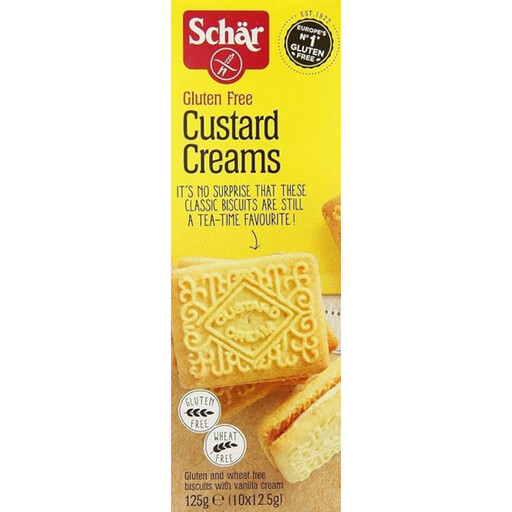
Schar Gluten Free Custard Creams 125g
This is a custard cream biscuit, not one of the NHS’s suggested routine snacks for young children. The product information warns that it is not suitable for young children because of a choking risk; do not serve it to a toddler.
View on Joybuy
Frequently asked questions
Is a high-cocoa dark custard cream a better toddler snack?
A dark or high-cocoa description does not establish that a custard cream is a better toddler snack. The checked chocolate-coated examples are labelled milk chocolate, while the NHS advises avoiding sugary snacks for children aged four or younger. Assess any different product using its own ingredients and nutrition label.
Are the checked custard creams suitable for a child with a milk allergy?
Do not treat the checked products as milk-free: their listed ingredients include milk. Check the current pack’s ingredients and precautionary information against the child’s allergy requirements, particularly when changing products or variants.
How should a toddler’s snack be served and the pack stored?
Have the child sit down and supervise them while they eat, in line with NHS-linked choking-prevention advice. Follow the particular pack’s storage directions; ASDA Groceries directs purchasers of its checked plain custard creams to use an airtight container after opening.
Are all custard creams banned from UK school meals under HFSS rules?
The cited HFSS retail-promotion rules do not establish a UK-wide school-meal ban for every custard cream. Department of Health and Social Care guidance describes restrictions on specified promotions in England; school food is governed separately. Department for Education guidance for state-funded schools in England, updated on 14 September 2026, says proposed changes intended for September 2027 remain subject to Parliamentary approval.
What if an early-years provider in England supplies the snack?
Food supplied by an early-years provider in England falls under requirements distinct from a parent’s choice of a snack at home. The Department for Education says meals, snacks and drinks provided under the Early Years Foundation Stage must be healthy, balanced and nutritious; providers must take its nutrition guidance into account and follow it unless there is good reason not to.


