What matters when choosing a monitor
OLED, Mini LED VA and IPS address different priorities here; the panel choice does not replace checking the exact monitor and the system connected to it.
High-refresh QHD OLED
Choose it when: Dark-scene contrast and fast motion are central to your choice, and your PC can produce frame rates that make a high refresh ceiling useful.
Accept: OLED-care guidance remains relevant, and a headline refresh rate cannot create frames your system does not produce.
QHD Mini LED VA
Choose it when: You want an LCD with local dimming for dark scenes and bright effects. RTINGS found deep blacks and good local dimming on the AOC Q27G3XMN.
Watch for: Local-dimming and VRR behaviour are model-specific; RTINGS also reported distracting VRR flicker on that AOC monitor when frame rates changed.
QHD IPS
Choose it when: A conventional LCD setup and connections for mixed desktop use matter more to you than the deepest dark-room blacks. The BenQ MOBIUZ EX271Q is a feature-oriented example.
Accept: BenQ lists 1000:1 native contrast for the EX271Q; its DisplayHDR 400 certification alone does not establish how it will handle dark scenes.
| Concern |
What to check |
Who this matters to |
| Dark-scene contrast |
Check panel type and contrast. For an LCD, check whether the exact model has local dimming rather than relying on an HDR badge. |
When I play with the room lights off, I want dark areas and bright effects to remain distinguishable. Roughly 42% of consumers would put dark-scene presentation first. |
| Motion and changing frame rates |
Match refresh rate to the frame rates you can sustain, then confirm VRR compatibility and the chosen input’s refresh limit. |
If aiming feels less consistent when the action gets busy, I care most about smooth motion and reduced tearing; around 33% of consumers would make that their primary need. |
| Connections and mixed use |
Check each port’s capabilities and, if needed, USB-C video and charging support or switching between connected devices. |
I also use my desk for another computer, so the connections have to work for both setups. About 25% of consumers would prioritise that practical fit. |
Joybuy monitors for dark-room gaming
These OLED monitors offer different refresh rates and screen formats for dark-room co-op gaming. Check that your games, system and desk suit the particular model rather than treating the largest screen or refresh figure as the deciding factor.
 No image available
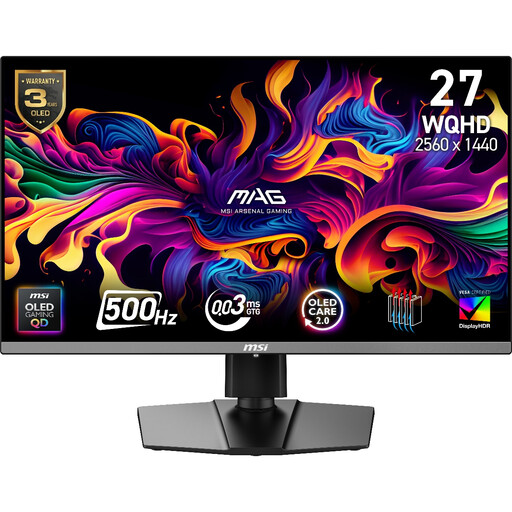
MAG 272QP QD-OLED X50 27-inch
Consider this QD-OLED model if dark-scene contrast and a high refresh ceiling are priorities for your PC setup.
The listed resolution is 2560 × 1440, with a 500Hz refresh rate, 0.03ms response-time rating and AMD FreeSync. Check that your system, connection and game settings can use the refresh rate, and read the exact OLED-care and warranty terms.
View on Joybuy
 No image available
LG UltraGear 34GX900A-B 34-inch OLED
This is an option if you want an OLED screen and have room for an ultrawide gaming setup.
The listed refresh rate is 240Hz. Confirm that your co-op games and connected system handle the monitor’s 21:9 format as you want, and follow its screen-protection guidance for extended static images.
View on Joybuy
 No image available
Acer X Predator X49X 49-inch QD-OLED
Consider its wide viewing format only if it fits your desk and the shooters you intend to play.
The listed 32:9 curved display has a 240Hz refresh rate and AMD FreeSync Premium. Check game support for the format, the frame rate your system can drive and the model’s VRR behaviour if frame rates vary substantially.
View on Joybuy
 No image available
MSI MAG 271QP QD-OLED X28 27-inch
This QHD QD-OLED model suits a conventional-sized desk setup where dark-scene presentation and fast motion both matter.
Its listed refresh rate is 280Hz, with a 0.03ms response-time rating. Confirm the exact HDR certification before choosing it for HDR, and check its OLED-care and warranty terms.
View on Joybuy
 No image available
Samsung Odyssey G6 S27DG612 27-inch OLED
This QHD OLED model is another conventional-sized option when dark-scene contrast and shooter motion are both priorities.
The listed refresh rate is 240Hz, with a 0.03ms response-time rating. If HDR or long-term OLED ownership matters to you, confirm this exact model’s HDR specification, care guidance and warranty terms.
View on Joybuy
Questions about dark-room gaming monitors
Does DisplayHDR 400 mean a monitor will show deep blacks?
No. VESA says local dimming is typically absent and is not required at DisplayHDR 400. For an LCD monitor used in a dark room, check the exact model’s native contrast and whether it has local dimming.
Should I use VRR for co-operative shooters?
VRR is worth trying when your graphics hardware, connection and monitor support it: NVIDIA describes it as a way to reduce tearing, stutter and input lag. Check how the exact monitor behaves across the frame rates your games reach, particularly if those rates fluctuate.
Will every monitor input support its advertised refresh rate?
No; check the resolution and refresh limit for the input you plan to use. BenQ, for example, lists the MOBIUZ EX271Q at up to 144Hz over HDMI but up to 180Hz over DisplayPort, so the connection can change which setting is available.
What if a monitor bought online in the UK is faulty?
Report the fault to the seller. GOV.UK says a trader must repair or replace a faulty item returned within six months unless it can prove the item was not faulty when bought. A remedy for a fault is distinct from cancelling an order because you have changed your mind.


