Hosts planning a dark-themed sweet selection
Decide whether you need a particular colour or flavour, or cocoa content. A blackcurrant flavour can help narrow a jelly-sweet search, but the pack still needs checking for its appearance and ingredients.


If “dark” means a colour or a flavour such as blackcurrant, compare jelly sweets with that flavour stated on the pack; if it means high cocoa content, look at dark chocolate instead of assuming a jelly sweet contains cocoa. For a children’s party, check each pack’s ingredients, sugars and age warnings, and check the venue’s food policy if the event is at a school.
Decide whether you need a particular colour or flavour, or cocoa content. A blackcurrant flavour can help narrow a jelly-sweet search, but the pack still needs checking for its appearance and ingredients.
Haribo and M&S identify their respective Jelly Beans as vegan, but that does not establish the suitability of another jelly sweet. Check the dietary statement and ingredients on every product you plan to serve.
Check product-specific age warnings: M&S says its Jelly Beans are not suitable for children under 36 months because of a potential choking hazard. For a school event, confirm what the venue permits rather than treating retail promotion rules as its food policy.
Settle what “dark” needs to mean at this party, then compare the exact packs on dietary suitability, nutrition information and serving conditions.
| Priority | What to check | Your needs |
|---|---|---|
| Colour or cocoa | Check the product category and ingredients if cocoa is required. Check the actual sweet’s appearance if a dark colour matters; a flavour name alone does not confirm it. | I want the sweets to fit the party theme, but I need to decide whether that means a dark-looking jelly sweet or dark chocolate. |
| Dietary suitability | Read the current ingredients and any explicit dietary claim on each pack. Do not extend a vegan claim from one product to another in the same brand range. | Some guests may need a vegan option or need to check particular ingredients, so the exact product matters more than the brand name. |
| Sugars and portions | Compare sugars per 100 g on the nutrition panels, then check each pack’s stated serving. The Sainsbury’s listing for Rowntree’s Jelly Tots gives 59.8 g sugars per 100 g and defines a serving as 11 sweets. | I’m planning how much to put out, rather than treating a sharing pack as one serving. A claim about colours or fruit juice does not tell me its sugar content. |
| Age and venue | Read age warnings on the exact pack. For a school event, check the venue’s food policy; Department for Education school-food guidance concerns food provided in state-funded schools in England, while Department of Health and Social Care HFSS promotion guidance concerns businesses selling to England. | Young children may be attending, or the party may be held at a school, so I need to check both the product warning and the venue’s requirements. |
A fruit-flavoured jelly sweet and dark chocolate answer different requests, even if either could fit a dark-themed party.
Decide whether you mean appearance, a named flavour or cocoa content before choosing a product.
Haribo and M&S make vegan claims for their named Jelly Beans, not for every jelly sweet they sell.
Check the ingredients and dietary statement on each pack, including any substitute bought later.
The Sainsbury’s listing describes Rowntree’s Jelly Tots as having no artificial colours, flavours or preservatives, while its nutrition panel gives 59.8 g sugars per 100 g.
Use the sugars-per-100 g figure and the stated serving when comparing packs and planning portions.
Department for Education guidance addresses food provided in state-funded schools in England. Separate Department of Health and Social Care HFSS promotion guidance addresses businesses operating in and selling to England; neither tells you on its own what a particular school allows at a birthday event.
Ask the school for its food policy before buying sweets for an event there.
Haribo lists party, vegan and other filters for its sweets, but the claims that matter at checkout belong to the individual product.
The Rowntree’s Jelly Tots listing at Sainsbury’s names blackcurrant among the flavours and states a serving of 11 sweets.
M&S offers several kinds of jelly sweets, so check the details for the particular pack rather than applying one product’s claims across the range.
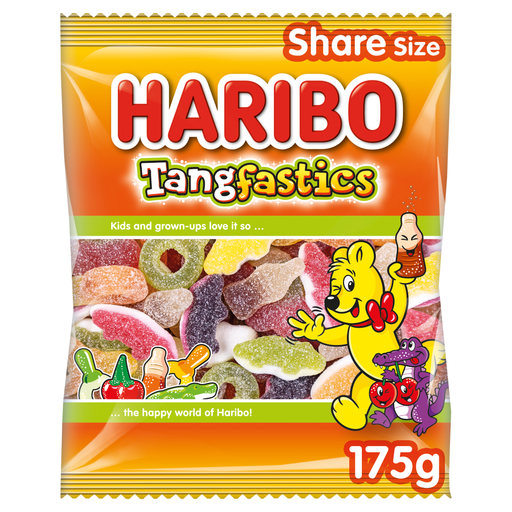
This cola-flavour sharing bag is an option if that flavour suits the party. Check the sweets’ appearance if you need a dark colour; cola flavour does not establish colour or cocoa content.
 No image available
The stated cola flavour may suit a party selection based on flavour, rather than a requirement for cocoa or a confirmed dark appearance.
This is a 175 g sharing bag of fizzy fruit and cola-flavour jelly sweets. If serving vegan guests or young children, check the current pack’s ingredients and age information before putting it out.
Only if colour or flavour is the requirement, not cocoa content. Haribo Jelly Beans and Rowntree’s Jelly Tots name blackcurrant among their flavours; check the sweets’ appearance for a colour theme, or choose the chocolate category if cocoa is what you need.
No. The Sainsbury’s listing for Rowntree’s Jelly Tots states no artificial colours and gives 59.8 g sugars per 100 g; M&S lists 51.8 g sugars per 100 g for its Jelly Beans. Compare the nutrition panels and stated servings on the exact packs.
Suitability depends on the product and the child. M&S warns that its Jelly Beans are not suitable for children under 36 months because of a potential choking hazard, so read age warnings and check ingredients for each sweet you intend to serve.