For survival games played mainly in a dark room, start with contrast and the exact model’s HDR capabilities rather than choosing by refresh rate alone. A QHD OLED at 240Hz is a sensible route if dark scenes are the priority; consider reflection control when the room is sometimes lit, or a higher refresh rate if you also play fast competitive games and your PC can use it. Long periods with fixed game interfaces or desktop elements make OLED panel care part of the decision.
Who these monitors suit
Dark-scene immersion players
You spend much of your time exploring dimly lit survival games and care more about separating shadows from bright highlights than reaching the highest available refresh rate. RTINGS notes that contrast makes a particularly noticeable difference to blacks in dark rooms.
Survival and competitive-game crossover players
You want an atmospheric picture for survival games but also play fast shooters or action games. Refresh rate matters more if your games and PC can produce the frame rates needed to use it.
Mixed gaming and desktop users
You game at night but also spend long periods with taskbars, browser windows or fixed game interfaces on screen. LG’s OLED support guidance says prolonged static elements may cause temporary image retention, so the exact monitor’s panel-care instructions matter.
What matters when choosing
Decide how much you value dark-scene contrast, then check whether your other games, screen habits and room lighting change the choice. Compare the exact models rather than assuming every OLED or LCD monitor behaves alike.
| Concern |
What to check |
Who this matters to |
| Dark-scene contrast and HDR |
Check the exact panel and any VESA DisplayHDR or DisplayHDR True Black certification; confirm that your game and source device can use HDR. |
I want dark areas and bright light sources to remain distinct during exploration. Around 37% of consumers put dark-scene contrast and HDR first. |
| Motion responsiveness |
Check the supported refresh rate at your chosen resolution and whether your PC, port and cable can deliver that mode. |
If I also play fast action games, I want motion to keep up with the frame rates my PC can produce. Motion is the primary concern for around 27% of consumers. |
| Static interfaces |
Read the exact OLED model’s panel-care and warranty guidance, particularly for long sessions with fixed HUDs or desktop elements. |
My health bars, menus or taskbar can stay in place for hours, so I need screen-care habits I can live with. Around 18% of consumers prioritise managing static content. |
| Lighting and connections |
Assess reflections at your desk, then check the screen finish and the monitor’s supported timings for your PC or console. |
My room is not always fully dark, or I need the monitor to work with more than one device. Lighting and connection flexibility come first for around 18% of consumers. |
Buying pitfalls
-
Assuming any HDR label settles the dark-scene question
An HDR label alone does not establish a certified performance tier. VESA says a display must meet its specifications to carry a DisplayHDR logo; the game’s HDR implementation also affects what you see.
Check the exact model’s VESA DisplayHDR or DisplayHDR True Black tier, then confirm HDR support on your game and source device.
-
Choosing 480Hz without checking your setup
A monitor’s maximum refresh rate does not mean your PC or console will output that mode in the games you play.
Check achievable game frame rates, graphics output, cable and the monitor’s supported timings at your intended resolution.
Using the intended mode may require a different cable or graphics hardware.
-
Overlooking fixed images on an OLED screen
Game HUDs, menus and taskbars can remain unchanged for long periods. LG advises that prolonged static elements may cause temporary image retention on its OLED monitors.
Follow your model’s panel-care instructions and avoid leaving a paused game or desktop unchanged unnecessarily.
-
Assuming a dark room has no reflections
A lamp, window or second screen may still affect viewing conditions. Samsung describes a Glare Free treatment on its Odyssey OLED G6 G61SH, but that model’s finish should not be assumed for other Odyssey variants.
Look at the lighting where you actually play and check the finish of the exact monitor you are considering.
Relevant brands to consider
LG UltraGear
The 27GS95QE-B is one 27-inch QHD OLED option for players prioritising dark-room contrast alongside 240Hz gaming.
- LG UK specifies DisplayHDR True Black 400, HDMI 2.1 and a 240Hz refresh rate for the 27GS95QE-B.
- Those specifications do not apply to every UltraGear model. Consider LG’s OLED image-care guidance if fixed interfaces stay on screen for long periods.
ASUS ROG
The ROG Swift OLED PG27AQDP is a QHD OLED option for players who give fast competitive games substantial time alongside survival games.
- ASUS ROG UK specifies a native 480Hz refresh rate for this 26.5-inch model.
- To make use of that refresh rate, check your PC’s achievable game frame rates and supported output mode.
Samsung Odyssey
The Odyssey OLED G6 G61SH is a 27-inch QHD QD-OLED option to examine when some light reaches the room.
- Samsung UK lists a Glare Free finish, HDR10+ Gaming and 240Hz for the G61SH.
- Glare-reduction descriptions are Samsung’s own claims. Check the exact model and your game platform rather than applying its specifications to another Odyssey G6 variant.
Our top recommendations
These Joybuy-listed OLED monitors include standard-size QHD choices and much wider screens. For the wider models, check whether your games, graphics output and desk suit the format before treating screen size as an advantage.
 No image available
LG UltraGear 34GX900A-B 34-inch OLED
Consider this if you want a wider OLED view for survival games and can accommodate a 34-inch screen.
The product title specifies WQHD resolution and 240Hz. Check the exact model’s screen shape, game compatibility and OLED-care instructions before choosing it.
View on Joybuy
 No image available
Acer Predator X49X 49-inch curved QD-OLED
Consider this unusually wide screen only if your survival games and desk setup suit its format.
The product title specifies a 32:9, 1800R curved display, Double Quad HD resolution and 240Hz. Check your graphics output and each game’s support for the intended display mode.
View on Joybuy
 No image available
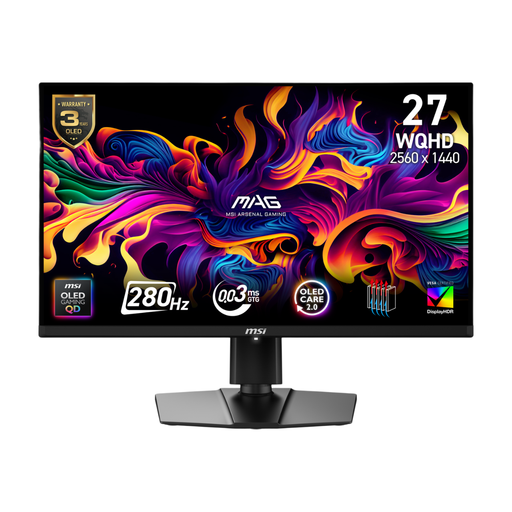
MSI MAG 271QP QD-OLED X28 27-inch
This QHD QD-OLED option is relevant if you split your time between dark survival games and faster titles.
The product title specifies 280Hz and a 0.03ms response-time rating. Check whether your PC can use the intended QHD refresh-rate mode; the stated response time is not an independent measurement.
View on Joybuy
 No image available
MAG 274QP QD-OLED X24 27-inch
This is a QHD QD-OLED choice to consider when dark-scene gaming matters more to you than seeking a 480Hz monitor.
The product title specifies 2560 × 1440 resolution, 240Hz and Adaptive-Sync. If certified HDR is important to your decision, confirm the exact model’s certification tier before ordering.
View on Joybuy
 No image available
Samsung Odyssey G6 S27DG612 27-inch
Consider this QHD OLED monitor if you want a 240Hz option and need to assess how its screen handles your room lighting.
The product title specifies 240Hz and a 0.03ms response-time rating. This S27DG612 is not the G61SH discussed in Samsung’s model information above; check this model’s screen finish and HDR certification on their own terms.
View on Joybuy
Frequently asked questions
Is OLED always the right choice for survival games in a dark room?
No. OLED is worth considering when deep blacks and contrast are your priorities; RTINGS explains why contrast is particularly noticeable in dark rooms. Compare specific LCD or Mini LED alternatives too if room lighting or long periods of static desktop use are more important to you, and check each model’s HDR capabilities.
Do I need 480Hz, or is 240Hz enough?
A 240Hz QHD monitor is a reasonable choice when atmospheric survival games are your main use; 480Hz becomes more relevant if you also play fast competitive games and your PC can deliver very high frame rates. ASUS ROG UK specifies QHD at 480Hz for the PG27AQDP, but you should check the output mode and frame rates available in your own setup.
How should I handle fixed HUDs on an OLED monitor?
Follow the exact monitor’s panel-care instructions and avoid leaving static menus, HUDs or desktop elements displayed unnecessarily. LG says prolonged static elements may cause temporary image retention on its OLED monitors and provides image-cleaning guidance for affected models.
Can a retailer take back my old monitor when I buy a new one?
GOV.UK says retailers subject to electrical-waste take-back responsibilities must offer to take back waste of the same type as the item a customer buys. Ask the retailer which take-back route applies to your purchase before ordering; this is separate from any return of the new monitor.


