Marathon trainees drawn to dark toffee
If you want the flavour on a long run, compare what a carried portion provides with the carbohydrate intake you have planned. Taste alone does not tell you whether a sweet can serve as your main fuel.


Keep dark chocolate toffee as a flavour-led extra you have tried in training, rather than the mainstay of a marathon fuelling plan. The UK Sports Institute explains why carbohydrate matters as exercise gets longer, while Sports Dietitians Australia advises choosing familiar, well-tolerated food and testing snacks in training. Check carbohydrate and fat per portion, allergens and how you would carry it before taking toffee on a long run.
If you want the flavour on a long run, compare what a carried portion provides with the carbohydrate intake you have planned. Taste alone does not tell you whether a sweet can serve as your main fuel.
If you prefer an ordinary sweet to a sports product, test the exact portion and timing during training. A snack you enjoy at rest may be less convenient to eat or carry while running.
If milk, soya, wheat, nuts or other ingredients affect your choice, read the current pack before carrying a product. The ingredient and precautionary statements differ between the toffee and chocolate-bar examples here.
Decide how you will cover your long-run carbohydrate needs first, then whether a tested dark-toffee portion fits alongside that plan.
Consider it when: You need a repeatable way to carry and eat carbohydrate over a long run.
Trade-off: A product chosen for its carbohydrate portion and your tolerance may not offer the dark-toffee flavour you want.
Consider it when: You want the flavour and have already tried the exact product while running.
Trade-off: The examples here contain fat alongside carbohydrate, so check how each portion fits your wider fuelling plan.
| Priority | What to check | Your needs |
|---|---|---|
| Carbohydrate per portion | Read the amount per piece or serving; compare it with the portions you intend to carry and eat. Storck UK lists 6.0 g per RIESEN piece, while Sainsbury’s lists 15 g per 30 g serving of Tony’s Chocolonely Pretzel Toffee. | For a long run, I want to know what each portion contributes rather than assume one sweet covers my plan. |
| Fat and tolerance | Compare fat on the same portion basis as carbohydrate; try the exact snack and timing in training. Sports Dietitians Australia advises familiar, well-tolerated foods and testing snacks before competition. | I’d rather find out during training whether the portion suits me while running. |
| Chocolate and toffee type | Check whether it is toffee coated in dark chocolate or a chocolate bar with toffee pieces; read the stated cocoa description separately from the nutrition panel. | The darker chocolate flavour matters to me, but I don’t want its name to stand in for a fuelling check. |
| Carrying and portioning | Check the pack format, the size of a usable portion and whether you can carry it as planned. | Can I take the portion I have tested without changing how I eat it mid-run? |
| Ingredients and allergens | Read the current ingredients and precautionary warnings on the physical pack. The listed RIESEN and Tony’s products have different ingredients and warnings. | I need the actual pack to fit my ingredient or allergy requirements before I take it away from home. |
Dark chocolate describes part of the flavour and composition, not how much carbohydrate or fat a carried portion provides.
Compare both figures per portion, then decide whether the sweet is an extra alongside your main plan.
You will not know how convenient the exact portion is to eat while running until you try it. Sports Dietitians Australia advises trialling snacks and timing in training rather than experimenting on competition day.
Test the product, portion and timing on a training run before considering it for a race.
A piece and a bar serving are different measures. Storck UK lists 6.0 g carbohydrate per RIESEN piece; Sainsbury’s lists 15 g per 30 g serving of Tony’s Chocolonely Pretzel Toffee.
Use the current label and the amount you will actually carry when working out where it fits your plan.
Ingredients and precautionary warnings matter when a product must fit allergy requirements; a product listing is not the pack you will consume.
Check the physical pack’s ingredients and warnings before use.
Storck UK describes RIESEN as chocolate toffee coated in 30% dark chocolate.
The 180 g Pretzel Toffee product listed by Sainsbury’s is a chocolate bar with pretzel and toffee elements and at least 42% cocoa solids, rather than coated toffee.
Marks & Spencer lists English toffee, chocolate fudge and individually wrapped pieces in its fudge and toffee range.
This chocolate, pretzel and toffee bar is a flavour-led option to consider testing as an extra during training, not a suggested mainstay for marathon fuelling.
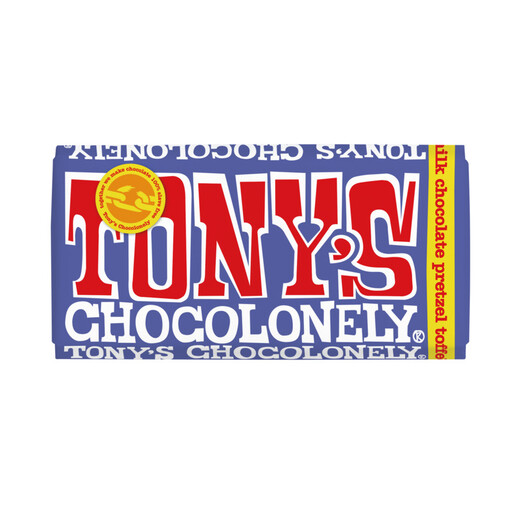 Image unavailable
If you want this pretzel and toffee flavour on a run, trial the portion in training as an extra rather than relying on the bar for your whole fuelling plan. Sainsbury’s lists 15 g carbohydrate and 9.9 g fat per 30 g serving of its 180 g Pretzel Toffee bar, with at least 42% cocoa solids. Check the current pack for milk, wheat and soya, its may-contain warning for egg and nuts, and how you would portion and carry the bar.
Do not assume it will cover your main fuelling plan: first compare carbohydrate and fat in the portions you would actually eat. The UK Sports Institute explains that carbohydrate needs rise as exercise becomes longer or more intense, and Sports Dietitians Australia advises choosing familiar, well-tolerated food and testing snacks in training. Dark toffee can instead be a small extra if you have tried it while running.
Try the exact product, portion and timing during training rather than for the first time on race day. Sports Dietitians Australia advises using training to trial snacks and meal timing before competition.
Check carbohydrate and fat per portion, the ingredients and allergen warnings, and how you would carry and eat it. Cocoa percentage describes the chocolate, not the whole fuelling picture: Storck UK lists 6.0 g carbohydrate and 1.7 g fat per RIESEN piece, while Sainsbury’s lists 15 g carbohydrate and 9.9 g fat per 30 g serving of Tony’s Chocolonely Pretzel Toffee.