
24/7 Customer Support

Free returns

Same-day & Next-day Delivery

Quality Guaranteed

Unlock Your Welcome Offers: FREE Delivery | Up to 80% OFF | Free 30-day JoyPlus trial
Download the APP
A dash cam can provide useful video evidence after a collision, help document an incident in a car park and support an insurance claim. However, choosing one based only on a large resolution number or a long feature list can lead to unnecessary expense.
The most common buying problems are not always obvious at checkout:
A 1080p dash cam can be suitable for straightforward front recording and usually creates smaller files. A 2K dash cam offers more detail, while a 4K dash cam records at 3840 × 2160 resolution on compatible models.
Resolution is only one part of image quality. Check the following:
Avoid placing too much emphasis on phrases such as “crystal clear” unless the listing also provides measurable resolution, frame rate and sensor details.
A front and rear dash cam normally uses two cameras connected by a cable. A dual-channel dash cam is useful for drivers who want evidence ahead of and behind the vehicle. A 3-channel dash cam can add an interior camera, which may suit taxi drivers, rideshare operators or families.
Before buying, check:
A camera should be mounted so it does not interfere with visibility or distract the driver. Follow the supplied installation instructions and check the vehicle’s electrical system before connecting any hardwire kit.
A loop recording dash cam automatically overwrites older, unlocked clips when the memory card is full. Impact-protected files may be stored separately through the G-sensor, but they should still be backed up and managed regularly.
A dash cam with memory card can be more convenient for immediate installation. Confirm the included capacity and maximum supported size. For example, some models support cards up to 128GB, while others support up to 256GB. Format the card in the camera according to the manufacturer’s instructions and consider a high-endurance card for frequent recording.
A GPS dash cam can record speed, route and location data. A Wi-Fi dash cam allows footage to be viewed or downloaded through a smartphone app without removing the card. These features are convenient, but they do not replace checking that recordings have saved correctly.
Parking mode deserves particular attention. Impact detection while parked may require a hardwire kit, and using a constant power source can affect the vehicle battery if installation or settings are unsuitable.

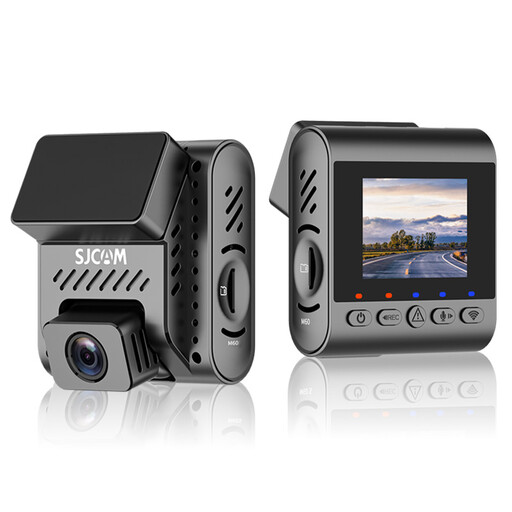
Why This Fits Their Persona: A practical single-front option for commuters and drivers who want a compact setup without adding a rear camera.
The listing clearly states that it is front-only and that the microSD card is not included, helping buyers budget for the required storage.
1080p recording, 60fps capture, HDR, Wi-Fi app control and a 2-inch IPS screen.
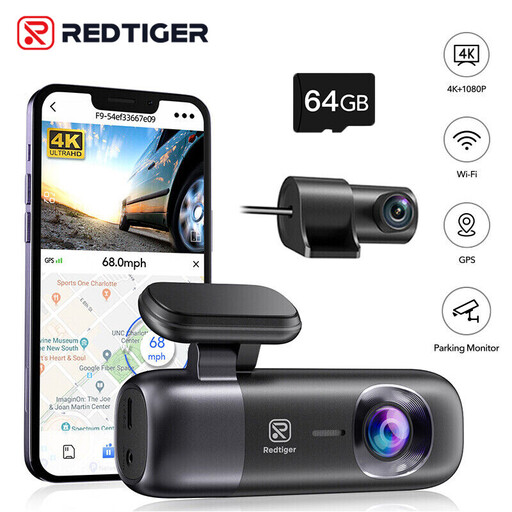
Why This Fits Their Persona: Suitable for drivers prioritising detailed front footage, GPS data and convenient wireless file transfer.
It specifies the Sony IMX678 sensor, HDR, 4K at 30fps and 2K at 60fps rather than relying on resolution alone. A 64GB card is included.
4K front recording, 170° lens, GPS/BeiDou positioning, dual-band Wi-Fi and support for cards up to 256GB.
Why This Fits Their Persona: A dual-camera layout for families, regular motorway users and drivers wanting footage behind the vehicle as well as ahead.
The specification identifies front and rear cameras, includes a 64GB card and notes that parking mode typically needs a hardwire kit.
4K front and 1080p rear recording, GPS, Wi-Fi, loop recording, night vision and app control.
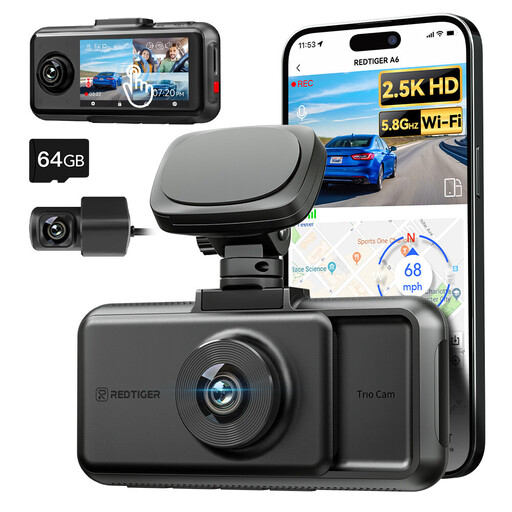
Why This Fits Their Persona: A three-camera arrangement can suit professional drivers who need front, rear and interior coverage.
The stated modes distinguish between 4K front plus 1080p rear and 2.5K front plus 1080p interior and rear. Parking use requires hardwiring.
Touch screen, adjustable front and rear cameras, 64GB card and 360° rotation on the rear camera.
We have compiled a complete, real-time list of products that fully satisfy these strict selection criteria and UK safety regulations.
Usually, yes. A car dash cam needs power while the ignition is off, so parking monitoring commonly requires a compatible hardwire kit connected to the fuse box. Check voltage compatibility and installation instructions. Professional fitting may be sensible if you are unfamiliar with vehicle electrics.
It depends on resolution, frame rate, camera channels and card capacity. A 4K or 3-channel dash cam uses storage faster than a single 1080p model. Loop recording keeps the camera operating by overwriting older unlocked files, so save important clips promptly.
Not necessarily. Audio may capture conversations inside the vehicle, so drivers should consider privacy and data protection responsibilities, particularly when carrying passengers. Check local requirements and use the camera’s microphone settings where appropriate.