
24/7 Customer Support

Free returns

Same-day & Next-day Delivery

Quality Guaranteed

Unlock Your Welcome Offers: FREE Delivery | Up to 80% OFF | Free 30-day JoyPlus trial
Download the APP
A dash cam front and rear system can provide useful video evidence after a collision, during a disputed manoeuvre or when your vehicle is damaged while parked. However, comparing models by headline resolution alone can lead to an unsuitable purchase.
The practical differences often appear in the details: whether the rear camera is genuinely included, how footage is protected, whether parking mode needs extra wiring and how easily recordings can be retrieved. This guide explains the main buying pitfalls and highlights suitable options for different UK driving needs.
A 4K dash cam may produce detailed front footage, but a front-only camera cannot record a rear-end collision or activity behind the vehicle. For dual coverage, confirm that the package includes a rear camera, connection cable and mounting accessories.
Also check the rear resolution. Some dual dash camera systems combine 4K front recording with 1080P rear recording, while others offer 2K rear footage. Both can be useful, but the difference matters if you regularly drive motorways, tow, operate a van or need to read details further behind the vehicle.
A 24-hour parking mode normally requires a separate hardwire kit or a suitable constant-power connection. A standard cigarette-lighter adapter may stop working when the ignition is switched off.
Before ordering, check whether the required kit is included. Hardwiring can also affect installation time and should be completed carefully to avoid loose trim, drained batteries or incorrect fuse connections. A professional fitting service may be appropriate if you are unfamiliar with vehicle electrics.
Loop recording continuously overwrites the oldest unlocked files when the microSD card is full. This is convenient for daily driving, but important footage can be lost if it is not protected.
A useful system should include a G-sensor emergency recording function, which locks clips when a sudden impact is detected. Even so, you should manually save relevant files promptly. Use a compatible, high-endurance microSD card where required and format it according to the manufacturer’s instructions.
Front resolution is only one part of image quality. Lens aperture, sensor type, HDR or WDR processing and lighting conditions all affect how clearly signs, vehicles and number plates appear.
A 4K dash cam can capture more front-frame detail than a 1080P model, while a 2K system may offer a practical balance between image size and storage use. For night driving, look for features such as night vision, HDR, WDR or a Sony STARVIS dash cam sensor. These features can improve the camera’s handling of bright headlights and darker areas, but they do not guarantee readable footage in every situation.
Wide-angle lenses cover more of the road, but an extremely wide view can make distant objects appear smaller. A front lens around 140° to 170° and a rear lens around 120° to 150° are common specifications in this category.
Mount the front unit behind or near the rear-view mirror without obstructing the driver’s view. Cables should be routed securely along the headliner and trim. For rear cameras, confirm whether the unit is suitable for interior window mounting, external mounting or both. Waterproofing is particularly important if the camera is installed outside the vehicle.
A Wi-Fi dash cam allows you to preview or download files to a phone without removing the memory card. Faster Wi-Fi specifications can reduce transfer time for large 4K files, although phone compatibility and app quality still affect convenience.
A GPS dash cam can record route, speed and location information alongside video. Check how this data is displayed and whether it can be reviewed through an app or desktop player.
Some models include ADAS dash cam functions, such as lane-departure, forward-collision and headway alerts. These are driver-assistance notifications, not a replacement for concentration, safe following distances or the vehicle’s own safety systems. If you drive in busy UK town centres, alerts may also require careful calibration to avoid unnecessary notifications.
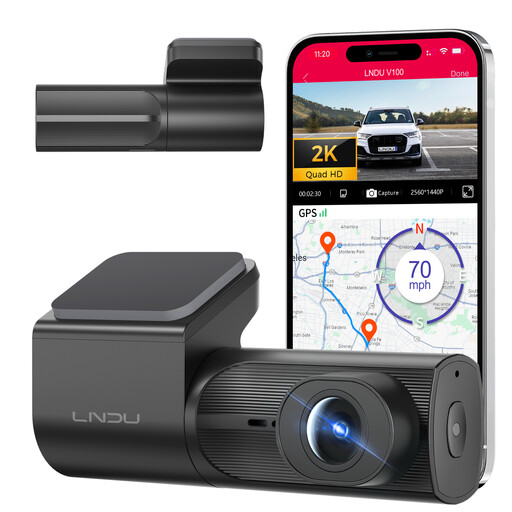
Why This Fits Their Persona: A compact front-facing car dash cam for drivers who want app access, 2K recording and parking support without immediately moving to a multi-camera setup.
Its specifications clearly identify a front camera, so there is less risk of confusing single-channel coverage with a front and rear dashcam system. Parking mode requires the LNDU hardwire kit, which should be planned separately.
2K recording, Wi-Fi app control, loop recording, G-sensor protection and night vision support.
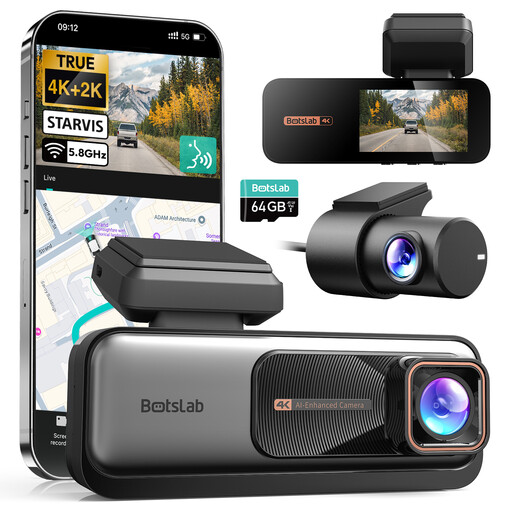
Why This Fits Their Persona: Suitable for motorists prioritising detailed dual-channel footage, GPS records and a broad field of view for regular motorway or long-distance driving.
The listed 4K front and 2K rear specifications make its coverage clearer than products using vague “ultra HD” wording. Its 24/7 parking function requires a separate hardwire kit.
Sony IMX415 STARVIS sensor, 170° front and 150° rear lenses, 5.8GHz Wi-Fi, GPS and included 64GB microSD card.
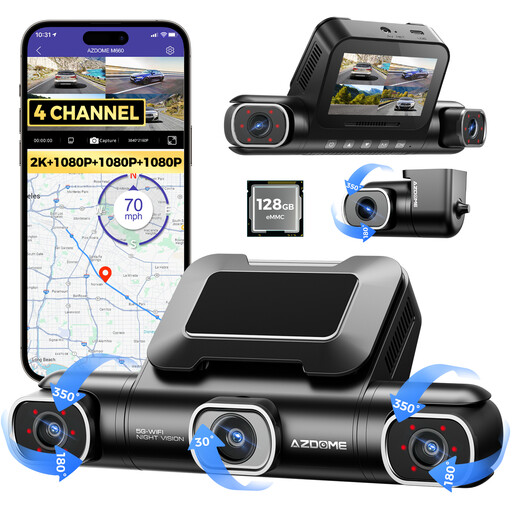
Why This Fits Their Persona: Designed for drivers, rideshare users and fleet operators who want front, rear, left and right coverage rather than a standard dual dash camera arrangement.
It provides four listed channels, helping reduce blind-spot concerns that a normal front and rear dashcam cannot address. Parking monitoring still depends on suitable wiring and installation.
Four-channel 360-degree coverage, 2.5K front recording, built-in GPS, 5G Wi-Fi, voice control and 128GB eMMC storage.
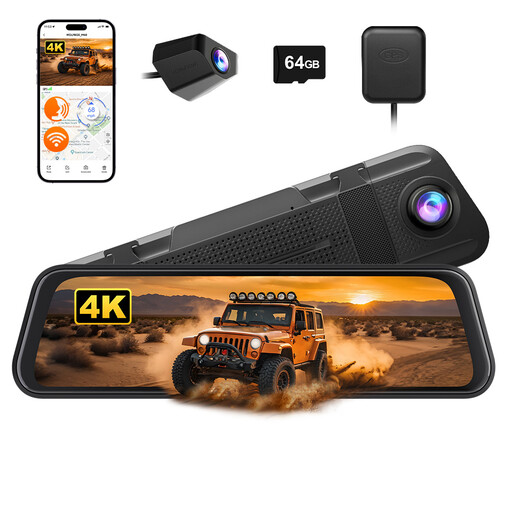
Why This Fits Their Persona: A mirror-style design for drivers who prefer a larger viewing display and flexible rear-camera positioning in a car, SUV or lorry.
The rear camera can be mounted internally or above the number plate, making it easier to adapt to different vehicle layouts. The separate hardwire requirement for parking mode is clearly stated.
10-inch display, 4K front and 1080P rear recording, GPS, Wi-Fi, voice control and ADAS/BSD alerts.
We have compiled a complete, real-time list of products that fully satisfy these strict selection criteria and UK safety regulations.
It can provide coverage of incidents occurring ahead of and behind the vehicle, which a single front camera cannot. It is particularly useful for motorway drivers, vans, SUVs and motorists concerned about rear-end collisions or damage while parked.
Not always. Many systems use a 12V vehicle socket, but the rear cable may need to be routed through trim or a tailgate grommet. 24-hour parking mode generally requires a hardwire kit, and professional installation may be sensible if you are unsure about fuse-box connections.
This depends on resolution, memory capacity, camera channels and recording length. Higher-resolution front and rear footage uses more storage. Loop recording overwrites older unlocked files, while G-sensor-protected clips are normally retained until the card is formatted or the files are deleted manually.