
24/7 Customer Support

Free returns

Same-day & Next-day Delivery

Quality Guaranteed

Unlock Your Welcome Offers: FREE Delivery | Up to 80% OFF | Free 30-day JoyPlus trial
Download the APP
Navigating UK roads, from congested city centres to winding country lanes, comes with its share of unpredictability. A sudden stop, a disputed incident or a bump in a car park can quickly become a complicated and stressful situation. An in-car camera system that records both ahead and behind your vehicle provides an impartial record, offering peace of mind and crucial evidence when you need it most.
Choosing the right dash cam front and rear system can feel overwhelming with so many features and specifications to consider. This guide is designed to simplify your decision. We will walk through the key features to look for and present our top recommendations to help you find a reliable setup for your vehicle.
Before diving into specific models, let's cover a few essential features that can make a significant difference in performance and usability.
The primary purpose of a dash cam is to capture clear, usable footage. While 1080p (Full HD) is a common standard that provides good detail, a 4K dash cam offers superior clarity, making it easier to read licence plates and identify details from a distance. Also, consider the number of channels. A standard dual dash cam covers the front and rear, but a 3 channel dash cam adds an interior-facing camera, which is particularly useful for professional drivers or those wanting to monitor the vehicle's cabin.
Your vehicle is vulnerable even when parked. A car camera with parking mode can automatically start recording if it detects an impact or motion, helping to capture evidence of hit-and-runs or vandalism. This feature often requires a separate hardwiring kit to draw power from the car's battery without draining it, so be sure to factor that into your setup.
A dash cam with GPS automatically logs your vehicle's location, route and speed, embedding this data into the video file. This can be invaluable for verifying your account of an incident during an insurance claim. Furthermore, since many incidents occur in low-light conditions, a high-quality night vision car camera is essential. Look for models with features like HDR (High Dynamic Range) and large aperture lenses, which help to produce clear, balanced footage after dark.
Here are our recommendations for front and rear dash cams that offer a strong combination of features, reliability and value for UK drivers.
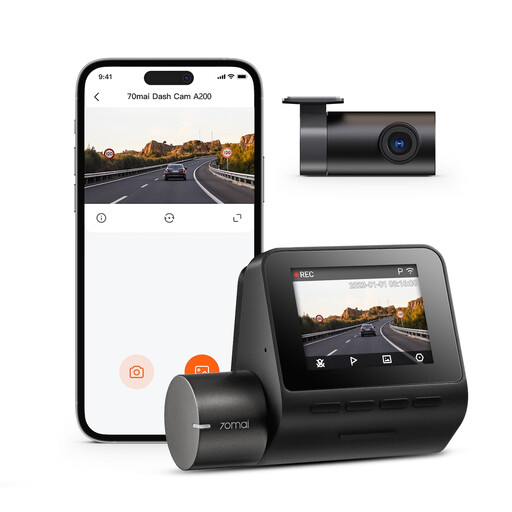
70mai Dash Cam A200-1, Dual 1080P HDR Front and Rear Camera
Why It Stands Out: The A200-1 set is an excellent all-rounder that focuses on delivering core functionality with precision. The front camera’s ability to record at 60FPS (in single-channel mode) results in exceptionally smooth footage, which is ideal for capturing clear details at speed. The dual-channel 1080P HDR recording ensures both front and rear views are sharp and well-exposed.
Pros:
Who is it for? This is a great choice for daily commuters and drivers who want a reliable, no-fuss dash cam front and rear system that delivers high-quality 1080p footage without an overwhelming number of features.
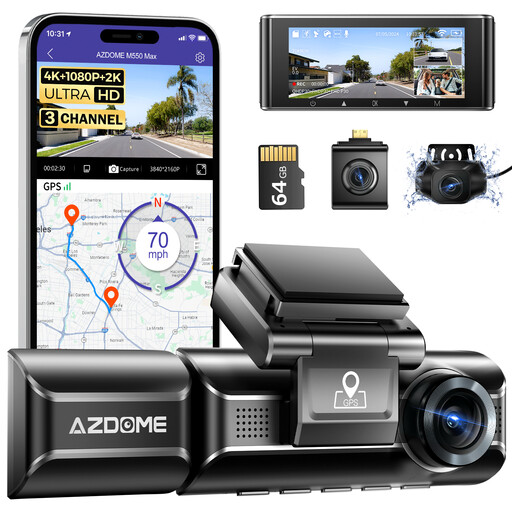
AZDOME M550 MAX 4K Dashcam Car 4K+1080P+2.5K Front Rear Interior
Why It Stands Out: The AZDOME M550 MAX is a 3 channel dash cam that provides a near-360° view of your vehicle's surroundings. It simultaneously records the road ahead in 4K, the rear in 1080P and the vehicle's interior in 2.5K. The cabin camera is equipped with infrared (IR) LEDs for clear night vision inside the car, even in complete darkness.
Pros:
Who is it for? Ideal for ride-share drivers, taxi operators and safety-conscious families who require a complete record of events both outside and inside the vehicle. Note that activating the 24-hour parking monitor requires a separate hardwire kit (sold separately) and professional installation is recommended.
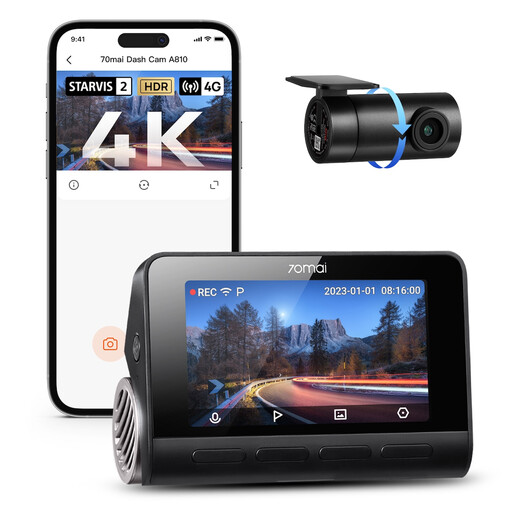
70mai 4K Dash Cam Front and Rear A810-2, True 4K UHD with Sony STARVIS 2
Why It Stands Out: The A810-2 set raises the bar for image quality, using dual Sony STARVIS 2 sensors for both its True 4K front camera and 1080p rear camera. This hardware, combined with Dual-HDR technology, delivers exceptional video clarity, colour accuracy and low-light performance. It also includes advanced features like AI-driven parking surveillance and optional 4G connectivity for remote monitoring.
Pros:
Who is it for? This system is for vehicle owners who prioritise the highest possible video quality and want advanced security features. It is an excellent fit for tech-savvy users who value features like remote monitoring and intelligent parking surveillance.
If exceptional performance in low-light conditions is your top priority, a dedicated night vision car camera might be what you need. These models are specifically engineered to capture clear footage after dark.
? Explore our full collection of night vision car cameras here.
While a front-facing camera captures most incidents, a rear camera is crucial for recording rear-end collisions, which are very common. It also provides evidence against "crash-for-cash" scams where a driver brakes suddenly in front of you and another vehicle hits you from behind. For comprehensive protection, a front and rear setup is highly recommended.
Parking mode allows the dash cam to monitor your vehicle when the engine is off. It typically works in two ways: some models use a G-sensor to start recording upon detecting an impact (like a bump or collision), while others use motion detection to record any activity around the car. To function correctly and avoid draining your car's battery, this mode usually requires a hardwire kit that connects the dash cam directly to the vehicle's fuse box.